Monday, 22 April 2019

52 Ancestors: Week 16 - Merchant Marine Records on Family Search

https://www.familysearch.org/ark:/61903/3:1:3QS7-L9WB-Q4ZF?i=10&wc=MXM9-WP8%3A387479201&cc=2057673


This week's 52 Ancestor's prompt is "Out of Place". If you have maritime ancestors, then you know they can turn up in any location. A good record set covering Canadian ports is the collection Canada, Merchant Marine Agreements and Accounts of Crews, 1890-1920 on Family Search.

This collection is a browse only collection. This means that it is not indexed, so if you use the regular search engine, you will not get hits from here. According to the Wiki of the collection, it covers mainly ports in British Columbia, and mostly Victoria. However, you can find records from Nova Scotia, Newfoundland, and a few ports outside Canada.

Agreements and Crew Lists can give you valuable clues of your ancestor. Among the information you can find in the agreements are:


  • Year and place of birth
  • Date of sailing and route
  • Their position on the crew
  • Previous ship they sailed on
  • Death information
  • Pay
It helps to know the ship they sailed on when looking at the collection. However, if you don't it just means more time spent browsing. Each microfilm holds the index and images for 5-7 boxes of records. It is set up that first there will be an index to each ship's records in a particular box. The images proceeding that are the crew lists and agreements relating to that index. They seem to go into chronological order. Then there will be the index for the next box, and then the images relating to that index. Here is the index for box 1 on microfilm 1:
https://www.familysearch.org/ark:/61903/3:1:3QS7-99WY-YJ31?i=8&wc=MXM9-WWL%3A387479701&cc=2057673

https://www.familysearch.org/ark:/61903/3:1:3QS7-89WY-YNVP?i=9&wc=MXM9-WWL%3A387479701&cc=2057673

Because there are multiple boxes on each microfilm, you will have to to do some jumping around between images to find what you need. If a particular index doesn't have what you want, I found a fairly quick way to find the next index. At the bottom of each image, it states what box and file number an image belongs to:

https://www.familysearch.org/ark:/61903/3:1:3QSQ-G9WY-YN2C?i=10&wc=MXM9-WWL%3A387479701&cc=2057673

By jumping ahead by 50 images or so at a time, I was able to find where the next box's images were, and then go back page by page to find the index. I found that each box runs just over 400 images or so. 

Once you find a crew list you want to look at, the first page will be the over all particulars of the ship. 
https://www.familysearch.org/ark:/61903/3:1:3QS7-99WB-M93Q-5?i=287&wc=MXM9-WZS%3A387479901&cc=2057673

The next few pages are crew registers:

https://www.familysearch.org/ark:/61903/3:1:3QS7-L9WB-M9QF-N?i=289&wc=MXM9-WZS%3A387479901&cc=2057673


https://www.familysearch.org/ark:/61903/3:1:3QS7-99WB-M934-4?i=290&wc=MXM9-WZS%3A387479901&cc=2057673


What is really neat is that the crew had to sign, so you can also obtain a copy of your ancestor's handwriting. Look at this one where you can actually get street addresses:

https://www.familysearch.org/ark:/61903/3:1:3QS7-99WB-M933-9?i=327&wc=MXM9-WZS%3A387479901&cc=2057673


After the crew particulars, I also found some telegrams and correspondence linked with some of the ships. My maritime ancestor Dugald McArthur was a ship's cook and steward on Scottish vessels. His period of time sailing was before this collection starts, so I knew that there wouldn't be a chance of finding him in here at all. But it's quite an interesting read none the less. If your ancestor was connected to a particular ship for a long time, you're in luck. While scanning the indexes, I saw certain ships mentioned repeatedly, especially if Victoria, BC was their home port. It would be quite possible to trace decades of sailing for a particular vessel.

If you are looking for the originals of these images, they are in the custody of the Royal BC Museum and Archives in Victoria, British Columbia.

52 Ancestors: Week 15 - Do You Have Florence Elizabeth Hance in Your Family Tree?

Image by <a href="https://pixabay.com/users/PublicDomainPictures-14/?utm_source=link-attribution&amp;utm_medium=referral&amp;utm_campaign=image&amp;utm_content=163710">PublicDomainPictures</a> from <a href="https://pixabay.com/?utm_source=link-attribution&amp;utm_medium=referral&amp;utm_campaign=image&amp;utm_content=163710">Pixabay</a>


I am a new addict to DNA. I hemmed and hawed for a long time before I took a DNA test through Ancestry last year. Since I got my results in November, I have been obsessed with unraveling the mystery of some of my DNA matches.

I've had a group of matches that all trace back to one woman, Florence Elizabeth Hance or Hence (1865-1935). These matches look to relate to my paternal side. She appears to be a 2x great grandmother. I have narrowed down to her being the mother of one of my paternal great grandfathers: John Wellington McDonald or James Henry Douglas. I have eliminated my great grandmothers as being possible connections. My great grandmother Edna Johnson was born and raised in Nova Scotia, and the mysterious Elizabeth Hance has no connection to there. Also Edna's line goes back to the Foreign Protestants, which is a very well documented group of early settlers. My other great grandmother, Mary Black MacArthur, came to Canada in 1919 from Scotland. Elizabeth spent her entire life in Ontario, Quebec, and New York State. I also know who Mary's mother was: an Irish born woman named Annie O'Connell.

Finding these matches has been so exciting and yet so frustrating. Finding where she fits into my tree will break one of my two biggest brick walls. Both my great grandfathers were born between the years 1885 and 1895. Either one could very well be one of her children. I built what they call a "quick and dirty" tree on Ancestry for Elizabeth, and she did not have an easy life. This is a quick time line for her:


  • 31 October 1865: Florence Elizabeth Hence is born in Williamstown, Glengarry, Ontario. She is the youngest daughter of Henry Hance and Josephet LaBerge (source: Census records)
  • 1871: Elizabeth Hence is living in Charlottenburg, Glengarry, Ontario with her parents and siblings (Source: Ancestry.com and The Church of Jesus Christ of Latter-day Saints. 1871 Census of Canada [database on-line]. Provo, UT, USA: Ancestry.com Operations Inc, 2009.) 
  • 1881: Elizabeth Hence is living in Chalottenburg, Glengary, Ontario as a servant in the house of Ronald and Adelaide Pariseau (Source: Ancestry.com and The Church of Jesus Christ of Latter-day Saints. 1881 Census of Canada [database on-line]. Provo, UT, USA: Ancestry.com Operations Inc, 2009.)
  • 31 August 1886: Elizabeth Hence marries Joseph Taillon in Dundee Quebec (Source: Ancestry.com. Quebec, Canada, Vital and Church Records (Drouin Collection), 1621-1968 [database on-line]. Provo, UT, USA: Ancestry.com Operations, Inc., 2008.)
  • 7 February 1889: Elizabeth gives birth to her son Walter Joseph Tyo/ Taillon in Fort Covington, New York, USA (Source: Ancestry.com. New York State, Birth Index, 1881-1942 [database on-line]. Lehi, UT, USA: Ancestry.com Operations, Inc., 2018.)
  • 20 April 1890: Elizabeth remarries to Moses Ledger in Fort Covington, New York, USA (Source: Ancestry.com. New York State, Marriage Index, 1881-1967 [database on-line]. Lehi, UT, USA: Ancestry.com Operations, Inc., 2017.)
  • 1893 to 1900: Elizabeth gives birth to children Florence, Agnes, Francis and Rose. (Source: Census Records)
  • 27 November 1899 : Husband Moses Ledger dies in a logging accident in Franklin, New York, USA (Source: The Malone Palladium newspaper obituary 7 December 1899. Image of the obit on a public Ancestry tree)
  • 1900: Elizabeth Ledger is living in Fort Covington, New York, USA with her children. She is listed as a widow (Source: Ancestry.com. 1900 United States Federal Census [database on-line]. Provo, UT, USA: Ancestry.com Operations Inc, 2004.)
  • 9 March 1902: Elizabeth marries Alonzo Mitchell in Fort Covington, New York, USA (Source: Ancestry.com. New York State, Marriage Index, 1881-1967 [database on-line]. Lehi, UT, USA: Ancestry.com Operations, Inc., 2017.)
  • 1904 to 1908: Elizabeth gives birth to sons Alonzo and Darwin Mitchell (Source: Census Records)
  • 1910: Elizabeth Mitchell is living with her children in Fort Covington, New York, USA. She is listed as a widow (Source: Ancestry.com. 1910 United States Federal Census [database on-line]. Lehi, UT, USA: Ancestry.com Operations Inc, 2006.)
  • 1915: Elizabeth is now the wife of Peter Blair and living in Bombay, New York, USA. Living with her are Peter's children as well as her 3 youngest children Rose, Alonzo and Darwin. (Source: Ancestry.com. New York, State Census, 1915 [database on-line]. Provo, UT, USA: Ancestry.com Operations, Inc., 2012.)
  • 1920: Elizabeth Blair is listed as a widow again and living in Bombay, New York, USA. Living with her are her two youngest boys Alonzo and Darwin. Also living there is her eldest daughter Florence, her husband Nolan Reynolds, and their children (Source: Ancestry.com. 1920 United States Federal Census [database on-line]. Provo, UT, USA: Ancestry.com Operations, Inc., 2010. Images reproduced by FamilySearch.)
  • 1930: Elizabeth is now married to Nelson McDonald and living in Malone, New York, USA. They are living with her daughter Agnes, her husband Arthur Noreault and their children. (Source: Ancestry.com. 1930 United States Federal Census [database on-line]. Provo, UT, USA: Ancestry.com Operations Inc, 2002.)
  • 12 June 1935: Apparently, this is the death date of Elizabeth in Fort Covington, New York, USA. I have not found a definitive death date. This information is taken from the trees of my matches, and none are sourced.

I have followed Elizabeth's children, and have been able to trace the lives of all but two: her eldest son Walter Joseph Tyo, and her son Francis W Ledger. Because of all the half sibling relationships, it is difficult to say which son I could descend from. Both sons fit into a birth timeline for my great grandfathers. Without finding information on them and "killing them off", I cannot say which one might be either James Henry Douglas or John Wellington McDonald. Of course, there is also the possibility that Elizabeth had another son that was adopted into the Douglas or McDonald line. I want to eliminate Walter Tyo and Francis Ledger as possibilities before I try and go down that route.

If you are a descendant of Elizabeth Hance, I would love to hear from you. I would especially like to hear from descendants of Walter Joseph Tyo/Taillon or Francis W Ledger. You can reach me by the contact information of my contact page. 


Monday, 8 April 2019

52 Ancestors: Week 14 - The craftsman and Canadian Masonic record

This week's 52 Ancestors prompt is Brick Wall. I'm giving it a bit of twist in that I'm going to look at the Canadiana collection of the periodical the craftsman and Canadian Masonic record. This collection runs from 1869 to 1877.

http://online.canadiana.ca/view/oocihm.8_04074_85/2?r=0&s=1


The amount of information in here is excellent. Even though the issues were published in Ontario, the information in it is not limited to Ontario. I found articles about Lodges from other parts of Canada, and from around the world. Here's some correspondence about accepting the Quebec lodges from lodges in western Canada in 1870:

http://online.canadiana.ca/view/oocihm.8_04074_10/13?r=0&s=1


Scattered throughout these publications, you will find individual names. Here's an obituary for George T. Malcolmson, who drowned:


http://online.canadiana.ca/view/oocihm.8_04074_11/33?r=0&s=1

Now these publications seem to be an annual compilation of newsletters. Each microfilm is numbered to the Volume, and all except the last one has 12 microfilms. The volumes shown are:

  • Volume 4 October 1869 to September 1870
  • Volume 5 October 1870 to September 1871
  • Volume 6 October 1871 to September 1872
  • Volume 7 October 1872 to September 1873
  • Volume 8 January to December 1874
  • Volume 9 January to December 1875 
  • Volume 10 January to December 1876
  • Volume 11 January to June 1877
The trick is to look at number 1 of each volume.


The first roll of each volume shows an index of articles and corresponding page number. Then click on the subsequent rolls to find the page number you want. You can find the page numbers of each roll by clicking on the drop down menu on the top left:


Once you have found what your looking for, right click on your mouse, and then click on Save image As... This will save the image to your computer.


While your on the Canadiana site, type in the search word Masonic into the general search engine, and see what else they have digitized in relation to your Masonic ancestor.

Saturday, 30 March 2019

52 Ancestors: Week 13 - Historical Newspapers in Nova Scotia


Large collections of historical newspapers on line are hard to find in Canada. If you have Nova Scotia ancestors, you'll want to check out the collection of digitized historical papers you access through Libraries, Archives, and Museums Nova Scotia.

This collection is a collaboration between LAM NS, Nova Scotia Archives, the Beaton Institute (Cape Breton University), and the Angus L. MacDonald Library (St. Francis Xavier University). The collection spans from 1769 to 2003. Some are in PDF form, while others are not. The PDF versions are keyword searchable.Just press Ctrl and F to show a search bar in the top right.

These collections are by no means complete. Some papers are only 1 or 2 editions, others have several. This website provides direct links to the three partner institutions' digital collections. What is really unique about the collections is that there are cultural newspapers for French, Gaelic and Native populations. The papers available are:


English

  • Nova Scotia Chronicle and Weekly Advertiser - Halifax
  • The Royal American Gazette - Shelburne
  • The Port-Roseway Gazetteer and Shelburne Advertiser
  • The Nova Scotia-Packet and General Advertiser - Shelburne
  • Acadian Recorder - Halifax
  • Liverpool Tanscript
  • The Bee - Pictou
  • The Atlantic Advocate - Haifax
  • The Tiny Tattler -Central Grove, Digby Neck
  • The 4th Estate - Halifax
  • The Nova Scotia Gleaner - Sydney
  • Guysborough Journal 


French

  • Le Courrier de la Nouvelle-Ecosse - Meteghan River


Gaelic
  • An Solus luil - Guiding Light - Sydney
  • Fear na Ceilidh - The Visitor -  Sydney
  • Mosgladh - Awakening - Sydney
  • Teachdaire nan Gaidheal - Then Messengers of the Gaels - Sydney
  • Am Braighe - Higher Ground - Mabou
  • An Cuairtear Og Gaelach - The Gaelic Tourist - Antigonish


Native 
  • Billa Na Queg - A New Day - Eskasoni
  • Micmac News - Membertou

The digital images of the publications are a treat. They are very clear and crisp. When you consider just how old some of these editions are, it's amazing. Take a look at this one from the Nova Scotia Gleaner. Even though the original is not in pristine condition, you'll have no trouble reading it.

http://beaton.cbu.ca/atom/newspapers/nsgleaner/NovaScotiaGleaner-1929-10-05.pdf


Here's one from the Atlantic Advocate discussing prohibition:

https://novascotia.ca/archives/newspapers/archives.asp?ID=3496

Please take note of a few things though:

  • The newspapers on the Nova Scotia Archives site cannot be downloaded to your computer. 

  • I had trouble accessing the papers from the Angus L. MacDonald Library. The server kept timing out on me. I did find a work around though. Use this link to access their digital collections. While you're at it, take a look at the other digitized material they have. It looks pretty interesting.

Wednesday, 20 March 2019

52 Ancestors: Week 12 - 12 Sites to Further your Canadian Research

Everyone knows about the big search sites for record sets. But when you're missing out on a lot if you only stick to Ancestry, Family Search, My Heritage and Find My Past. There are lots of other sites that are FREE that you can go to that can give you information. This week I'm going to point you towards 12 sites that you should add to your internet bookmarks for Canadian research.

I thought at first that this would be a simple post. My trouble was narrowing it down to 12! Canada is the second biggest country in the world, and is quite ethnically diverse. I could probably list 12 French Canadian sites, or 12 military sites, or 12 sites that just deal with a certain geographical area with no problem. We have 13 provinces and territories, and I could probably highlight 12 collections at each one that are wonderful. In the interest of trying to find something that will appeal to everyone, I decided to try and list sites that will give you the most bang for your buck, so to speak. This list is not a "best of", so don't be offended if your favourite isn't listed. I also won't be delving too deeply into any of them. You can explore all they have to offer on your own.


1. Library and Archives Canada (LAC)


http://www.bac-lac.gc.ca/eng/discover/genealogy/Pages/introduction.aspx


If you're new to Canadian research, Library and Archives Canada is our National Archive. No list would be complete without it. Free to use, it has the widest variety of records to help in your research. It's very user friendly, and has both online and offline collections. I've highlighted just some of their collections in previous blog posts:


2. Canadiana
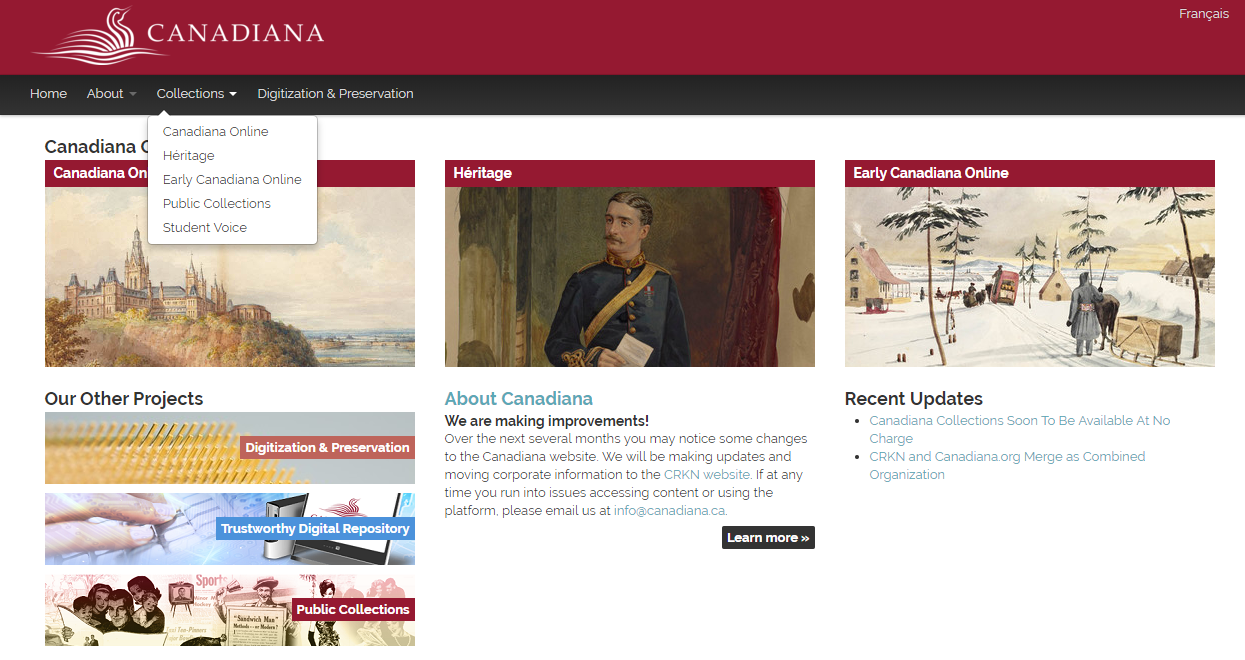
This wonderful website has digitized collections of government records, magazines/periodicals, newspapers, and books. It also has photographs, brochures, and pamphlets. Canadian genealogists were ecstatic when they recently changed it to a completely free website.


http://www.canadiana.ca/


Click on the Collections tab to access three separate collections:
They also have a search engine to find collections from archives and repositories around the country through the Public Collections tab. Clicking on the Student Voice takes you to a portal to search digitization of student newspaper from colleges and universities.

I and every other Canadian genealogist are still exploring all this website has to offer. You can read my posts Library and Archives Canada Microfilms on Heritage Website and Love and Marraige on Canadiana to give you an idea of what you can find on there.


3. Historical Atlas of Canada Online Learning Project
Historical maps are essential in genealogy research. Looking at them gives you clues into further genealogy research. Can't find your ancestor in one township or county's records? Looking at historical maps can show you boundary changes. Ever wonder why they worshiped at church A, when church B was closer? A map can show you there was a river in between them and church B, so church A was actually easier to get to. 

The Historical Atlas of Canada Online Project is a work in progress. They have been digitizing maps from the 3 volume Historical Atlas of Canada and making them interactive to boot. 

http://www.historicalatlas.ca/website/hacolp/index.htm

This 3 volume set is on my wish list of "Things I HAVE to Have". However they are kind of pricey. Amazon has them right now at about $90 per volume. Until I can get my hands on them, this website has been immensely helpful. As I said it's a work in progress. Keep checking back to see if a map you're looking for has been digitized yet.


4. Peel's Prairie Provinces

http://peel.library.ualberta.ca/aboutsite.html

If you're delving into research of the Canadian West, you'll want to bookmark Peel's Prairie Provinces. Dedicated to the history of the Canadian West, it is hosted by the University of Alberta. According to the website, "...Peel contains approximately 7,500 digitized books, over 66,000 newspaper issues (4.8 million articles!) 16,000 postcards, and 1,000 maps." It's a goldmine of information on the various cultural and ethnic groups that settled in the West. My recent blog post Photographs on Peel's Prairie Provinces gives an overview of what you can find in their postcard and photo collections.


5. Internet Archive

https://archive.org/index.php

This one is a go-to for genealogy research in general, not just Canadian. The amount of material you can find on here is makes it a rabbit hole. A lot of genealogical and historical societies have uploaded all forms of media onto it. I've mentioned Internet Archive in many blog posts as a source for different kinds of records. Here are a few:
You will have to play around with search terms and fields, just because of the sheer amount of information on there. My suggestion is to wait until you have a "genealogy day" to explore it. 


6. Hudson's Bay Company Archives

https://www.gov.mb.ca/chc/archives/hbca/index.html

Canada's history and heritage is hugely intertwined with the Hudson's Bay Company. Founded in 1670, the HBC had posts in just about every corner of Canada. If your ancestor came over during the l600s and 1700s, there's a good possibility that they had some contact with the HBC.

The Hudson's Bay Company Archives was given UNESCO status in 2007. There is not a whole lot of their information on line right now, but don't despair. Just last month, it was announced that a huge digitization project is going to start. As part of Manitoba's 150th anniversary, over 1000 microfilms from the Archives are going to be digitized and put online for free. You can read about the announcement on the CTV News website.

As for what's available right now, you can look at the blog post I did called Manitoba Ancestors: Hudson's Bay Company Archives.


7. Maritime History Archive

https://www.mun.ca/mha/

If you have Maritime Ancestors, check out the Maritime History Archive. They have records that cover both coasts of Canada. If your ancestor came from the UK or the US, there are records that can be found for them on here too. I wrote a 2 part blog post about this great site. You can access Part 1 here, and Part 2 here


8. Dictionary of Canadian Biography

http://www.biographi.ca/en/

Not all of us have famous (or infamous) ancestors. So why include this one? I've included this one because your ancestor doesn't necessarily have to be a politician, explorer, or captain of industry to be included. If your ancestor came in the early years of Canada, there's a good chance they might be in here, or at least mentioned in someone else's biography. As an example, I typed "Landry" in the search box. This is one of my Acadian surnames. 115 entries are on the website that either involve someone with the surname Landry, or a Landry is mentioned in someone's biography that doesn't have the surname Landry.

At the bottom of each entry are footnotes showing what sources were used. Now you know where to look for the original information. As well, they also list related biographies to your selected person. The Dictionary of Canadian Biography has 22 volumes at the moment. Volumes I to XV are fully online, Volumes XVI to XXII are only partially online.


9. The Ancestor Hunt

http://www.theancestorhunt.com/

Simply put, historical newspapers are awesome. And not only to find birth, marriage and death notices. Even if they didn't do anything heroic or naughty, you can still find them in the everyday activities of their area. Kenneth Marks runs a blog called The Ancestor Hunt, and has compiled a huge collection of newspaper links for mainly the US and Canada. The link to his newspaper links is here. He also has links for Canadian obituariesBMDs, and photos. He has helpfully divided the Canadian links by province to make your searches easier.


10. Canada's Gen Web Cemetery Project


https://cemetery.canadagenweb.org/

This free site is volunteer run, and has information on over 18,000 cemeteries across Canada. It has a very user friendly set up. Please keep in mind that they do not do research or take photo requests. However, volunteers have posted their willingness to help on their own, and not as part of the site.

For each cemetery listed, they have contact information for the cemetery. They have also listed helpful links on the internet and contact information off the internet for groups and societies that have more information. It's a nice starting place for your cemetery research.


11. Canadian Great War Project


http://www.canadiangreatwarproject.com/index.asp


This site says that it is the largest fully searchable database of Canadian men and women that served in WWI. What I find so delightful about the Canadian Great War Project is that they are so many ways to search. It has information not only on the soldiers, but on war diaries, statistical information, and medal information. This is just a sampling of what it has to offer.

Take note though, in the process of modernizing and updating, the site is going through some growing pains. The University of Victoria is helping the site owner, Marc Leroux, with this. It's a work in progress so keep visiting the site to see what new things they have to offer.


12. CanLII


https://www.canlii.org/en/index.html


The Canadian Legal Information Institute is a database of court cases across Canada. You can search by keyword and/or province. The years covered varies depending on the province. Most of these cases run from the 1970's to the present day. However, you can find some earlier years as well. I found one from Quebec dating back to 1902. A good site for more recent events in your Family Tree, genealogically speaking. You can get a good amount of information on cases, either by PDF of documents, or by transcription. This is by no means a complete database. I could not find anything on their site about adding more historical years of cases, but keep checking back.


What's your go-to website? Leave a comment with a link to it.

Tuesday, 12 March 2019

52 Ancestors Week 11: The Double Edged Sword of Large Families

http://clipart-library.com/cartoon-family-cliparts.html


I'm both blessed and cursed with having large families in my tree. This is one maternal line:

  • My mom was one of 17. 
  • My maternal grandmother Mary Mallais was one of 10. 
  • Her mom Annie McLaughlin was one of 12. 
  • Annie's mom Mary Louise Fournier was one of 12. 
That's four generations on just one line of my tree, and I'm already at 51 children. Here's a paternal line:

  • My grandfather Edward McDonald was one of 5 and had 5 half siblings. 
  • His mother Edna Johnson was one of 5. 
  • Her father James Johnson was one of 8 and had 5 half siblings
  • His father James Johnson was one of 3 and had 2 half siblings that I know of so far, but I suspect there's more.
That's another 4 generations through a different line and there are 31 children accounted for so far.

This is a blessing because I have lots of genealogy cousins to collaborate with. My DNA results on Ancestry and My Heritage are proof of that. I'll never run out of lines to research. There are some downsides and pitfalls though.

Name Repetition
Every family loves to recycle names. It becomes even more of a problem in large families. The amount of times that the names and assorted variations of James, Joseph, John and Edward that appear in my tree makes me want to pull my hair out. My Mary/Maries and Ann/Annas could fill a banquet hall all by themselves. One reason for this is the practice of naming patterns. My blog post What's In a Name? A Look at Naming Patterns gives some examples from different ethnic and cultural groups.


Endogamy
What is endogamy? This is when intermarriage of family lines happen. Have a person or couple in your tree that is a degree of great grandparent more than one generation? That's endogamy at work. The common misconception is that cultural isolation is the reason for this. However, you also have to look at geography, especially if your paper trail goes back to the early colonization of areas in both the US and Canada. There simply wasn't enough of a population for intermarrying NOT to happen. If you're delving into genetic genealogy, taking endogamy into account is a must. Some people will have higher degree of DNA matches to you than they should because you share multiple ancestral couples. I've even found one fellow who appears to match on BOTH my maternal and paternal side. For Canadian research, if you can trace your tree to one of the following groups or areas, you will need to look into endogamy:
  • Catholic
  • French Canadian
  • Acadian/Cajun
  • Jewish
  • Colonial Americans
  • Foreign Protestants
  • Newfoundland 
The International Society of Genetic Genealogy has a great Wiki on endogamy. Even if you haven't delved into the DNA side of genealogy yet, it's a great resource.

Endogamy isn't all bad though. Because of so many descendants, these groups have become quite well documented. There are many websites devoted to researching these groups of people, and they can be exceptionally well researched. A few that I have used in my own research:
There are others that I have also found extremely helpful. This is just a sampling. 

Organization
You're going to have to be more organized following all those descendants of your ancestor couple. So how to organize? Family group sheets are your best friend. The more tech savvy of you can create something in Excel. However, if you're like me and like a piece of paper in your hand, there are several versions of the basic family group sheets kicking around the internet. You can find one that works for you. Here's a few to look at:
If you're a purely digital person, you can still organize. From what I understand most of the genealogy software programs have ways to organize and sort people. I've been dabbling in moving my Ancestry tree to one of these programs, but haven't decided on one that works best for me yet. 

One of Ancestry's big announcements at RootsTech this year was tagging features being added both with DNA matches and within your tree itself. I find the tagging within our trees quite exciting. Called MyTreeTags, they have pre made tags but you can also create ones that work best for you. If you haven't watched Crista Cowen's presentation of the new tools, you should. You can access it through the Video Archives section of the RootsTech website here. Crista is an excellent presenter so be prepared to have your mind blown at the possibilities. I reached new levels of genealogy geekdom after watching it. It took an extreme amount of self control not to babble to the non genealogy people in my life.

Do you have any tips on how you handle large families? Or a go-to website for certain cultural groups or settlement areas? Let us know in the comment section.


Sunday, 10 March 2019

52 Ancestors Week 10: Records for Spinster Aunts and Bachelor Uncles


We get so caught up looking at our direct lines that we don't always look at our ancestors' siblings. There's almost certainly siblings who didn't marry, or married and didn't have children. With no direct descendants, their stories get lost, and that's a shame. We're always looking for interesting ancestors, and sometimes these forgotten ancestors led interesting lives.

Take for instance, my maternal grandmother's oldest brother Jules Mallais. He died in the influenza pandemic in 1918 after being a soldier in World War I. He died a few months shy of his 19th birthday, when my grandmother was only 5 years old. She would have barely remembered him herself, so his story could have been lost. He never got the chance to marry, or have children.

On my paternal side there's my great uncle Hector McDonald. A veteran of Korea, he was a big influence in my dad's life. He married, but never had children. Thankfully, I have my dad and aunt and uncle to tell me stories about what a character he was.

The further back you go through the generations though, you're not going to have people still alive to share their stories. So where can we find information on our "spinster aunts" and "bachelor uncles"?

Following records for unmarried women can often be easier than searching for married women. Because they are not attached to a spouse, they owned assets in their right, and you never have to figure out if that "Mrs. John Smith" is the one your looking for.

Check census records for when your grandparent couples were older. In many cases it was the unmarried daughter who cared for them the last years of their lives. And once their parents passed, many of these women moved in with a sibling. The same can also hold true for the uncles. Also for uncles check the entries on the same page as your direct ancestors to see if they are a neighbour. For that matter, check the pages before and after. Many families stayed very close to each other. A few years ago I wrote a two part blog post on Canadian census records. See here for Part 1, and here for Part 2.

Land records can be useful in tracing those unmarried aunties. They accumulated property in their own name, and not a husband's. The uncles were sometimes given a piece of the main homestead. I haven't yet written a series of posts relating to land records. Because of the complexity and differences between provinces, it's been one that I haven't been able to devote enough time to in order to give it justice. I've provided a link to each province to get you started.


Wills and Probate Records can be a good source of information. Unmarried women had an advantage over married women in this regard. For many years, in the majority of provinces married women were not allowed to legally make a will of their own. The bonus about unmarried aunts' and uncles' wills is that favourite nieces and nephews are often mentioned. One of your ancestors could be mentioned in them. I wrote a series of posts about the Wills and Probate process.
  • Part 1 is a brief introduction
  • Part 2 covers Newfoundland and Prince Edward Island
  • Part 3 covers Nova Scotia and New Brunswick
  • Part 4 covers Quebec and Ontario
  • Part 5 covers Manitoba and Saskatchewan
  • Part 6 covers Alberta and British Columbia
  • Part 7 covers Yukon, Northwest Territories, and Nunavut

I mentioned my great uncle Jules was a soldier in the first World War. One of the unfortunate spin offs of military conflict is that many young men died before they married or had children. Library and Archives Canada is your best place to go to start searching for military service. Scroll down to the Military section on their Ancestors Search page. And don't forget about the Nursing Sisters and other women who served. They are included in these databases.

Without the constraints of children, your aunt or uncle may have been involved in churches, fraternal organizations, charities, and local groups. Don't forget to look at these to see if you can find them on membership lists and committees. Local newspapers and City Directories can help with this. I've also found some great surprises on Internet Archive.

Speaking of newspapers, those unmarried aunts and uncles were sometimes a little eccentric for their time period. Check newspapers to see if they were scandalizing the community in some way.

Women didn't often travel alone, but those unattached uncles could have. Check border crossing records between Canada and the US. A lot of times they had to list who they were visiting. You might find extended family in those records to help grow that tree.

If you have any other idea for finding those unmarried and/or childless aunts and uncles, feel free to share below.