Showing posts with label British Columbia. Show all posts

Sunday, 18 April 2021

University Ancestors: The University of British Columbia Handbook

We tend to look at marriages, occupations, and other details of our ancestors' adult lives. The years between birth and marriage don't always get the attention they deserve. School yearbooks and handbooks are a fun resource for family history research. They give an insight into a part of your ancestor's life that is often glossed over. 

If you're ancestor attended the University of British Columbia from the 1920's and later, then check out the collection of UBC Handbooks digitized on the UBC Library website. These were published once a year, usually in December, and given to students. The UBC Library has various years from 1921 to 2019.


It is quite user friendly to use. Just scroll to the year you want (left click and hold to move the time line across. Underneath is a calendar and just click on the blue box showing the issue date.

Once you click on a publication, it will go to the image viewer. There are lots of great options in the image viewer. You can scroll through the pages either by the arrows, or by directly clicking on a page.


The icons in the red circle allow you to view transcriptions and download the image. In the blue circle are icons to zoom in and out, rotate the image, and go full screen. You can also zoom in and out using the icons in the black circle.

So what can you find? These handbooks covered all aspects of life at the campus. Here's a bylaw from 1927 about the university sweaters


Here's the members of the Student's Council in 1932


Here's some of the track and field record holders for the University as of the 1945 issue


Here's a list of some of the many clubs and societies in 1954. Some have a contact person listed


Publications like these rely on ad revenue from nearby businesses. Here's a page of ads from 1966


Unlike yearbooks, these handbooks don't have a lot of pictures, but there are a few. Here's some of the Student Council members from 1951


If you can't find your ancestor's name among the handbooks, don't be disappointed. These handbooks are still a great resource. They will give you a window into everyday academic life of your ancestor. Remember, family history research is more than just collecting names and dates.

Sunday, 13 September 2020

BC Ancestors: The Bill Silver Digital Archive

Free online newspaper sites are always a good thing. If your ancestors lived in and around Vanderhoof, British Columbia, you'll want to explore The Bill Silver Digital Archive. Provided free of charge, it is hosted on the Vanderhoof Public Library website.

Bill Silver was a local historian who built a collection from 3 local newspapers
  • The Vanderhoof Herald
  • Nechako Chronicle
  • Omineca Express
After his death, his wife Edith continued the collection until her death in 2003. The collection of weekly newspapers runs from 1917 to 2007. It is the result of a collaboration between the Vanderhoof Public Library and the Vanderhoof Heritage Museum. Simply enter in a search term and you get digital images of the newspaper pages. Just click on the link on the top of the page to get to the search screen.


https://www.vanderhooflibrary.com/my-lists/explore/the-bill-silver-digital-newspaper-archive/


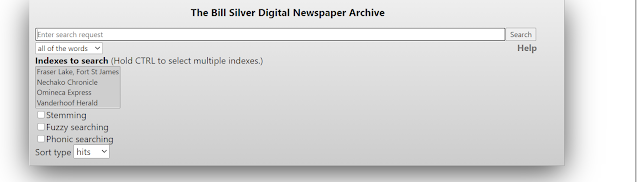
Just type in your search term and hit enter. As you can see below, you can do a more targeted search by paper. You can also adjust your searching method to stemming, fuzzy and/or phonic searching.

 
http://archive.vanderhooflibrary.com/


I used "mcdonald", and got 1140 hits on a general search.  I then tried a phonic search and got over 4000 hits. The search results can be sorted by relevance, newest date or oldest date. You can also print your search results. Just use the tabs on the top right. now, I did find that it sorts by paper first, then year if you're doing a newest or oldest filter. Which means the oldest issues, which are from The Vamderhoof Chronicle, will show up last. My suggestion is to search each paper separately.

http://archive.vanderhooflibrary.com/archive/dtSearch/dtisapi6.dll


Next just click on the link to a particular page and a digital image will open in a new window. That's handy, as you don't lose your results list. The page opens as a PDF that you can download and/or print.

As with any paper on a local level, you can find lots of little tidbits that you don't see in newspapers that are published for a larger audience. Here's some examples of what I found:

Here's some "Local Happenings" from March of 1918


Here's some birth announcements from October 1962 


Here's some items covered during recent Vanderhoof Council meetings in June 2001 


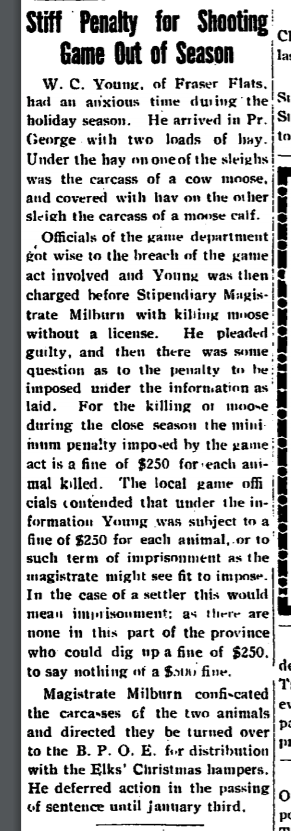
W C Young got into some trouble in December 1934 for shooting game out of season


As a last example, here's an article on the accidental death of Ralph Andros from March 1956


Some tips for using the site:
  • The search capability appears to be OCR technology. Anyone who's dealt with OCR on older newspapers knows it is far from fool proof. So make sure you try all the search options 
  • There is no highlighted boxes for your search words. This means you will have to read the whole page. But that's part of the fun.
  • Because the saving is to PDF, you won't be able to crop like you can with a picture. One suggestion is to make a transcription for yourself if you're printing. Another option is to zoom in on the article in the PDF and then take a photo of the screen with your phone or tablet. Alternately, you can zoom in on the article, and then use a snipping tool to take a screen shot. 
  • Some of the search terms I tried would not give me results in the year ranges I was looking for. But, I found putting in a year, such as "1928" gave me results in the 1920's and 1930's
The searching is a little clunky, compared to other sites. It's still worth looking at in your research though. One improvement to the collection I would like to see is the ability to browse issues. If there is a way to do that I could not find it.


There were several donors involved in getting the collection up and running. You can thank the following for this collection:
  • The Irving K. Barber Learning Centre
  • Vanderhoof Co-op Association
  • Friends of the Library
  • The Bill Silver Family
  • Nechako Valley Historical Society
  • Black Press
  • Rosemary Boyd

Monday, 18 May 2020

British Columbia Ancestors: Historical BC Government Gazette Online

Government Gazettes are a great resource. During the early years of Canada, these publications gave information on many aspects of the lives of our ancestors. They had notices of divorces, bankruptcies, and business dealings, just to name a few. I've written before on the Canada Gazette, the publication of the federal government. But provincial governments publish their own versions.I've found 3 online sources for free digitizations.


University of Victoria
Their collection, Official Gazettes of the Province of British Columbia, contains 715 issues. The issues run from 1863 to 1871, before it became a Canadian Province.

https://vault.library.uvic.ca/collections/d9265b4b-b757-4508-bc7d-85bd3ae91ddc?locale=en
The set up is extremely easy to use. They are by default listed by date created ascending, but you can modify the list to

  • date created descending
  • title ascending
  • title descending
  • relevance
  • date modified ascending
  • date modified descending
Just pick a year and issue and click on the image to have it open to browse page by page. My suggestion if using this method is to right click on the issue title and open the issue in a new window. It will make it much easier on yourself than constantly using the back arrow to go back to the main page.

If your searching for something specific, use the search bar located just above the issues list to search by keyword. This will then give you a list of issues with your keyword. It does not however, highlight the keyword within the issue itself.

Once you're looking at a particular issue, you can zoom in and out by using your mouse. You can also full screen the issue. To save, you can download or print the whole issue. 


University of British Columbia
Their collection of digitized directories has duplicates of the ones that UVic has, but also later editions up to 1882. The ones on this site have an entire year in book form. Just click on the volume and it will take you into the image viewer. As with the UVic's collecton, I would suggest opening in a new tab for ease of browsing volumes. You can search within each volume sing the search bar, or you can browse page by page. If you use the search function, the result will first highlight a page within the volume for your keyword. It will then highlight the word itself.


As with UVic's collection you can manipulate the image. You can also download individual pages to your computer. 


Internet Archive
Lastly, Internet Archive has a huge amount of years on their site in the collection Official Gazettes of the Province of British Columbia. They have various years from the start of the colony up to 1974. A good chunk of them are not tagged with a date. You can search within specific volumes with keywords. You can zoom in and out. To save a specific page, right click on the image, and then on Save image as. There is no way to print directly from the site.


So, what can be found in these issues? Here's a list of Road Tax Defaulters from 1870:


And here's a notice from 1868 looking for information on who shot John Crocket, alias Crosby. They are offering a $100 reward. That's quite a large sum back then.


And in August of 1864, there is a very lengthy account of the Bentick Arm Expedition. It runs for several pages


Here's some estate notices from 1879


And here's a Register of Medical Practitioners from 1873


Here's some notices of intention to purchase land from 1882


Here's some about Coal Prospecting Licences in 1911


Sunday, 19 April 2020

British Columbia Ancestors: Naturalization Records on Family Search


Naturalization records can be a valuable brick wall buster. These records often tell country of origin and immigration details that may not be found in other records. The naturalization process applied to immigrants that did not come from the UK. Our UK ancestors were automatically considered Canadian citizens. Some of the details found in naturalization records can be:
  • Residence
  • Place of origin
  • Date of arrival in Canada
  • Residence
  • Years residing in Canada
  • Occupation
  • Residence
  • Date of birth
  • Place of birth
  • Date of immigration
  • Name of ship
                    If your ancestor applied for Naturalization in British Columbia between 1859 and 1926, then you'll want to check out Family Search's browse only collection British Columbia Naturalization Records, 1859-1926. This collection of over 23,000 images focuses on naturalization records from Victoria and Cranbrook. The records contain any or all of the following forms:
                    • Application
                    • Oath of Allegiance
                    • Oath of Residence
                    • Naturalization Certificate
                    https://www.familysearch.org/search/collection/2001101


                    To narrow your browsing, first you'll want to pick either Victoria or Cranbrook. 


                    Cranbrook
                    The records in this collection consists of 9 boxes covering from 1905 to 1923. This section also includes a handy index. You'll want to first go to the index to find your ancestor. These are not listed alphabetically. They are arranged by box and file number. The boxes are arranged by immigration year. Also take note of the Folio number to the right of the applicant's name. This will come in handy when you're looking for the file.


                    Once you find your ancestor, just go to the box and file number to get the file. I decided to take a look at Fetsuya Yamaguchi, who applied for Naturalization in 1907. His records are in Box 1 File 9, and he is Folio 39/1907. I then went to the subset Naturalization records Box 1 to Box 6, 1905-1919 and bounced forward through the images. At the bottom of each image is a tag showing the Folio number. I found the start of Fetsuya's documents in image 120


                    Subsequent documents let me know that there was a transcription error on the index. Looking at the handwritten word February alerted me to the fact that his name was actually Tetsuya Yamaguchi. He came to Canada from Yokamaha Japan about 3 years earlier. He was a merchant in Japan, and a labourer in Cranbrook. The documents relating to him included his application, his oaths of allegiance, and his Naturalization Certificate.


                    Victoria
                    Unfortunately there is no index for this section. Covering 1859 to 1917, and then also 1926. It is divided into 6 subsections
                    • Naturalization records Box 1, file 1, no 1 to Box 10, file 9, no 843, 1859-1896
                    • Naturalization records Box 10, file 9, no 844 to Box 18, file 9, no 1585, 1896-1899
                    • Naturalization records Box 18, file 9, no 1586 to Box 26, file 6, no 2288, 1899-1902
                    • Naturalization records Box 26, file 6, no 2289 to Box 32, file none, no 2938, 1902-1906
                    • Naturalization records Box 33, file 1, no 2939 to Box 38, file 10, no 3523, 1906-1909
                    • Naturalization records Box 39, file 1, no 3524 to Box 44, file 11, 4119, 1909-1917, 1926
                    Since BC did not join Confederation until 1871, the records pre 1871 look different. Before joining Confederation, the Naturalization process was handled by the Colonial Governors. As such, you are going to see more handwritten entries, as opposed to the forms in later years. The earliest years are oaths of allegiance only. Here's one from 1859 for William Henry MacNeil 

                    In the years after joining Confederation, you will see the paperwork getting more standardized. First it was still all handwritten, as with Peter Bordot in 1871


                    Later as the years go on, the forms become very standardized.


                    As with anything with Family Search, you have the option to zoom in and out on the digital images. As well, you can print or download to your computer. If you want to find out a little more about the collection, you can read Family Search's wiki page on the collection.

                    Tuesday, 28 January 2020

                    Metis Ancestors: Resources from the Glenbow Museum

                    If you have Metis ancestors, then you know finding resources for them can be difficult. One of the sites you should be book marking is the online collection at the Glenbow Museum in Calgary. This online collection contains genealogies with source citations.

                    Metis in Canada are the descendants of marriages between Indigineous and non Indigenous people. For the most part, the marriages were between Indigenous women and the European men employed in the fur trade. The Glenbow's collection deals with Metis in what is now Manitoba, Saskatchewan, and Alberta. Some parts of the Northwest Territories, Ontario and British Columbia are also covered.

                    https://www.glenbow.org/collections/archives/genealogy/
                     In their online collection are several resources. They do warn that the researcher will need to trace the family line back pre 1900 for their collection to be helpful for research. They have included on the site a PDF of a pedigree chart to help in research.

                    Not everything is digitized. However, these are still important because they give the important file numbers you need. This way you can provide the exact file numbers to staff when you visit in person. Even if you hire a researcher to do the visit for you, giving them this number will save a lot of valuable research time.


                    Charles Denney fonds and Métis genealogy files
                    This collection comprises of genealogical files for Prairie Metis as well as those families connected to the Red River Settlement. The collection was compiled between 1967 and 1985. Among the collection is charts, photographs, and correspondence. It also contains indexes and microfilms of census and parish records. There are genealogies of approximately 1200 family lines in the collection. The majority of it has not been digitized, but there are a few. It is divided into 9 subsections:
                    • Series 1 Scanned Document Family history files : alphabetical list. — 1967-1985
                    • Series 1-A Family history files : microfilm copies. - Microfilmed 1990 (originally created 1967-1985)
                    • Series 2 Denney's indexes to family history files. — 1967-1985
                    • Series 3 Scanned Document Collected reference materials. — 1956-1990 (originally created 1709-1985)
                    • Series 4 Denney family personal papers. — 1906-2001
                    • Series 5 Scanned Document Photographs. — [ca. 1855]-2000
                    • Series 6 Elsie Denney's family genealogy. — [ca. 1900-1996]
                    • Series 7 Miscellaneous writing. — 1924-2000, predominant 1972-2000
                    • Series 8 Subject files. — [ca. 1910]-2002
                    • Series 9 Priscilla Gilmour's papers. — 1927-1945, predominant 1942-1945

                    Now, if your file of interest is digitized, you will see this:


                    Just click on the "View now" to see the digitized documents in the file. They are digitized as a PDF, so can be downloaded to your computer. Onsite, the collection has restricted access for conservation reasons. They have microfilms available.


                    Pat McCloy Genealogical Collection
                    This collection, compiled from the 1970s to 1996, has a wealth of information. Along with index cards, there is also primary source material. It has wills, certificates, correspondence, newspaper clippings, obituaries, and photographs. There are 8 subsections:

                    • Series 1 Genealogical research files. - [ca. 1970s-1996]
                    • Series 2 Alphabetical files. - n.d.
                    • Series 3 Miscellaneous genealogical files. - n.d.
                    • Series 4 Thomas Rennie "Pat" McCloy personal papers. - [1900-1970s]
                    • Series 5 McKay genealogical index cards. - Compiled [ca. 1970s-1996]
                    • Series 6 Genealogical index cards. - Compiled [ca. 1970s-1996]
                    • Series 7 Research notes index cards. - Compiled [ca. 1970s-1996]
                    • Series 8 Scanned Document Photographs. - [ca. 1870s]-1941

                    Only Series 8, Scanned Document Photographs. - [ca. 1870s]-1941, has digitized images. The 9 images contained people and places in the Prairies and British Columbia. Onsite, there are no restrictions on access.


                    Warren Sinclair's Metis Genealogy collection
                    This collection contains 450 Metis biographies and 910 descendancy charts. The collection also includes indexes for both the biographies and charts. As a side note, this collection is also available at the HBC Archives in Winnipeg. The collection appears to be fully digitized, and is divided into two subsections:

                    • Series 1 Scanned Document Tables of contents, biographies, and indices. - 1997-1999
                    • Series 2 Scanned Document Descendancy tables. - 1997-1999

                    Both the biographies and charts have extensive source citations. A real bonus for us, since we can go straight to the horse's mouth so to speak, to verify. If you've never used a descendancy chart before, they are titled with the earliest known ancestor couple, and work down the successive generations that were born pre 1900. Onsite, there are no restrictions on access.


                    Geoff Burtonshaw's Metis Genealogy Research collection
                    This is a collection of photocopied material from Library and Archives Canada, churches, and libraries. It also includes correspondence, researcher lists, and the personal memoirs of Geoff Burtonshaw. Not all of the collection is digitized. It is divided into 6 subsections:

                    • Series 1 Scanned Document Geoff Burtonshaw's writings. -- [ca. 1990s]
                    • Series 2 Scanned Document Metis genealogy reference files. -- [ca. 1981-2009]
                    • Series 3 Alphabetical files of Metis researchers. -- [ca. 1981-2009]
                    • Series 4 Terry Punch correspondence. -- 1989-2003
                    • Series 5 Personal papers. -- 1881-1980s
                    • Series 6 Photographs (unprocessed). -- [ca. 1940s-2000s
                    Those familiar with Maritime research will recognize Terry Punch's name. Very little of the collection has been digitized. Onsite, there are no restrictions to access.


                    The Glenbow Library Newspaper Clippings files
                    This last online collection does not have digitized images. It's function is more of a finding aid to prepare for an onsite visit. You can either search or browse by:
                    • Keywords or Phrases
                    • People
                    • Place
                    • Subject
                    They have included some instructions to maximize your searches on the collection's main page.
                    http://ww2.glenbow.org/search/libraryNewspaperSearch.aspx


                    The results page will tell you what collections to ask to look at when you visit. For instance, when I typed in "Ferguson" as a surname, I received results that looked like this:
                    http://ww2.glenbow.org/search/libraryNewspaperResults.aspx

                    The Archives notes on the main page that this section is a work in progress. They will continue to add search terms as the collection gets examined over time. In other words, keep checking back to see what new items turn up.


                    A Final Note
                    The Library and Archives reading room at the Glenbow Museum is now closed. They have been moving their collection over to the Glenbow Western Research Centre. The Centre is located on the second floor of the Taylor Family Digital Library on the University of Calgary’s main campus. They have requested that any research inquiries for material access be directed to archives@ucalgary.ca.


                    Sunday, 27 October 2019

                    52 Ancestors: Week 41 - Finding Context with BC Newspapers

                    The prompt for Week 41 of 52 Ancestors is "context". Sometimes its not enough to know the specific events of your ancestor's life. You also have to look at why they did what they did. My future great great grandchildren will probably wonder how I ended up in my new home province. Now, as a good family historian, I will be leaving them the reasons why. Unfortunately our ancestors weren't so accommodating. It's up to us to make educated guesses, and look into records that us some context about what their world was like.

                    A great way to find out about the social history of our ancestors is through newspapers. If you have British Columbia ancestors, you'll want to bookmark the University of British Columbia's BC Historical Newspapers website.

                    https://open.library.ubc.ca/collections/bcnewspapers
                    One of the UBC's Open Collections, the site has had over 10 million image views and over 240,000 downloads. It has 51,093 digitized copies of 168 different newspapers that cover most of the province. I was happy to see some Northern BC historical papers in the collection, as the north of the province is often ignored here. The majority of the newspapers cover the south of the province.

                    I have a half great uncle, Robert Simpson Douglas. Born 1905 in Scotland as Robert Simpson Herd, he was a son of the first marriage of my great grandmother Mary Black McArthur. He emigrated to Canada as a British Home Child and ended up reuniting with his mother in Canada. He took the last name Douglas from my great grandfather James Henry Douglas, who seems to have unofficially adopted him and his brother, another British Home Child. A mining engineer, Robert ended up migrating from Ontario to British Columbia. He passed away in Vancouver in 1975. I decided to look into the newspapers available to see if I could find mention of him, his wife Matilda "Tilly" Patton, or his son George Robert Douglas. there are several ways you can search.


                    General Search
                    I used the general search first. The trick with the general search is to use quotations. Just typing in Robert Douglas will give me results showing all papers with both Robert and/or Douglas. By using "Robert Douglas" I can narrow down the results considerably. Robert moved from Ontario to BC sometime between 1937 and 1953. His son George was born in Kirkland Lake Ontario in 1937, and I first found Robert in BC Voter's Lists in 1953. I then filtered the results further by newest to oldest. You can do this by using the filter just to top right of the results:
                    https://open.library.ubc.ca/search?q=%2522robert%2520douglas%2522&p=0&sort=0&view=0&circle=n&dBegin=&dEnd=&c=6&collection=bcnewspapers

                    Now in the results, you don't want to click on the title of the paper. That will take you to the first page of that particular issue. What you want to do is click on the Show Details button. This will give you more information and the page that the result appears on.
                    https://open.library.ubc.ca/search?q=%2522robert%2520douglas%2522&p=0&sort=6&view=0&circle=n&dBegin=&dEnd=&c=7&collection=bcnewspapers


                    Then click on the page number. This will then take you to the page the result is on. You can zoom in and out, and you can also download the image to your computer.


                    Search by Newspaper
                    https://open.library.ubc.ca/collections/bcnewspapers
                    As you can see from the map above, there is an interactive map on the website to help you narrow down which newspapers they have from your ancestor's area. You can either click on the newspaper name, or click on one of the location pins. A window will pop up with the name of the paper. Then click on the explore button to go to that paper's search page.


                    I chose The Mining Review out of Sandon BC. I did not expect to find information of my great uncle because of the publication dates. However, it might give me some insight in the history of mining in the province. Once I went to The Mining Review page, you have two options. You can use a search term in the box at the top of the page:
                    https://open.library.ubc.ca/collections/bcnewspapers/xminingrev
                    Or, you can scroll down and browse by individual issues. Just click on a year, then one of the highlighted boxes for an individual issue:

                    I used search first. I used the term engineer. The search results page works exactly the same as I described above when using the General Search. What I found in the "Mines and Mining" column on October 27 1900 was a tidbit about mining engineer Alex Sharpe. He was in the area looking over operations on behalf of the Burns-Wilson syndicate. But what I found farther down the page was really interesting:

                    "...The Noonday mine at Silverton, another property that paid the large wage for the short day during the lockout, and whose manager used to say could do it with profit, is in serious financial difficulties; and it is a question if the ownership is not changed all around before all is over..."

                    Now for me, the mention of a lockout is interesting. If I had a mining ancestor in that area and time period, I would want to research that lockout. To be honest, I want to anyway.


                    All in all this is a great site. It is very user friendly. As well, the images are very clear and crisp. I looked through several papers, and I did not find a bad image once. Underneath the images are the metadata information. You should have no problem doing source citations from the information given.


                    Sunday, 1 September 2019

                    52 Ancestors: Week 34 - Finding Coroner's Reports


                    Week 33's theme for the 52 ancestors series of posts is "tragedy". When you have an ancestor who died in unusual circumstances, there might have been a coroner's, or chief medical examiner's, inquest. These inquests looked into these kinds of deaths. Because the coroner could interview people and look at evidence that would not qualify in a criminal court, one could find a wealth of information in them. These are the responsibility of provincial governments. As such, each province does things a little differently.

                    So how to find out if your ancestor's death warranted an inquest? Well the first thing you'll want to look at is historical newspapers. Because of the circumstances in which inquests were held, newspapers would almost certainly have reported on it. Even if the death itself didn't make the news, the fact that a coroner would be looking into it would ensure that it made the news. Depending on the circumstances, you might even find articles on the proceedings themselves.

                    The majority of Provinces today have a Coroner's Office. Alberta, Nova Scotia, Newfoundland and Labrador, and Manitoba have Offices of the Chief Medical Examiner. These provinces have modeled their death investigation systems after the US, while Coroner provinces have modeled their systems after the UK model. There are slight differences in how they do things, but the main elements are the same. Statistics Canada has been compiling a national database and has some background here. You can also see their findings investigating deaths from 2006-2008 here. It gives a general view of the types of deaths investigated. Even though it does not discuss individual cases, it is interesting reading.

                    In both systems, the inquests and their findings were open to the public at the time they happened. However, now the average time restriction for access by the public is 100 years. Until that time, records are held by either the Coroner's Office, or the Attorney General. If the death you are looking at it is less than 100 years ago, your first course of action should be to contact the Coroner/ Chief Medical Officer's office. They would be able to let you know whether it is open access. If it is not, then they should also be able to direct you in whether you qualify for access to restricted records, and how to request access.  What I'm going to focus on is where to access open records.

                    Provincial Archives of New Brunswick


                    Provincial Archives
                    The majority of Provincial Government records are deposited at Provincial Archives once they become open to the public. I did some searching on their websites, and these types of records will require an on site visit. Or, you can hire a researcher if that's not possible for you.


                    • The Rooms in Newfoundland has a few records as part of their Supreme Court Fonds
                    • The Public Archives and Record Office  of Prince Edward Island have them as part of the Attorney general Fonds
                    • The Nova Scotia Archives has inquest records among their County Court Fonds. Not all districts have surviving records.
                    • I checked the County Guides at the Provincial Archives of New Brunswick, but I cold not find specific mention of Coroner's Inquest records. My suggestion would be to contact the Archives directly.
                    • BAnQ in Quebec holds historic coroner's inquest reports. They have several different fonds and files in their online search. Because there are BAnQ Archives across the province, you will want to pay special attention to which location the record is kept at.
                    • As usual, the Archives of Ontario has a comprehensive research guide for coroner's reports. Here is their PDF guide Criminal Justice Records at the Archives of Ontario. Scroll down to the Coroner's Reports section.
                    • The Archives of Manitoba hold records covering 1870-1916
                    • The Provincial Archives of Saskatchewan's search capabilites are transitioning to new software. Because of that, I could not definitely say they have coroner's reports. 
                    • The Provincial Archives of Alberta has coroner's inquests in several collections.
                    • Coroner Reports are part of the Ministry of Attorney General fonds at the BC Archives.

                    Local County, Municipal and University Archives
                    If you can't find what you're looking for at the Provincial level, try looking at more location specific archives. For whatever reason, these smaller archives may have obtained the records. You may also find collections relating to coroners themselves. For instance:


                    Canada Gazette and Provincial Gazettes
                    In the past, I wrote a blog post about what a great resource the Canada Gazette is. Though a federal publication, I did find some interesting results looking for "coroner's inquest". Here's a page thathas a proclamation saying that a Mr. William E Brainerd has a warrant out for his arrest due to the findings in the shooting death of his mother:

                    Also check Provincial Government gazettes. Historical issues can be found in provincial archives.


                    Canadiana
                    A search on Canadiana using the words "coroner inquest" resulted in over 7,000 results. Look at this gem titled Authentic report of the proceedings of a coroner's inquest held upon the body of Job Broom


                    Some Final Tips
                    • Make sure you contact the Archives before you visit. Sometimes records are stored off site, and require some notice to have them ready for you.
                    • Don't limit your search to government record collections. As I showed in the examples above, information can be found in family fond collections.
                    • On that note, take some time to research who the Coroner/Chief Medical Examiner was in your ancestor's place and time period. By searching their name, you might find additional record sets. 
                    • Now for the downside: a lot of these records did not survive. So, just because you found mention of an inquest in the newspaper does not mean that you will have a record of the proceedings. But the information you might glean from these records make it worth the search.

                    Monday, 22 April 2019

                    52 Ancestors: Week 16 - Merchant Marine Records on Family Search

                    https://www.familysearch.org/ark:/61903/3:1:3QS7-L9WB-Q4ZF?i=10&wc=MXM9-WP8%3A387479201&cc=2057673


                    This week's 52 Ancestor's prompt is "Out of Place". If you have maritime ancestors, then you know they can turn up in any location. A good record set covering Canadian ports is the collection Canada, Merchant Marine Agreements and Accounts of Crews, 1890-1920 on Family Search.

                    This collection is a browse only collection. This means that it is not indexed, so if you use the regular search engine, you will not get hits from here. According to the Wiki of the collection, it covers mainly ports in British Columbia, and mostly Victoria. However, you can find records from Nova Scotia, Newfoundland, and a few ports outside Canada.

                    Agreements and Crew Lists can give you valuable clues of your ancestor. Among the information you can find in the agreements are:


                    • Year and place of birth
                    • Date of sailing and route
                    • Their position on the crew
                    • Previous ship they sailed on
                    • Death information
                    • Pay
                    It helps to know the ship they sailed on when looking at the collection. However, if you don't it just means more time spent browsing. Each microfilm holds the index and images for 5-7 boxes of records. It is set up that first there will be an index to each ship's records in a particular box. The images proceeding that are the crew lists and agreements relating to that index. They seem to go into chronological order. Then there will be the index for the next box, and then the images relating to that index. Here is the index for box 1 on microfilm 1:
                    https://www.familysearch.org/ark:/61903/3:1:3QS7-99WY-YJ31?i=8&wc=MXM9-WWL%3A387479701&cc=2057673

                    https://www.familysearch.org/ark:/61903/3:1:3QS7-89WY-YNVP?i=9&wc=MXM9-WWL%3A387479701&cc=2057673

                    Because there are multiple boxes on each microfilm, you will have to to do some jumping around between images to find what you need. If a particular index doesn't have what you want, I found a fairly quick way to find the next index. At the bottom of each image, it states what box and file number an image belongs to:

                    https://www.familysearch.org/ark:/61903/3:1:3QSQ-G9WY-YN2C?i=10&wc=MXM9-WWL%3A387479701&cc=2057673

                    By jumping ahead by 50 images or so at a time, I was able to find where the next box's images were, and then go back page by page to find the index. I found that each box runs just over 400 images or so. 

                    Once you find a crew list you want to look at, the first page will be the over all particulars of the ship. 
                    https://www.familysearch.org/ark:/61903/3:1:3QS7-99WB-M93Q-5?i=287&wc=MXM9-WZS%3A387479901&cc=2057673

                    The next few pages are crew registers:

                    https://www.familysearch.org/ark:/61903/3:1:3QS7-L9WB-M9QF-N?i=289&wc=MXM9-WZS%3A387479901&cc=2057673


                    https://www.familysearch.org/ark:/61903/3:1:3QS7-99WB-M934-4?i=290&wc=MXM9-WZS%3A387479901&cc=2057673


                    What is really neat is that the crew had to sign, so you can also obtain a copy of your ancestor's handwriting. Look at this one where you can actually get street addresses:

                    https://www.familysearch.org/ark:/61903/3:1:3QS7-99WB-M933-9?i=327&wc=MXM9-WZS%3A387479901&cc=2057673


                    After the crew particulars, I also found some telegrams and correspondence linked with some of the ships. My maritime ancestor Dugald McArthur was a ship's cook and steward on Scottish vessels. His period of time sailing was before this collection starts, so I knew that there wouldn't be a chance of finding him in here at all. But it's quite an interesting read none the less. If your ancestor was connected to a particular ship for a long time, you're in luck. While scanning the indexes, I saw certain ships mentioned repeatedly, especially if Victoria, BC was their home port. It would be quite possible to trace decades of sailing for a particular vessel.

                    If you are looking for the originals of these images, they are in the custody of the Royal BC Museum and Archives in Victoria, British Columbia.