Monday, 28 January 2019

52 Ancestors: Week 4 - I'd Like to Meet John Wellington McDonald

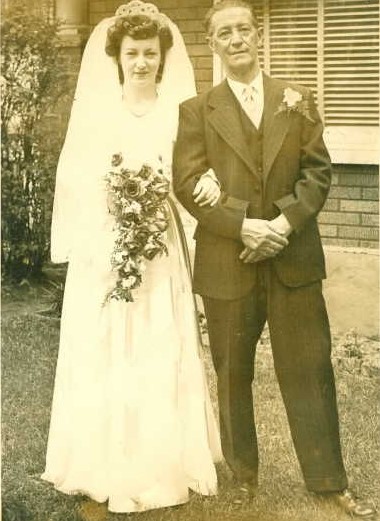
John McDonald and his daughter Marion

This week's 52 Ancestors prompt is "I'd like to Meet". I have more than one ancestor I'd love to sit down with:

  • My 6x great grandfather Michael BASTARCHE DIT BASQUE. His and his brother Pierre were deported by the British from Acadia to South Carolina in 1755. They fled and went on an incredible journey through the American colonies, Quebec and New Brunswick to finally be reunited with his wife and children in Prince Edward Island. You can find his story in the Dictionary of Canadian Biography
  • Any of my Foreign Protestant ancestors, who came over from what is now Switzerland, Germany and France. They founded Lunenburg, Nova Scotia. It would be incredible to hear what their lives were like before they came, and to hear why they came.
  • My grey sheep 2x great grandfather Honore GOVEREAU. Originally born Germain DEVEAU in Quebec, he migrated to the Boston area with his wife and child. He left them to find work in New Brunswick and never returned. He changed his name and married 2 more times. I descend from his marriage to his last wife, Appoline Savoie. My recent DNA matches to DENEAU descendants has confirmed for me his original name. I call him my grey sheep ancestor because life is not black or white, and neither are people. I would really like to know why he made the choices he did.
  • My great grandfather James Henry DOUGLAS. His birthplace is a mystery. Somehow around the end of WWI he ended up in Glasgow, Scotland. There he met my great grandmother Mary Black MACARTHUR, had 2 children, and then brought her to Canada. There they had 4 more children. He also informally adopted Mary's children from her first marriage.
The person I'd like most to meet though is my great grandfather John Wellington MCDONALD. He's been my biggest brick wall, and I'd love to find out more about him. It frustrates me to no end that the man who my surname comes from is the one I know the least about. Every bit of information I've got on him was hard won. All records I have about him state he was born in Ontario. Somehow between 1922 and 1925 he went to Nova Scotia and met my great grandmother, and ran off with her to Ontario. My sadly short time line pertaining to John is as follows. 

14 June 1894?
John's marriage and death registrations give birth calculations of 1894 and 1896. I have not been able to find a definitive birth registration for him. 

27 June 1922
Edna marries her second husband Adolphus FREDERICKS in Halifax, Nova Scotia. Record obtained from Nova Scotia Historical Vital Statistics.
,
26 January 1925
Jack and Edna are in Ontario. My grandfather Edward James MCDONALD is born in Cochrane, Ontario. Information obtained from family.

6 November 1927
My great aunt Beulah Gertrude Marion MCDONALD is born in Cochrane, Ontario. Information obtained from family.

19 April 1929
My great uncle Hector Martin MCDONALD is born in North Bay, Ontario. Information obtained from family.

1 August 1932
My great aunt Pauline MCDONALD is born somewhere in Ontario. The date of birth came from her death registration.


14 November 1934
Pauline dies of the flu in Toronto, Ontario. John is in the informant on the death certificate and stated he was born in Ontario.


25 June 1935
John and Edna have a still born baby boy in Toronto, Ontario. Jack stated he was born in Kingston, Ontario.


1945
John is a plastics worker living on 34 McMurrich Street, St. Paul's, Ontario. Obtained from Ancestry's Canada Voter's Lists collection.


1949
John is a taxi driver, and still living on McMurrich Street. Obtained from Ancestry's Canada Voter's Lists collection.


19 March 1956
John and Edna finally decide to get married. I'm not sure if the late wedding had to do with pension concerns, or if it was because of Edna's second husband. A death certificate for Adolphus FREDERICKS has never been found. John states he was born in Ontario, and the son of John Angus MCDONALD and Mildred MURPHY. He states they are immigrants from Ireland. John also states he is a bachelor.  Information obtained from their marriage registration.


1958
John is a taxi driver, and the family has moved to 415 Christie Street in Toronto, Ontario. Obtained from Ancestry's Canada Voter's Lists collection.


5 February 1964
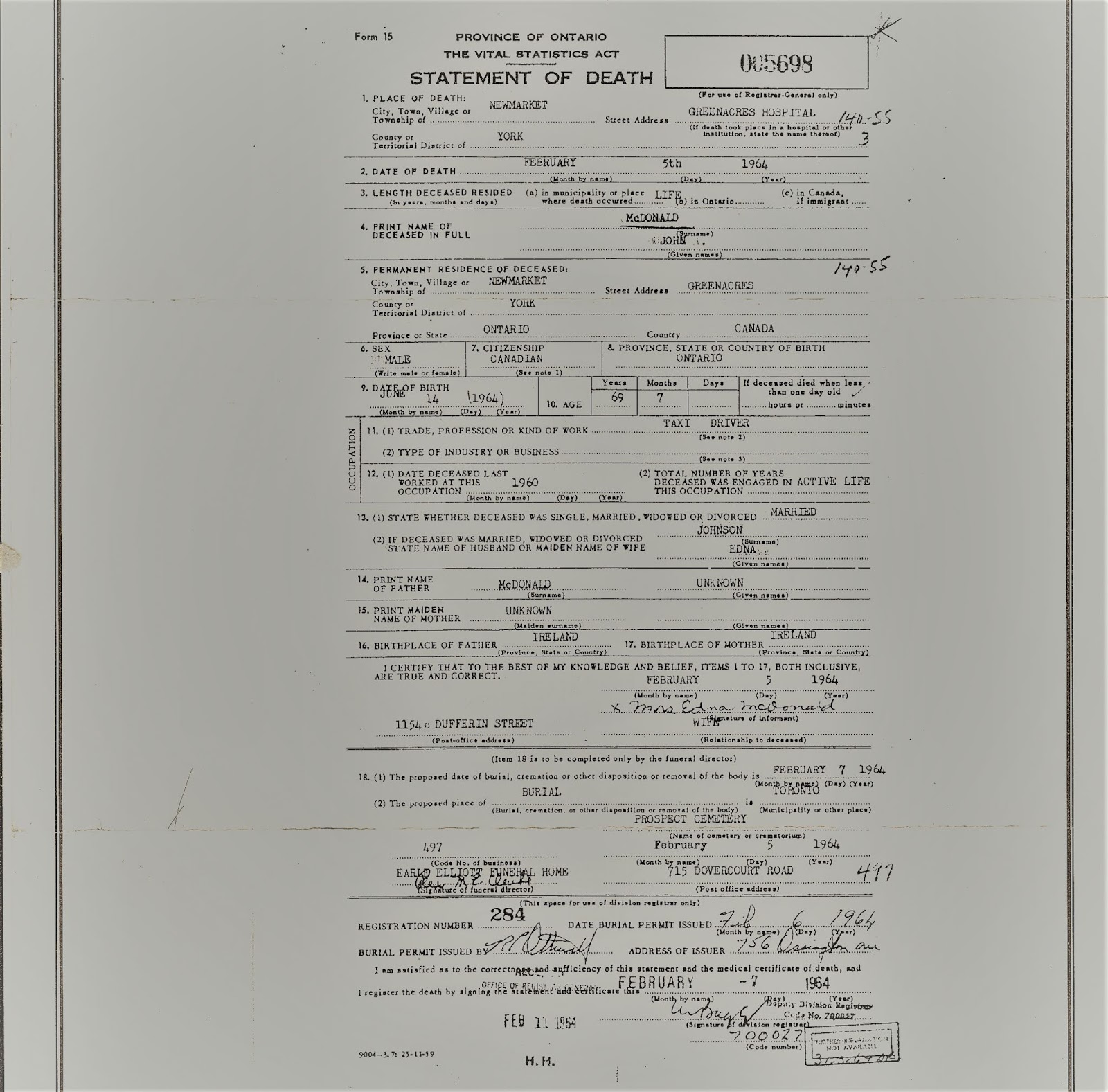
John dies in Greenacres Nursing Home in Newmarket, Ontario.  Information obtained from John's death certificate. Edna was the informant, and stated that she did not know his parents' names, only that they were born in Ireland. Which says to me she never met them.

Unfortunately his obituary in the Toronto Star does not give any information either.


In summary, this is what I have about John:

  • Born in Kingston, Ontario about 1894
  • Son of Irish immigrants John Angus McDonald and Mildred Murphy
  • Lived in Cochrane and North Bay Ontario, before settling in Toronto
  • Married Edna in 1956 in Toronto, Ontario.
  • Died in 1964 in Newmarket Ontario

The information I have about John was obtained from the following record sets:

What I am still looking for is a record of John's birth in Ontario. I also have yet to locate him before 1925. I have found no definitive record of him with either of his parents. In fact, I have found no definitive records of his parents in Canada. 

Interestingly enough, there is a John Wellington McDonald born in Nova Scotia in the 1870's. He is NOT my John however. Firstly, this John was born about 20 years before my great grandfather. Secondly, once I "killed him off" Nova Scotia John, I found that he married someone else, and is buried with her in Nova Scotia.

My next steps to find out more about my tight lipped ancestor John:
  • Obtain birth registrations for Edward, Marion, Hector and Pauline. Because they were all born less than 104 years ago, I will have to apply to the Ontario Registrar General for these. As I am not the nearest next of kin, I will have to ask older members of my family to give me a hand. 

  • Contact or visit the Presbyterian Church Archives in Toronto. John and Edna were married in St. John's Presbyterian church, and I'm hoping the church register might have some information.

  • The family thinks John may have served in World War I. I am wading through all the MCDONALD soldiers to try and find a connection to John, John Angus, or Mildred. As you can imagine, it's slow going. Library and Archives Canada recently completed their massive digitization project of services records for WWI Canadians soldiers. You can access the collection on the LAC website under the collection title Personnel Records of the First World War.

  • Send away for the 1940 National Registration Record for John. These records are not publicly available, but you can apply to get a copy of them from Statistics Canada. You can see an explanation of the record set here. The link to order the records is here.

  • I have over a thousand 4th cousin or closer DNA matches, thanks to my French Canadian/ Acadian maternal side. I have 1st cousins and an aunt on my maternal side who've also tested. By looking at who they DON'T match to, I've managed to isolate a group of matches that look to come from my paternal side. I'm hoping to exchange information with these matches to see if I can determine where and how we match.

If your family tree has a John MCDONALD that you think might be my great grandfather, I would love to hear from you. My contact information can be found on the Contact Page tab.

Monday, 21 January 2019

52 Ancestors: Week 3 - Unusual Names


This week's 52 Ancestors in 52 Weeks prompt is Unusual Name. I have not been blessed in my own research with many unusual names. My maternal French Canadian side has a fondness for the names  Joseph and Mary/Marie that borders on the ridiculous. My paternal side has heavily favoured the names James and  John. My recently discovered Scottish MacArthurs are starting to look like they feel strongly about the name Dougald.

In the course of researching other people's trees and blog posts, I have come across some fabulously unusual names. They've made me a little jealous that I don't have names like these in my tree. Here are some of the unusual names from my own and other people's trees I have come across:

My Family Tree

  • Great aunt Beulah Gertrude Marion McDonald. Born 1927 Ontario, Canada, died 2010 Toronto, Ontario.
  • 2x Great uncle Freeman Elias Johnson. Born 1899 Nova Scotia, Canada, died 1959 Nova Scotia, Ontario.
  • 4x Great grandfather Joseph Savoie. His given names were not unusual, but he seems to have been known as Rooster. Born about 1750 in Acadia, Canada, died 1810 in New Brunswick.
  • 6x Great grandmother Magdeline Schwineheimer. Magdaline and her parents were part of the Foreign Protestant settlers of Lunenburg, Nova Scotia.
  • 6x Great grandfather Ulrich Hubley. Born about 1719 in what is now Germany, died 1802 Lunenburg, Nova Scotia.
  • 8x Great grandfather Jean Bastarache dit Le Basque. Born about 1658 in the Basque region of southern France, died 1733 in Acadia. Those familiar with the French Canadian "dit" names know that these are names that can best be described as nicknames to distinguish men or families with similar names.

My Inlaws' Family Tree
  • Hamlet Wood. Born 1870 in Halifax, England. Died 1944 Ontario, Canda
  • Francis Parnel Gladwish. Born about 1837 Kent, England. Died 1886 Kent, England
  • Hannah Maria Horsfield. Born 1850 Halifax, England. Death Unknown
  • Sarah Tooby. Born 1809 Derbyshire, England. Died 1855 Derbyshire, England

Unusual Names I've Comes Across
  • Willoughby Nicolson Noble Norrie. Born 1869 Angus, Scotland. Died 1944 Ontario, Canada. My favourite name I've discovered by far.
  • Reuben Cardinell. Born 1845 Ontario, Canada. Death unknown.
  • Fanny Jane Oldfield. Born England. Death unknown. What is unusual is that Fanny was her legal given name, and not a nickname.
  • Almilda Sager. Born 1851 Ontario, Canada. Died 1915 Ontario, Canada.
  • North Clark. Born 1815 Durham, England. Died 1899 Durham England.
  • Charles Longmuir King. Born 1902 Aberdeen, Scotland. Died 1972 British Columbia, Canada
  • Commodore Conley Cowger. Born 1909 West Virginia, USA. Died 1999 West Virginia, USA.

Monday, 14 January 2019

52 Ancestors: Week 2 - The Challenge of Organization: Forms and Charts


https://pixabay.com/en/cluttered-desk-dirty-education-1295494/


This week's 52 Ancestors in 52 Weeks prompt is "Challenge". I have two great grandfathers by the names of John MCDONALD and James DOUGLAS that are challenges. I have yet to find which cabbage patches they came from. My biggest challenge however, is organization. I'm sure I'm not alone on that one, so I've decided to make my challenge post about forms and charts.

Once you start getting deeper in your family tree, being able to keep track of what you've looked at, what you have, and what you need to find becomes essential. Especially if you're like me and do the old school paper thing for at least some of your ancestors. I keep paper files of my direct lines. Collateral lines are kept on my Ancestry tree. I've built a little collection of links that I like to use to to find my forms.

Ancestry
Ancestry has a form for just about anything you might need for your research files.


Family Tree Templates.net
This great site has a ton of varieties of forms. They are free to use, though if you want fillable PDF versions for some of the forms, you'll have to pay a small fee.

Family Search
Family Tree Magazine
I cannot remember where I first found these. Global Genealogy is in the main URL, but I could not find a way to find it on their main site now.

Bailey's Free Genealogy Forms
Click here to access their free research forms:
  • Pedigree charts
  • Family Record Sheet
  • Cemetery Logs
  • Time Lines Forms
  • Research Log
  • Correspondence Log
  • Relationship Chart


Monday, 7 January 2019

52 Ancestors: Week 1 - First Nominal Census in Canada

http://heritage.canadiana.ca/view/oocihm.lac_reel_c2474/7?r=0&s=4


Amy Johnson Crow has started a new year of her 52 Ancestors in 52 Weeks prompts. Each week for 52 weeks, Amy gives a theme for participants to write about your family history. You don't have to be a blogger to join in. The point is to get yourself writing abut your ancestors. My blog focuses on more on record sets than on my personal family history. Because of that, my blog posts will try and feature Canadian record sets tying into the prompts, rather than strictly on my personal research.

This week's prompt is "First", so I'm going to look at the first census taken in Canada. The first major census in Canada was in 1851/1852, but that's not the first census taken. There was several small censuses done in the 2 centuries before the 1851/1852 census. Library and Archives Canada's finding aid on early Census records states they have records going back to 1640 onsite, and is described as "notes on Montreal neighbourhoods". The earliest nominal census return is from 1666. Many of my ancestors appear in this census, as I am the 11x great granddaughter of Louis Gaston Hebert, who came to New France first in 1606. He went back to France, and came back with his wife, Marie Rollet, and their 3 children to settle permanently in 1617. Thanks to a small population, and intermarrying, I also descend from several of the first few waves of settlers in New France. For simplicity's sake, I'm just going to look for the direct descendants of Louis.

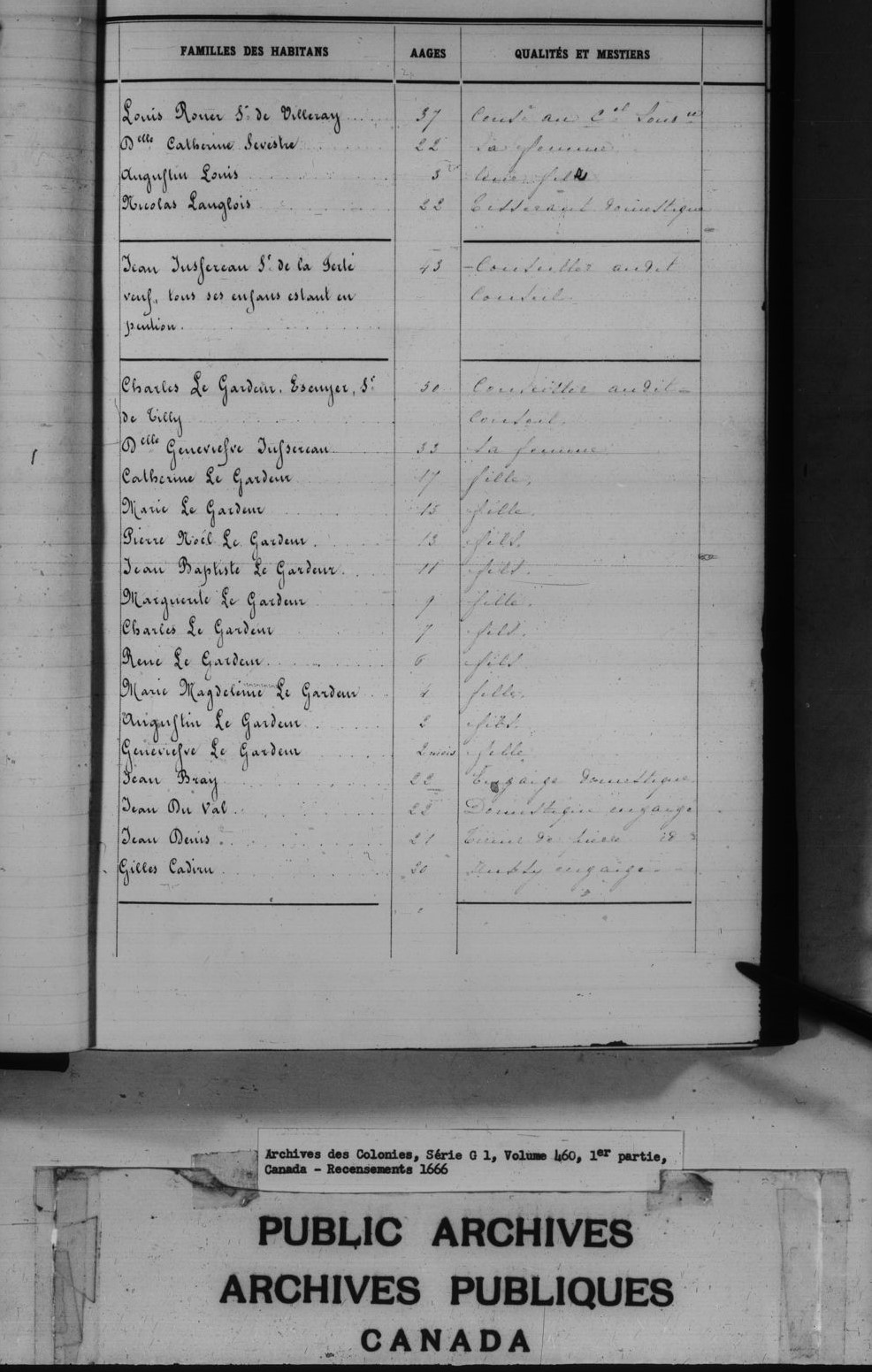
You can find the digitized 882 images of the 1666 census here on Hèritage. This census is almost a work of art. The handwriting is beautiful, and you can read each page clearly. It is in French of course. However, you will not need an advanced knowledge of French to be able to read it. The first few pages comprise of the names of the men and women who lived and worked in the seminary and hospital. After that they list those families in the surrounding area. The wonderful and unusual thing about this early census is that it lists all members of the household. As well, married women are listed with their maiden names, a common practice that French Canadian researchers benefit from. Unmarried, or those with spouses still in France, are listed under a special heading. Take a look at this sample page:

http://heritage.canadiana.ca/view/oocihm.lac_reel_c2474/6?r=0&s=5


The areas covered are:


  • Quebec
  • Beaupre
  • Beauport
  • Ile d'Orleans
  • St. Jean, St. Francois and St. Michel
  • Sillery (Cap Rouge and St Francois Xavier)
  • Notre Dame des Anges, La Rivere St. Charles and Charlesbourg
  • Coste de Lauuzon
  • Montreal
  • Trois Riveres

If you are finding things hard to decipher, don't despair. There are two published transcriptions of the census on Internet Archive here and here. The nice thing besides the clarity on Internet Archive is the fact than you also use their search bar at the top right to search for specific names. A word of advice though if you try the search function: Use as many variations on spelling as you can think of.

Louis and Marie have passed by the time of this census, and so has my 10x great grandfather Guillaume Herbert. My 10x great grandmother, Helen Des Portes, has remarried to Noel Morin. They can be found in St. Jean, St. Francois and St. Michel:

https://archive.org/stream/rapport13queb#page/84/mode/2up

What I find really interesting is how many of these surnames are still in existence 350-ish years later. Not only still in existence, but well known and common. In my non genealogy job I see some of these surnames quite often in northern British Columbia, some 5,000 or so kilometers away. Some have been anglicized in pronunciation, but you can still see the French surname they originated from.

If you would like to explore more of the pre-1851 census records, be sure to check out the LAC Finding Aid on early census records.


Monday, 26 November 2018

Manitoba Ancestors: Manitoba Church Records on Family Search

https://commons.wikimedia.org/wiki/File:Souvenir_of_Winnipeg_(1889).jpg


Church records can be a goldmine of information for genealogists. Not only will you get that valuable birth, marriage and death information, but you can also get names of extended family. These records can also pre date civil registration and census records, getting your family further back.

The problem with church records is that they are harder to track down that census and civil registration. They are held by the various churches and dioceses, not by the government. When you're researching from a distance, anything you can find online is a definite bonus.

If you have Manitoba ancestors, you'll want to check out Family Search's collection, Manitoba Church Records, 1800-1959. This browse only collection contains entries from Catholic, Lutheran and Unitarian parishes. It is not a complete collection, but still worth a look.

According to the Family Search wiki on the collection, you should be prepared to look at records written in English, French, and possibly even Icelandic. The wiki has helpful links to help you understand and locate key French and Icelandic words, as well as a link on Scandinavian naming patterns.

There are 6,567 images in the collection, but you can narrow down things down pretty quickly. First you're going to click on Browse through 6,567 images.


https://www.familysearch.org/search/collection/1992433


Then you're going to pick one of the shown locations:

https://www.familysearch.org/search/image/index?owc=https://www.familysearch.org/service/cds/recapi/sord/collection/1992433/waypoints

Next you can narrow down by denomination/parish, and further by record type/year range.

I am more familiar with Catholic records, since my maternal grandparents were French Canadian/Acadian. So I decided to look at St. Eustache. I looked at Baptisms, marriages, burials 1874-1882, vol.1. The first image in the set says that the collection actually goes to 1897. So I immediately went to the last image to see, and the dates on the last few entries are indeed in 1897.

The first page of text for this one is quite interesting. My "franglais" serves me well enough, so from what I can gather, there are some entries included for Baie St. Paul, the original location of the church. Due to flooding, the church had to be moved, and in 1882 became St. Eustache.

Since the main congregation of the church was French and Metis, these records are in French. What is nice about them is that the handwriting is quite clear, however you will need to use the zoom feature to be able to read some of the entries. Depending on the writer, the handwriting can be quite small. Anyone who has experience in researching French Catholic records will be quite pleased overall though. French Catholic researchers have all seen at some point handwriting with the appearance of a drunk snake slithering across the page. Thankfully, that isn't the case here on the pages I looked at. The information in the records here is quite standard for Catholic records:

  • Date of event
  • Names of baby/bride/groom/deceased
  • Parents/Witnesses/Godparents' names
  • Age
  • Parish they belonged to
  • Marriage by license or banns
  • Occupations


Those who are unfamiliar with French Catholic records will be pleasantly surprised that a woman's maiden name followed her after marriage. There are a lot of burial entries where a married or widowed woman's name will be listed as well as her married name. Another bonus I've found in Catholic records sometimes is notations in the margins of the register. It isn't that uncommon to find a notation next to a baptism of a marriage later in life, or even a death. I found a few of these in this record set.

I also looked at the First Lutheran Ardal Congregation in the Gimli municipality to see how these compared to the nicely done Catholic ones. These ones had the look of a civil registration register. The birth ones had spots to record:

  • birth date and location 
  • baptism date
  • parents' names (including mother's maiden name)
  • sex
  • signature of the parent
  • father's occupation.
The death records gave information such as:

  • Name
  • Place and date of death
  • Cause of death
  • Sex
  • Age
  • Occupation
  • Birth place
  • Name, relationship, and residence of informant
  • Date of funeral
The marriage records have a bucket load of information for the bride and groom:
  • Name 
  • Age
  • Single or widowed
  • Parent's names
  • Birth place
  • Residence
  • Religion
  • Occupation of the groom
  • Names and residences of witness
  • Date and place of marriage
  • Married by license or banns
The records for this congregation are written mainly in English, and with a nice hand. I have absolutely zero familiarity with the Icelandic language, but I was still able to make out names clearly.

Now, this isn't a complete set of records. There are gaps in years, and I'm sure there aren't records for every parish. It's still a nice pleasant record set to deal with. It made me wish I had Manitoba ancestors.


Sunday, 4 November 2018

Military Ancestors: The weekly newspaper "Canada"

https://archive.org/details/canadaanillustr01unkngoog


I came across a rather interesting, and rare, resource this week. During the first World War, a newspaper was published in London England called "Canada: An Illustrated Weekly Journal for all Interested in the Dominion". Part weekly newspaper, part gazette, this fascinating resource is so rare that I had a hard time even finding out who published it and when. One rare book seller's website has 2 issues of it from 1917. From the description they are not in the best condition (loose pages and stains), and are being sold for $150 Canadian dollars as a set.

I cannot find a complete history of the publication. But what I've been able to piece together from several different sources was that it started sometime before WWI, and published in London England, and/or possibly in Toronto. They had an office in each location, and a later edition listed an office in Montreal. Sometime after WWI, its name seems to have become "Canada's Weekly". The most recent historical edition I could find was in 1942. Pre WWI issues had the set up as a general interest magazine. There were articles on just about anything under the sun. I found stories on commerce, agriculture, politics, tourism, fishing, and mining just to name a few. The articles were evenly balanced, highlighting areas across the country. After the start of WW1, the editions focus mainly on war news.

What makes this such a great resource is that among the war news, you'll find:

  • Birth announcements
  • Marriage announcements
  • Death announcements and Obituaries
Just look at some of the entries I found:

Births June 1907
https://archive.org/details/canadaanillustr01unkngoog/page/n22


Marriages August 1916
https://search.findmypast.com/record?id=gould%2fca0202-e%2f005


Deaths April 1922
https://archive.org/details/canadaillustrate00lefr/page/106

Even better than this, the wartime issues lists soldiers who received war honours, those wounded, those presumed missing, and those killed. Not just the officers either. You'll find lowly privates, corporals and sergeants too. The best part about the war honours entries is that they tell you the reason why these soldiers received their medal. Here's a few examples:

July 1916
https://search.findmypast.com/record?id=gould%2fca0202-d%2f009


https://search.findmypast.com/record?id=GOULD/CA0202-D/062&parentid=GOULD/CA0202-D/062

https://search.findmypast.com/record?id=gould%2fca0202-d%2f063

August 1916
https://search.findmypast.com/record?id=GOULD/CA0202-E/007&parentid=GOULD/CA0202-E/007


So where do you get your hands on them? Like I mentioned above, these are hard to find, especially online. Here's a few places I found issues:

Internet Archive
They're there, but extremely hard to find among the tens of thousands of items in their database. They have varying years. Here's the links I was able to find:

https://archive.org/details/canadaanillustr01unkngoog

https://archive.org/details/canadaanillustr02unkngoog

https://archive.org/details/canadaanillustr00unkngoog

https://archive.org/details/canadaillustrate00lefr


Find My Past
If you're a subscriber to Find My Past, among their collection are the issues for April - August 1916

Hard Copies
Here's a list of places that have hard copies of issues:


  • Fredericton Region Museum
  • Harvard College Library
  • Vancouver City Archives 
  • Library of Congress in Washington
  • Yale University Library
Unfortunately, I have not been able to find other locations, though I am sure they're out there. If anyone has come across these either online or off line, feel free to leave a comment letting us know where.

Friday, 26 October 2018

Ancestors in Service: Porters and Domestics Records through the LAC

My apologies for the absence of late. It's an awful thing when the daily demands of your non genealogy life gets in the way of doing what you love. I've been on holidays this week, and I've made it a genealogy stay-cation. Though I haven't broken through any brick walls in my personal family research, I've been able to catch up on some of my side projects.

As part of one of my side projects, I came across an interesting database on the Library and Archives Canada (LAC) website. If your immigrant ancestors went into "service" as a porter or domestic, then you'll want to look at LAC's database Immigrants to Canada, Porters and Domestics, 1899-1949.

During the 1800's and the first half of the 1900's, there was a great demand for domestic help in Canada. The demand was so great that an immigration policy was enacted to bring young single women (and some men) over to Canada to settle and work. The LAC has put together a database of the thousands that came over, using several different record sets to build it. Most of the women are from the UK, but there are some from other countries as well. If your ancestor was a black man who worked as a porter, he my be in here as well. A complete description of the database can be seen in the link above.

The Search Screen allows you to search by surname, given name and/or by keyword.

http://www.bac-lac.gc.ca/eng/discover/immigration/immigration-records/porters-domestics-1899-1949/Pages/search.aspx

I decided to use MURPHY in the surname box. It's a surname from my own tree, and not as common as my usual go-to UK surname MCDONALD. This database starts after where my Mildred MURPHY enters my family tree, so I know I won't find her.

My result was 12 MURPHYs.

http://www.bac-lac.gc.ca/eng/discover/immigration/immigration-records/porters-domestics-1899-1949/Pages/list.aspx?Surname=murphy&

I clicked on the number beside the first entry, Mary MURPHY, age 28. This is the information that came up:

http://www.bac-lac.gc.ca/eng/discover/immigration/immigration-records/porters-domestics-1899-1949/Pages/item.aspx?IdNumber=898&

    So, according to this, Mary departed the UK 28 Jan 1910, and arrived in Canada 4 Feb 1910 on the Empress of Britain. She came through Mrs. Helen Sanford's Girls Home of Welcome. Her final destination was Winnipeg, where Mrs. Sanford's receiving home was located. Now, what we want to especially take note of is the File number (22787 part 3) and Volume (119), where we will find Mary's Emigrant's Application for Ticket. The digitized file is NOT on the LAC, but don't groan just yet. You'll notice that the microfilm number at the bottom is underlined and highlighted. If you press and hold the Ctrl key and click on that microfilm number, it will open a new window on the Heritage site. This site has many digitized microfilms from the LAC.

What you'll see in this new window is a listing of the Headquarters Central Registry Files. Go through the list to find your microfilm number. There are listed numerically, so it won't take long to find the one you need. I found the one for Mary (C-4782) on page 13.

Those who've used Heritage before know that the downside to this site is that the microfilms are not indexed. This means you're going to have to go "old school" and go through page by page. This particular microfilm has 1469 images. This is where that file number 22787, part 3 comes into play.

I clicked through the first few images to see how the microfilm is set up. This particular microfilm starts with File 22787 part 3 Volume 18. So I know Mary is probably going to be pretty far into the microfilm, as she is in Volume 19. This may seem like a monumental task to find where Volume 19 starts, but look at the image below:

http://heritage.canadiana.ca/view/oocihm.lac_reel_c4782/6?r=0&s=1

Where I've put the red arrow has the File and Volume written sideways. I jumped forward and back through the images until I found the start of Volume 19. But then confusion struck, because Volume 119 belongs to File 22787 part 4, and deals with domestics who came in 1911. So I went back to the beginning of the roll. The first images deal with women who sailed in June of 1910. Mary's entry said she departed 28 January 1910. So obviously there's been an indexing error. Since this roll starts with departures in June 1910 and carries until at least 1911, we can reason that the files are in sequential order of sailing date.

I then went back to the main list of microfilm numbers on the Heritage page and selected the roll before this one: C-4781. This time I started at the last image and worked my way backwards. The last emigration tickets on this roll also stated departure was in June 1910. I kept jumping backwards until I finally found Mary in image 1676.

http://heritage.canadiana.ca/view/oocihm.lac_reel_c4781/1676?r=0&s=1
Now I know this is the Mary I'm looking for because she's 28. Of the other two Mary's on the list, one is 22. The other Mary doesn't show an age, but when I click on her information, it says she sailed in 1924. As well, our Mary's ship name and sailing date match. So what do we know from her application?


  • She lived at 16 Riddrie Terrace, Riddrie, Glasgow
  • She has worked as a domestic servant for 12 years in the Lanarkshire area\
  • The last year she worked as a general servant
  • She is a British subject by birth
  • Her final destination is Manitoba, and she intends to work as a domestic servant
  • She is not travelling with any family members, and traveled in steerage
  • The application was received by Immigration 9 Feb 1910
  • She applied 18 Nov 1909
  • She signed with a different surname, it was crossed out, and she signed Mary Murphy above it

Now let's look at further research options for Mary:
  • She came before the 1911 and 1916 censuses in Canada. 
  • She came after the 1901 Scotland census. We know she worked in the Lanarkshire area for 12 years, so we should be able to find her as a domestic in 1901.
  • What about that crossed out surname? 

Now, as you can see with my example above, don't totally trust the index. Mary was actually located on Roll C-4781, in File 22787 Part 2, Volume 118. If you've been researching awhile, you know that human error is inevitable with indexes. So if you can't find your ancestor where they say it's located in the index, look at the sets before and after it. But look at what we found when we did find her. We know where her last address was, and have an area in Scotland to research. We know what her occupation for the previous decade has been. We also have an area to fan out from for researching forward after 1910 in Canada. We can also do some research on the Agency that brought her, to find out more about her life. Not bad for a single page application.