Saturday, 3 April 2021

Quaker Ancestors: Canadian Friends Historical Association

 Do you have a Quaker ancestor? Then you might want to bookmark the Canadian Friends Historical Association's website. This great website has a wealth of information on the early history of Quakers in Canada. According to the website, Quakers started migrating into Upper Canada in the 1790s. Those who were in Dutchess County, NY settled around the Bay of Quinte. Quakers from New Jersey and Pennsylvania migrated mainly to the Niagara region. Before this, Quakers also migrated into Atlantic Canada. When Canada started expanding settlement to the West, Quaker settlements started appearing. The Canadian Friends Historical Association (cfha) has records focusing mainly on Upper Canada and the US Staes they came from.

https://cfha.info/


 To explore their site, click on tabs on the top right of the screen and follow the drop down menus. I'm going to focus on some of the sections in the WHAT WE DO drop down menu.


Who Are the Quakers?
If finding Quakers among your ancestors comes as a surprise to you, then this page is for you. There are 9 informative panels giving a general overview of Quaker history. You can view each panel separately, or download it as a PDF here.

Below the panel is a general overview of Canadian Quaker history specifically. For instance, did you know that after the Acadian Expulsion in 1755, the Friends of Philadelphia stepped in to help banished Acadians?


Publications
This section has several subsections that will be of interest. All are PDF downloads.
  • Research Papers - These papers highlight individual Quakers, Loyalist Quakers, and aspects of the Quaker faith. If your ancestry is connected to a fellow by the name of Timothy Rogers Jr., there is an interesting read called Timothy Rogers Jr: Quaker to Slave Master.

  • The Meeting House - The newsletter of the chfa. Check out the section called "Transcription Tidbits". You might just find a mention of your ancestor.

  • Canadian Quaker History Journal - First published semi annually, then annually. This section has issues 46 to 81. You can view full issues from 46 to 68. Issues 69 to 81 have table of contents, that provide links to individual articles. I found issue number 68 especially interesting. It was an entire issue devoted to Quaker and the Penal System.

  • Newsletters from 1972 to 1988, 1998 to 2005 - Before the Journal listed above, the publication was in newsletter form. This is where you will find issues 1 to 45. 


Transcriptions
This is the section you really want to look at. Here there are PDF transcriptions of Meeting Minutes, Journals/Diaries, Letters, and Memorials. The Meeting Minutes are by far the largest part of this section.

US
  • Muncy Monthly Meeting, PA - spans the years 1797-1834
  • Nine Partners Meeting, NY - spans the years 1779-1897
  • Ferrisburg Monthly Meeting VT - spans 1793-1816
Upper Canada
  • Pre 1828 Separation - various areas, spanning as early as 1739 to the late 1800s
  • Half Yearly Meeting - spans 1810-1864
  • Orthodox Meetings - various areas, spanning form the the early 1800s to the mid 20th century
  • Hicksite Meetings - various areas, spanning from the early 1800s to the mid 20th century
  • Canadian Meeting Outside Ontario - Bordon SK, spanning 1918-1983. There is also transcriptions of Epistles received from the Fritchley, England Society of Friends

Below the links to the various transcriptions are brief histories of the different areas covered.


Don't forget to check out their blog as well. Just a few day ago, they posted about the Quakers around Argenta BC. 

The transcriptions and digitization by the cfha are ongoing. If you found something on their site to further your research, thank them by making a donation. Even better, become a member to keep up to date on all the work they do. You can access their membership application here.

Saturday, 27 March 2021

Quebec Ancestors: The Montreal Fire Club at the McGill University Archives

 University Archives are a great resource. They often have unique items in the holdings that you wouldn't even think to look for. I spent a fair amount of time poking in several Canadian University online collections over the past few months and they never fail to surprise me.

One such find is online at the McGill University Archives Collection website. If your ancestor was a business owner in Montreal from in late 1700s/early 1800s, they might have been a member of the Montreal Fire Club. Founded by prominent businessmen and merchants of the era, the club was founded to help protect assist its members from fire. They had their own firefighting equipment and would come to the assistance of any member if their homes or warehouses caught fire. McGill University has digitized one their minutes books and it is available free to view as a PDF.

https://archivalcollections.library.mcgill.ca/index.php/montreal-fire-club-1

The volume covers meeting minutes from April 1786 to November 1814. In a day when penmanship was important, look at this page outlining the purpose of the club


Here is a list of the first fourteen members of the club. Those businesses that were a partnership counted as one member.


There are names interspersed throughout the minutes. Coffee Houses appear to be their regular meeting place for quarterly meetings. Attending the meetings was important. A member by the name of Cruickshanks was fined for non attendance in 1792. Further reading of the minutes showed that he was fined for absence on a regular basis.


Fines were also given for not having the required items. In 1799, each member was required to provide a book, six buckets and four bags. Mr. Frobisher was fined because he only had 3 bags.


In March of 1800 there was fire and it came to light that many of the members did not have the required equipment. There was a discussion about it at the following April meeting at Teasdales' Coffee House


They even had Watch Words and Answers. This was from the Quarterly Meeting in January 1805.


If you use Adobe Acrobat, it allows you to zoom in and out. The PDF can be downloaded/and or printed. You cannot save individual pages, but you could use a screen shot or snipping tool if you just want an individual page or zoomed in portion. I used the Windows Snipping tool for this post.


This minute book is just one example of the many digitized rare books that McGill has. Some other examples of what they have are:

Wednesday, 24 March 2021

I'm Back and Blogging Again


I've been silent on my blog for awhile, and I do apologize if you're a regular reader. For many people, the pandemic experience has been being house bound. My experience this past year has been different. My "job-that-pays-for-genealogy" involves Government Auto Insurance, as well as issuing plates and decals. Remote work from home is not an option for me. Even during the most restrictive lockdowns I still went to an office and interacted with the public. Now, I have been fortunate. I have had a job through the past year and I work for a company that takes amazing care of its employees.

But whether you've been stuck at home or having to leave your house to work, the new reality we live in will eventually take a toll on you. I took a break from blogging, social media and the news for the past few months. 

So what did I do with my self imposed break? I spent my time attending virtual genealogy conferences. The way the genealogy community came together and went virtual has been amazing. I attended a few of the Scottish Indexes Conferences, the Quebec Genealogical eSociety Conference, and various other webinars. I was able to attend RootsTech for the very first time, and I came away from it totally energized and wanting to blog again. My problem is I learned so much that I don't know what to share first!

I also made break throughs in my own research. Getting the time to really sit and analyze my DNA results broke down my biggest brick walls. I'll also be talking about these in future blog posts, as they both involve not one but two of my direct line ancestors who changed their names and began new lives.

So I'm back and ready to share what great and unexpected resources there are out there. I just wanted this first post in a while to tell everyone to be safe, and be kind. Everyone's experience during this past year and a bit has been different. And don't forget to write down your own experiences through this most unusual time period. Our future descendants will thank us for it.


Sunday, 22 November 2020

Saskatchewan Ancestors: The Greystone Yearbooks Online at the University of Saskatchewan Archives

Yearbooks are a fun way to find out about your ancestor's academic life. If your ancestor attended or worked at the University of Saskatchewan between 1912 and 1969, then you're in luck. The University has digitized their yearbooks for these years on their website.

The collection is called Student Yearbooks Online, 1912-1969. Digitized from microfilms, the images follow the yearbooks through its various name changes and formats

  • From 1913 to 1920, the April edition of the University's newsletter The Sheaf was the graduation edition and served as a yearbook.
  • 1921 a stand alone yearbook was published, called The Spectrum.
  • 1922/1923 - published as The Keystone
  • 1924-1926 - published as US
  • 1927 - 1969 - published as The Greystone
I looked through the years and the yearbooks are really not much different than the yearbooks I remember from my own school years. Faculty pictures, student pictures and bios, and extracurricular activities are all featured. As to be expected, the early years have quite formal pictures. 

Here's a couple of student bios from the very first graduating class of 1912


Here's a neat one from the 1920 yearbook. I always get excited to see an ancestor's signature.


Another unexpected find. A tribute to a student who died in WWI from the 1917 yearbook.


Don't forget the faculty. Here's the deans from 1937.


Extra curricular activities are a huge part of any academic life. Here's the badminton and cross country teams from 1956.


As the years progress, the pictures start becoming more candid. Here's some of the pictures taken at a dance after an awards banquet in 1964


Lastly, don't forget the advertisements. Here's some from the 1943 yearbook


The images in the collection are fairly clear. The website does warn that there may be missing pages and low quality images, due to the conditions at time of the original microfilming. Also, take note of these other caveats:
  • Due to privacy restrictions, later years won't have individual student photos and bios of the graduating class. Once a year book has passed the 92 year benchmark, they will also become available online. I looked and as of today, student bios and pictures are available up to 1927. However, there are still group photos from extra curriculars. You might still find your ancestor among those.
  • There is no zoom function. This can make the site a little clunky to use, but it's not terrible.
  • There is no ability to print. However, just right click on the image and save the page as a picture. Then you can use your computer's capabilities to crop and manipulate how you like.


Saturday, 31 October 2020

Manitoba Ancestors: Issues of "The Commercial" on Canadiana

Records for your ancestor's personal life are the back bone of genealogy research. Looking into their professional life can be harder. If they were in public service, such as law or politics, there are many sources that are a matter of public record. Business owning ancestors don't leave as much behind. Of course, if your connection is to the Christies, Redpaths, Molsons, Bombardiers, or Ganongs, then no problem. These iconic Canadian business families have mention everywhere. But what if your ancestor was a smaller business owner? If they lived in Manitoba in the late 1800's, then you should look through the pages of The Commercial. You can find over 1000 issues on Canadiana. Geared toward business owners, they stated that they were "A journal devoted to the financial, mercantile and manufacturing interests of the Canadian North-west."


The journal ran from 1882 to 1922. Canadiana has issues up to 1903. The main body of the journal is filled with articles that talk about market trends and news of interest to business and industry owners. It was a fore runner to industry magazines you see today like Canadian Business Magazine. They may not be the most interesting reading for someone not in, say, the business of selling farm machinery. But, these articles can give you an insight into the working world of your ancestor. These outside factors can tell you why they changed careers, sold their business, or why their business prospered when others didn't. For instance, there is a rather scathing article admonishing The Montreal Witness. The article basically says that their opinions on the quality of Manitoba crops is doing harm.


Another feature of the journal was snippets throughout about specific companies. In the very first issue, you can see that there was a huge fire at a HBC mill, and several changes in ownership of companies.


The journal focuses mainly on Manitoba, and Winnipeg in particular. However, other parts of Canada do get mention now and then. Here's an example from 1895 of Assiniboia and Saskatchewan.


Here's mention of Alberta in 1902.


Lastly, any publication needs advertisement revenue. If your ancestor was a business owner, don't over look the advertisement pages. They made have placed an ad. I think they're interesting to look at regardless, but I'm a genealogist and we're a special breed. Here's some from 1893


Here's some examples from 1889


And finally, some from 1903. Notice the one for lead paint in the bottom left. 


Canadiana lets you download whole issues by clicking on the PDF icon next to the "+" sign. 


Alternatively, you can right click on the image and save a single page.

As you can see above, you can also search keywords within a document. I used dry goods" and it told me which pages I could find that phrase. Just click on the page number and it will take you to that page. Keep in mind though that the keywords won't be highlighted.


Sunday, 25 October 2020

Ontario Ancestors: School and Teacher Directories on Internet Archive

 I can't say enough good things about Internet Archive. For the genealogist on a budget, it is a great resource for finding sources that go beyond Census records and BMD's. The trick to using it though is patience. Because of the huge amount of material on there, you will have to try various search terms to find what you want.

The recent reopening of schools in Canada are in news headlines. I consider myself thankful that I don't have to make the hard decision on whether or not to send a child to school. So I decided this week to see what I could find on Internet Archive relating to schools. As always, I was able to find an interesting resource. If your Ontario ancestor was involved in education, then you'll want to look at Internet Archive's selection of School and Teacher Directories.


Similar to City and County Directories, these publications were put out by the Ontario Department of Education. Internet Archive by no means has a complete collection, but they range from as early as 1911 and as late as the 1950's. What a gold mine of information these can contain on your ancestor! Take a look at this page for principals and assistants for Lindsay, Ontario in 1931


Just look at the information for Edith F Gerrish

  • Graduated with a B.A. from McMaster University
  • Specialized in Classics
  • Elementary/Intermediate certificate in Physical Culture
  • Appointed in 1930
  • 1 year of teaching Experience in a High School or Collegiate Institute
  • Her annual salary was $2100

There is no standard formula for each year, so not all years contain so much information on an individual. As well, it would be good to look at the first few pages to understand any abbreviations used. If you take a look at 1918, they use these abbreviations


So then if we look at some Hamilton, Ontario schools, you can see what level of teaching certificate they have and their salary


You can also find general information on School Districts, as well as the District Secretary's names. Here is a page from 1949 showing Attendance, Assessment, and Secretary's name. As you can see, a few schools weren't opened as of yet on the list.


These publications, depending on the year, can give you a lot of information. But what they are best for is to provide a stepping stone to further research. Taking this information, you can then know which collections at the Archives of Ontario you need to consult. The Archives of Ontario doesn't have the same wealth of information online that some provincial archives do. However, they have some of the best finding aids around. By consulting their main finding aid Research Guide 216- Student and Teacher Records, you'll know where to look next to find more detailed records of your ancestor. This main finding aid contains links to more specific collections.


Monday, 12 October 2020

Quebec Ancestors: Prison Registers at BAnQ

Some people are rather taken aback when they find their ancestor listed in a criminal register. Then there are those of us who get excited, because it means there's an interesting story to add to our family tree. If you have Quebec ancestors that may not have been totally straight and narrow, BAnQ has several criminal registers digitized on their site.

The collection, Prison de Québec - registres 1813-1964, is only partly digitized. They've digitized from 1813 to 1903. The titles on the BAnQ website are in French, but I've given Google's English Translations below.
  • P1 Detention register (admitted prisoners) of the Quebec prison (women and men), 1813-1823
  • P2 Quebec prison prison register (women and men), 1823-1837
  • P3 Quebec prison prison register (women and men), 1838-1843
  • P4 Quebec prison prison register (women and men), 1844-1847
  • P5 Quebec prison prison register (women and men), 1848-1855
  • P6 Quebec prison prison register (women and men), 1856-1865
  • P7 Detainee register (admitted prisoners) of the Quebec prison (women and men), 1865-1866
  • P8 Quebec prison prison register (women and men), 1866-1873
  • P9 Detainee register (admitted prisoners) of the Quebec prison (women and men), 1874-1880
  • P10 Detention register (admitted prisoners) of the Quebec prison (women and men), 1881-1903

You can access the digitized images for each book by clicking at the links on the right side of the screen


If your knowledge of French is sketchy, don't worry. These digitized registers are in English. They are all set up the same way, with the exception of the first volume, P1 Detention register (admitted prisoners) of the Quebec prison (women and men), 1813-1823. This book gives an index by surname at the front of the book, but part of the A surnames are missing. The entries for each person run across 2 pages, so make sure you look at the next image as well. The columns are:
  1. Prisoner Name and Description
  2. Committed When & How, By What Authority & for What Cause
  3. Bailed, When and by what Authority
  4. Recommitted, When, How, By What Authority & for what Cause
  5. Delivered When and by What Authority
  6. Remarks
The very first entry involves a snapshot into the War of 1812, with John Hill. Mr. Hill was taken into custody on suspicions of being an American.


The other registers are much more in ledger form. As well, look to the back of the volume for the index. Some of the volumes have double pages scanned as one image, while others do not. They contain any of the following headings
  1. Name
  2. Age
  3. Native of
  4. By whom Committed
  5. Crime with which charged
  6. Education level
  7. If committed before, No. of times
  8. Date of Commitment
  9. Period for which Summarily Committed
  10. Sentence
  11. Date of Discharge
  12. By what authority
  13. Conduct in Gaol
  14. Married
  15. Single
  16. Temperate
  17. Intemperate
  18. Size (feet and inches)
  19. Complexion
  20. Religion
  21. Occupation
  22. Residence
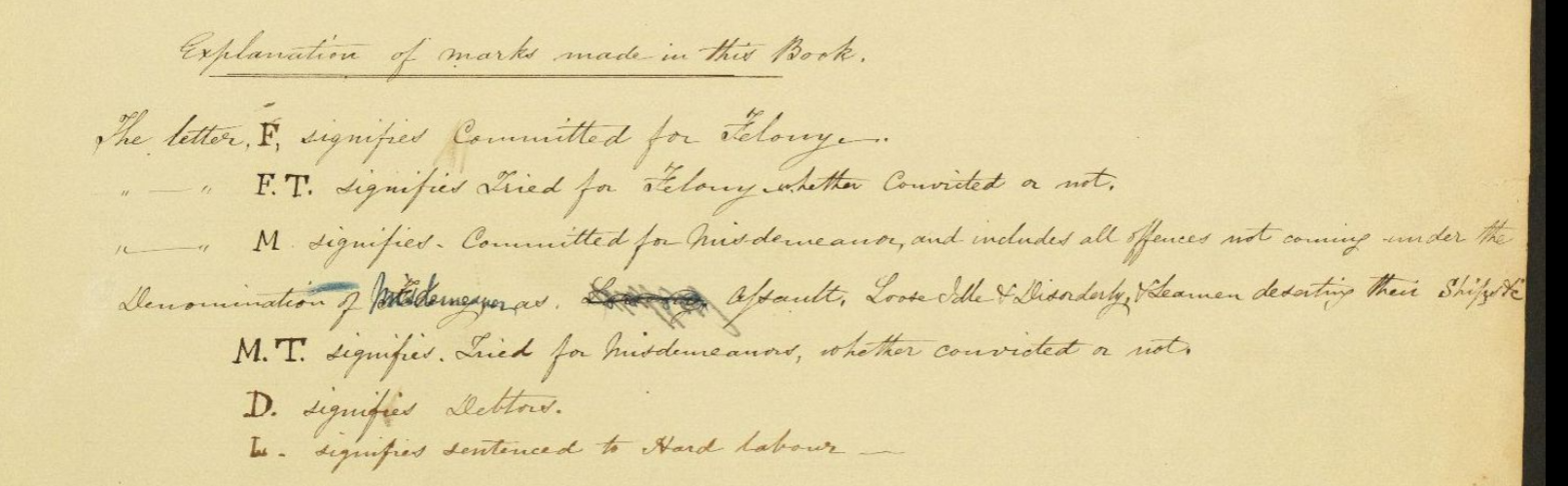
Some of the registers have additional codes, so it's always good to look at the first few pages of the books to see what the codes mean. For instance, here's a legend from P4 Quebec prison prison register (women and men), 1844-1847


Don't forget to look at the names around your ancestor's name. People arrested at the same time and for the same charge may have been friends or relatives, and can offer new avenues of research. Sometimes looking at the other names can give you a pretty good picture of the circumstances surrounding your ancestor's arrest. Take a look at the names and occupations of these people from book P8 Quebec prison prison register (women and men), 1866-1873


 Now if you look at the corresponding arrest details, you get the feeling that maybe a "house of ill repute" was raided.


So what happens if you find your ancestor listed and you want to find out more? BAnQ also holds court records in their collection. These are not online that I could see. Because of COVID, it may not be possible to do an onsite visit. However, BAnQ is still handling research requests. You can make a request through their online form. There are several different facilities around the province. If you know which facility the records you want are located in, then you can also contact that branch. The contact information for each BAnQ facility can be accessed here.