Sunday, 27 September 2020

Newfoundland Ancestors: Directories online at Memorial University

 Newfoundland did not become a province until 1949. However, the first official accounts of Europeans setting foot on Newfoundland goes back to the late 1400's. The historic site L'anse aux Meadows is over 1,000 years old, and attributed to Leif Eriksson. The province is considered England's first overseas colony, going back to Elizabeth the first.

Newfoundland is not in the available national Census records for Canadian research. They do have their own census returns, held onsite at Library and Archives Canada and The Rooms in Newfoundland. You can also view the original images online both at Family Search and at Ancestry for 1921,1935, and 1945. Transcriptions of many years are available at the Newfoundland Grand Banks website. I wrote a previous blog post on their site back in 2018, which you can access here. Directories are a great census substitute. I wrote a previous blog post on a what a great source of information directories can be, which you can read here. Memorial University has digitized several varieties of directories and indexes on their site.

For each of the publications, you view each a page at a time. Use the side bar to go through the pages. You have the option of downloading and/or printing specific pages to your computer.


I've provided links to some of what's available on the site

Directories


Blue Books
These ledgers kept by the Colonial Governors mainly deal with the mundane figures involved in running the colony. However, they also list appointments, and do have some names listed. The University has digitized a large amount of these. These are a few to get you started.

Miscellaneous
  • First four hundred Royal Artillery, 1940 - If your ancestor was one of the first 400 men attested to the two Newfoundland regiments of Britain's Royal Artillery during World War II, you'll want to look at this. It includes the names and addresses of then men, as well as an honour roll.


Sunday, 20 September 2020

Yukon Ancestors: Find your Yukon ancestors with the Yukon & Alaska Geneaology Centre

 One of the drawbacks to Yukon genealogy research is the lack of online record sets. A good site to help your research is YukonAlaska.com

http://yukonalaska.com/pathfinder/gen/


The site has compiled information from the massive 6,000 page database from Murray Lundberg. They have organized the information into several categories. 


Historic Yukon & Alaska Hotels, Roadhouses, Saloons & Cafes Index - Proprietors and Managers

While everyone thinks of the gold rush miners, there were many others who flocked to the Yukon. Some of them made their money by operating establishments that catered to the miners. This alphabetical list of over 1200 names Includes many women, which is exciting to see. Women tend to be left out of historical records if they didn't come from wealthy backgrounds. Each entry gives the name of the establishment they own or ran, location, and years it operated. Some enterprising souls ran more than one. here's a section of the D's that show several people that belonged to more than one venture

http://yukonalaska.com/pathfinder/gen/rhse_ownersDG.html


Index to British Yukon Navigation Company Employment Applications at the Yukon Archives

The British Yukon Navigation Company's River Division built and ran steamer ships, and dominated the traffic of the Yukon river for the first half of the 20th century. This handy index lists all the personnel records held by the Yukon Archives. If you find your ancestor, you can order a copy of the file from the Archives' website

Information that can be found in the employee files can include:

  • age, possibly birth date as well
  • marital status
  • birthplace
  • names and address of parents if living, or next of kin and relationship if parents are deceased
  • years experience in the steam boat industry
  • past injuries, extent and who their employer was at the time
  • work history -includes the ship and line
  • last employer and reason for leaving
  • emergency contact
  • certificates obtained
  • signature
The amount of information you can get from these records make me wish I had a steamboat ancestor. The finding aid from the Yukon Archives states that the occasional record from the Air Division is included in the fonds.


 Ship Passenger Lists

This section lists the passengers on the following ships in 1899
  • Gleaner 
  • Lully C 
  • Ruth
  • Clifford Sifton
They have also provided a link to Explore North's comprehensive lists of vessels that traveled within both Alaska and the Yukon.


The Matanuska Colony: The New Deal in Alaska

This takes you to another page on the Explore North website. It provides a good overview of the history of the Alaskan colony. It also gives the names of the 203 families living in the colony at the time when the draws for land tracts was held. Though this section is not Canadian history per se, there was much travelling between Alaska and the Yukon in the past. It's worth a look if there are gaps in your ancestor's history.

http://www.explorenorth.com/alaska/matanuska_colony.html


Klondike Stampeders

If your ancestor was an American or Australian who got gold fever, you might find them on these lists. There are four lists, compiled from the "Pan for Gold" database at the Dawson Museum in Dawson City, Yukon
  • Klondike Stampeders from Montana (approximately 620 names)
  • Klondike Stampeders from Australia (approximately 260 names)
  • Klondike Stampeders from California (over 4,000 names)
  • Klondike Stampeders from Seattle, Washington (over 4,000 names)
The lists show what checkpoint they came into the Yukon through. You can find out the date and checkpoint. They also have death/departure details for many. For those who died, they list the death date and location. For those who left, they list departure date and address they are going to. A separate group of those who died in the Chilkoot Avalanche in 1897/98 have their own section. here's the list of California 

http://yukonalaska.com/pathfinder/gen/CaliforniaDb.htm


Biographies of Yukon & Alaska Pioneers

This section takes you a series of biographies of people connected to Alaska, the Yukon, and the Arctic in general. Some listed can be as simple as an obituary. Others are extensive, including photos are reference material for further reading. Here's part of the biography for the colorful John Leonard, who was a balloonist in the Yukon in 1899. It even has a photo.
http://www.explorenorth.com/library/bios/leonard-john-balloonist.html


Other Yukon & Alaska Genealogy Resources

This last section contains links to help you further your research. It has links that cover not only Alaska and Yukon, but the Northwest Territories and Nunavut too. 

Sunday, 13 September 2020

BC Ancestors: The Bill Silver Digital Archive

Free online newspaper sites are always a good thing. If your ancestors lived in and around Vanderhoof, British Columbia, you'll want to explore The Bill Silver Digital Archive. Provided free of charge, it is hosted on the Vanderhoof Public Library website.

Bill Silver was a local historian who built a collection from 3 local newspapers
  • The Vanderhoof Herald
  • Nechako Chronicle
  • Omineca Express
After his death, his wife Edith continued the collection until her death in 2003. The collection of weekly newspapers runs from 1917 to 2007. It is the result of a collaboration between the Vanderhoof Public Library and the Vanderhoof Heritage Museum. Simply enter in a search term and you get digital images of the newspaper pages. Just click on the link on the top of the page to get to the search screen.


https://www.vanderhooflibrary.com/my-lists/explore/the-bill-silver-digital-newspaper-archive/


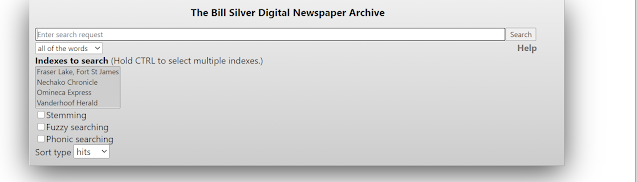
Just type in your search term and hit enter. As you can see below, you can do a more targeted search by paper. You can also adjust your searching method to stemming, fuzzy and/or phonic searching.

 
http://archive.vanderhooflibrary.com/


I used "mcdonald", and got 1140 hits on a general search.  I then tried a phonic search and got over 4000 hits. The search results can be sorted by relevance, newest date or oldest date. You can also print your search results. Just use the tabs on the top right. now, I did find that it sorts by paper first, then year if you're doing a newest or oldest filter. Which means the oldest issues, which are from The Vamderhoof Chronicle, will show up last. My suggestion is to search each paper separately.

http://archive.vanderhooflibrary.com/archive/dtSearch/dtisapi6.dll


Next just click on the link to a particular page and a digital image will open in a new window. That's handy, as you don't lose your results list. The page opens as a PDF that you can download and/or print.

As with any paper on a local level, you can find lots of little tidbits that you don't see in newspapers that are published for a larger audience. Here's some examples of what I found:

Here's some "Local Happenings" from March of 1918


Here's some birth announcements from October 1962 


Here's some items covered during recent Vanderhoof Council meetings in June 2001 


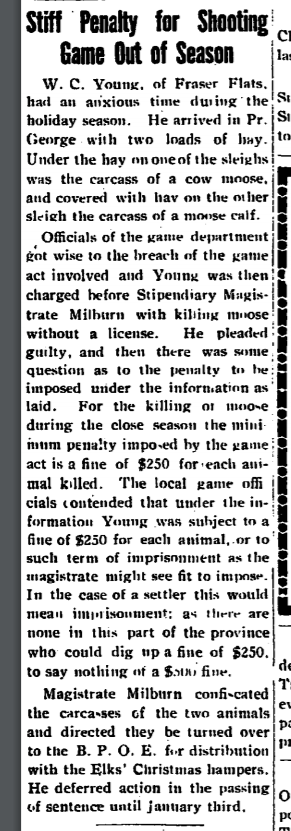
W C Young got into some trouble in December 1934 for shooting game out of season


As a last example, here's an article on the accidental death of Ralph Andros from March 1956


Some tips for using the site:
  • The search capability appears to be OCR technology. Anyone who's dealt with OCR on older newspapers knows it is far from fool proof. So make sure you try all the search options 
  • There is no highlighted boxes for your search words. This means you will have to read the whole page. But that's part of the fun.
  • Because the saving is to PDF, you won't be able to crop like you can with a picture. One suggestion is to make a transcription for yourself if you're printing. Another option is to zoom in on the article in the PDF and then take a photo of the screen with your phone or tablet. Alternately, you can zoom in on the article, and then use a snipping tool to take a screen shot. 
  • Some of the search terms I tried would not give me results in the year ranges I was looking for. But, I found putting in a year, such as "1928" gave me results in the 1920's and 1930's
The searching is a little clunky, compared to other sites. It's still worth looking at in your research though. One improvement to the collection I would like to see is the ability to browse issues. If there is a way to do that I could not find it.


There were several donors involved in getting the collection up and running. You can thank the following for this collection:
  • The Irving K. Barber Learning Centre
  • Vanderhoof Co-op Association
  • Friends of the Library
  • The Bill Silver Family
  • Nechako Valley Historical Society
  • Black Press
  • Rosemary Boyd

Saturday, 5 September 2020

Alberta Ancestors: Issues of University of Alberta's " The Gateway" Online

 Was your ancestor connected to the University of Alberta? Then you absolutely should be looking at the campus publication The Gateway. Still in publication, it was founded in 1910. Best of all, all issues have been digitized and are available online for free!


The publication focuses on issues relevant to students. According to their website, their objective is

  • To sponsor advancement of education of University of Alberta students through the various practices of journalism and the publication of the Gateway.
  • To provide a fair, reliable, and clear source of information, focused mainly, but not exclusively, on issues which directly affect students, whether they are local, national, or international.
The University of Alberta have digitized every available issue from 1910 to present day. You can find them online at two sites.


Peel's Prairie Provinces
This must see website for Western Canada research has all available issues from 1910 to 2008. These are available in PDF form. You can access the main browse page here

http://peel.library.ualberta.ca/newspapers/GAT/


Keyword searching can be done either on the main page to search all issues, or you can keyword search inside a particular issue. Just click on a year, and then a particular issue. The initial pages shown are quite small. However, if you click on the page image, it will reload to a much more readable size. Once you're into the larger size, there is an option to print. 

http://peel.library.ualberta.ca/newspapers/GAT/1910/11/21/6/Ar00600.html


Internet Archive
If you're looking for digitized items, you should always look to see if it's been uploaded to Internet Archive. A search on their site revealed they have over 3500 issues uploaded. They run from 1910 right up to 2020! The link from my search to access all issues is here.
https://archive.org/search.php?query=gateway%20alberta&and[]=mediatype%3A%22texts%22&and[]=subject%3A%22gateway%22


Just click on an issue and you can explore page by page. You can zoom in and out quite easily. Right click on an image to save the whole page and then print. Saving the image allows you to crop on a specific article if needed. Keyword searching can be done in a particular issue.


What's Inside 
So what information can you find? The issues contained news pertaining to the university, and university life. It also included articles on a local, national, and international scale. Pictures are included as well. Even if your ancestor didn't make the publication by name, you'll still get an insight into their academic life. 

Here's a short blurb about a new Science Professor, Dr. Ernest Sheldon, from 1910


Here's and article from 1934 about an upcoming night of boxing matches between the University's Varsity team and Camrose Normal.


Here's some letters to the editor from an issue in 1924


Here's the recipients of academic awards in 1943


Here's some members of the Archery Club in 1956


Here are some ads from 1969 aimed at recruiting upcoming graduates


Here is some club notices and classified ads from 1977


If your ancestor had a business that catered to the needs of students and faculty, then be sure to look at the ads throughout each issue. You might find an ad they placed. For the final example, here are some ads from 1918


I lost a couple of hours looking through the issues just for this post. Set aside some time when you research your ancestor. I can guarantee you'll get sidetracked.

Sunday, 30 August 2020

Saskatchewan Ancestors: "Saskatchewan History" Magazine

 Once you delve into Canadian sources, you'll find that some provinces are absolute gold mines for online records. Saskatchewan is not one of those provinces. It's a combination of the Province's privacy laws and the youth of the Province compared to some others. Only becoming a province in 1905 means there isn't the long history that you see in Provinces like Ontario or British Columbia. Because those essential BMD records aren't as readily available as in a province like Nova Scotia or New Brunswick, those with Saskatchewan ancestry have to be a little more "out of the box" on resources.

This week I found a great resource on Internet Archive that will appeal to both genealogists and history lovers in general. Saskatchewan History is a magazine that was published by the Saskatchewan Archives Board. Internet Archive has issues from 1948 to 1957. It was published 3 times a year. History lovers and those wanting to know what their ancestor's life was like will find it a great read. 


Each issue has articles on different aspects of early pioneer life. The articles are well sourced, complete with citations.In the very first issue (Winter 1948) there is a small article highlighting a problem early settlers had that was unique to the Prairies: readily available water.


 There were also book reviews on the latest history books written about the province. This can give you new avenues of research to track down. Here's a review on Fifty Golden Years. A Brief History of the Order of St. Benedict in the Abbey Nullius of St. Peter, Muenster, Sask (Winter 1955 issue)


And here's a useful article on how Saskatchewan Places got their names (Winter 1950 issue). This section appeared regularly in the magazine


So what about the genealogy side of things? Well, there's plenty of articles focusing on specific people. One section to look at is the Notes and Correspondence section. Very much like today's "Letters to the Editor" section in newspapers and magazines. Here's a example from Winter 1949. Just look at the great extra information in these two letters:


Some issues had profiles on individuals. There's an in depth article on Philip Turner in the Spring 1950 issue. Philip was an inland surveyor.


If you're a descendant of Arthur Rowe Miller, how excited would you be to find his diary transcribed? Here's the first three pages. The article in the Spring 1957 issue is much longer.


In 1952 the Archives Board put out a Pioneer Questionnaire. In the Winter 1953 issue they featured snippets from some of the responses. Here's the page showing some memories of Mr. H. F. Copeland, who came from England in 1910.


Click here to access all the issues on Internet Archive.


As I was about to upload this post, I realized that the Provincial Archives of Saskatchewan has digitized the entire run of the magazine from 1948 to 2017. Each entire issue can be downloaded as PDFs. They also have a PDF list of all the featured articles. You can get the links for each on the Archives' website.

There are advantages and disadvantages to both sites. The Provincial Archives has the complete run. However, you will have to download the entire issue. With Internet Archive you can have the ability to download specific pages. You do this by right clicking on the page and saving as a jpeg. Either way, if you have Saskatchewan ancestors, you'll want to take a look at this resource.


Saturday, 22 August 2020

Banking Ancestors and WWI on Canadiana

 Sometimes you find the most interesting things on Canadiana. I stumbled across a unique resource today that had to do with employees of what is now the CIBC during World War I. From 1915 to 1919, the Canadian Imperial Bank of Commerce published 11 pamphlets titled LETTERS FROM THE FRONT - Being a partial record of the part played by officers of the Bank in the Great War. Canadiana has all 11 volumes digitized. According to the pamphlets, by volume 11 in January 1919, a total of 1709 employees had served in the War, with 226 losing their lives. 

The pamphlets are a bonus to those with ancestors who worked with the Bank. Each issue listed every member serving. The information from the pamphlets were taken from letters by the soldiers to other employees. Family and friends of those serving also passed information along to the Bank to include in the series. 

Each issue listed all employees who have served as of publication. These were anyone from the lowest ranks to bank executives. Here's an example from Volume 2, showing name, rank, and CIBC branch


After the preface, the first section of each issue is the Honour Roll section, showing those who had died in the War up to that issue. By Volume 3 in late 1915, the Honour Roll was already growing. It lists name, rank, CIBC branch, date of death and cause of death.


The next section listed Casualties. This was further divided into subsections:

  • Wounded
  • Missing
  • Prisoners of War
  • Ill
Here's the some of the wounded as of Volume 4, which was published early 1916


Here's the Missing, POWs, and Ill soldiers from Volume 6, later in 1916


What I find are interesting is the extra information you can find here. In the Prisoners section, it tells you were they are being kept as a P.O.W. In the Ill section, you can in some cases see the cause of illness. As with other sections, you get name, rank, contingent/enlistment information, and the CIBC branch they belong to. Those researching Corp DA Wilson would find the fact that he enlisted in England a handy bit of information.

The best section though is the last section of the pamphlets, called Notes. Here they give specific information on soldiers. The information includes excerpts of letters written by soldiers, as well as Military dispatches. And what great information they have for those lucky enough to have an ancestor listed. I'm a little jealous, to be honest. 

Look at what was written about Mr. C S Cameron, who worked at the Fernie, British Columbia branch. This was from Volume 7 in July 1916


H.G. Murray was the lone survivor in a blast, from Volume 9 


The last section of the pamphlets are titled Letters from Bank Officers at the Front. This awesome section has whole excerpts of letters from the soldiers themselves. 

Here's an entry for nursing sister H V Petrie, who worked for the CIBC at the offices overseeing Western Canada


Here's an interesting one from Dr. Crozier, of Port Arthur. The letter was submitted by the brother of Dr. Crozier's partner in his medical practice. The brother was a Halifax branch manager


And here's one more example from V E McLeod, who worked at the Windsor, Nova Scotia branch


Remember that the CIBC had branches outside of Canada, and they made a point to include these employees as well in the publications. Here are the links to each individual volume on Canadiana: