Sunday, 14 June 2020

Manitoba Ancestors: Parish Records on Canadiana

This weekend while looking for online record sets for Manitoba, I stumbled across three microfilms of Parish records on Heritage, a sister site to the free site Canadiana.

For those unfamiliar, Canadiana is a huge digitization project to provide free access to newspapers, serials, books and government publications. It's sister site Heritage is free access to digitized microfilms held mainly by Library and Archives Canada. They are constantly adding to the site, so I like to periodically delve into it to see what I can find. I'm never disappointed.

All three rolls are under the heading Parish registers: Manitoba. The three microfilm numbers are H-1344, H-1812, and H-1813.


H-1344
This microfilm consists of index cards compiled by Clarence Kipling. According to Library and Archives Canada's website, the collection contains about 4,000 index cards of records from the churches of the Red River Settlement. The microfilm however, shows over 5,000 images. The reason for this is that there is part of a second set of index cards at the tail end of the reel. These index cards are finding aid cards made by the LAC for the collection. The Kipling index cards end at image 4301. The Kipling cards are arranged alphabetically by surname. They give person's name, and the baptism  during that person's life. This is the scope and content of the collection, according to the LAC website:

"...The series consists of approximately 4,000 cards prepared by Clarence Kipling from the parish registers of the Red River Settlement: St. John's Anglican Church, 1820-1884; St. Andrew's Anglican Church, 1835-1884; and St. Boniface Roman Catholic Church, 1824-1834. The entries for St. John's Anglican Church include marriages for 1820-1878 and 1881-1882; and deaths for 1821-1823, 1825-1838, and 1841-1875. The entries for St. Andrew's Anglican Church include marriages for 1835-1876 and 1878-1883; and deaths for 1835-1876 and 1878-1884. The entries for St. Boniface Roman Catholic Church include baptisms for 1824-1825, 1829-1830, and 1832-1834; and marriages and deaths for 1825, 1828-1830, and 1832-1834. Library and Archives Canada does not hold the original registers to which this index relates, but the index cards contain transcripts of the information supplied by the registers. The cards originally numbered about 3,100 but additional cards were made for brides (who were not originally noticed separately from the bridegroom) and for any cards which contained multiple entries. The index cards were removed from the LAC reference room in 2009 for digitization, and vault storage in four containers: R4084, volumes 1 to 4. The cards are filed in alphabetical order: volume 1 holds surnames A to F, volume 2 holds surnames F to M, volume 3 holds surnames M to S, and volume 4 holds surnames S to Z...." https://collectionscanada.gc.ca/pam_archives/index.php?fuseaction=genitem.displayItem&rec_nbr=115305&lang=eng&rec_nbr_list=115304,115306,115305

Some of the cards are typed, while others are handwritten. They can contain quite a bit of information. Here's one for Angelique Zoste, baptized 10 June 1832


Here's the marriage of Elizabeth Slater to John Vincent 26 March 1863


And here's the burial of James Cowley on 13 Feb 1849


H-1812
This microfilm has 4 sets of parish records. I'm only going to concentrate on the first two.


The Winnipeg District images are a hodge podge of records from different churches. Unfortunately, the images are not of the best quality, but are still readable.


The Holy Ghost Parish collection is fascinating. The parish is the oldest Polish Roman Catholic parish in Western Canada. Included in the collection are baptismal certificates issued in Eastern Europe. If your immigrant ancestor was in this parish, what a fantastic find for you!


H-1813
This microfilm deals with the work of the Rev. James S Stewart, a Presbyterian missionary. The microfilm contains not only BMD's from his Manitoba ministry. This microfilm also gives some great insight into the life of a missionary in the late 1800's. It contains his notes from seminary schooling, and other little bits of the mundane in his professional work. If you wanted an insight in what a missionary's life was like, then it is quite informative. If you looking only for BMD information, then you'll want to concentrate on images in the last half of the roll. There are financial sheets as well, naming individual parishioners.


Sunday, 7 June 2020

Ontario Ancestors: Roman Catholic Church Records on Family Search

Those of us with Catholic ancestors in Canada may not always appreciate how lucky we are when it comes to online research. Compared with other religious sects, there's an amazing amount of church records already online. If your Catholic ancestors came from Quebec and the Maritimes, then you are no doubt very familiar with the Drouin collection. This huge collection of digitized church records are easily accessible through several different providers. However, Catholics from Ontario are somewhat left out of the party. The records for Ontario are usually scattered among Quebec records, or behind pay walls of subscription sites. But Family Search has a browse only collection on their site. Because it is a browse only collection, it does not appear in searches. As such, if you were unaware of it, you would be missing a great resource. The collection, Ontario, Roman Catholic Church Records, 1760-1923, contains over 125,000 images. Each parish has varying years within the title's time frame.

https://www.familysearch.org/search/collection/1927566


The collection is very easy to navigate. First, select a County:
  • Algoma
  • Brant
  • Cardwell
  • Carleton
  • Carleton, Lanark
  • Cochrane
  • Dufferin
  • Dundas
  • Durham
  • Elgin
  • Essex
  • Frontenac
  • Grenville
  • Haldimand
  • Hastings
  • Huron
  • Kenora
  • Kent
  • Lambton
  • Lanark
  • Leeds
  • Lennox and Addington
  • Lincoln
  • Manitoulin
  • Middlesex
  • Muskoka
  • Nipissing
  • Norfolk
  • Northumberland
  • Ontario
  • Oxford
  • Parry Sound
  • Peel
  • Perth
  • Peterborough
  • Prescott
  • Prescott and Russell
  • Rainy River
  • Renfrew
  • Russell
  • Simcoe
  • Sudbury
  • Thunder Bay
  • Timiskaming
  • Victoria
  • Welland
  • York
If you're having trouble knowing which County your ancestor came from, then the Canadian County Atlas Digital Project through McGill University can help you to pinpoint which Counties to look at.

Next, pick a City or Town. Here's a screen shot of Frontenac County

After that, pick a parish. This is what comes up for Toronto in York County


Finally, pick a section. This is St. Francis of Sales parish in Smith's Falls, Lanark County

So, what information can you find from Catholic Church records?

Baptisms
  • Date of baptism
  • Date of birth
  • Child's name
  • Parents' names
  • Residence
  • Father's occupation
  • Godparents/Sponsors' names
Here's an example  of baptisms from St. Peter's Cathedral in London, Middlesex County dated for May and June 1843


Marriages
  • Bride and Groom's names
  • Groom's occupation
  • Bride and Groom's marital status
  • Parents' names
  • Residences and/or Birthplaces
  • Ages
  • Witnesses
  • Date of Marriage
Here's an example of a marriage from St. Jacques in Embrun, in Prescott and Russell


Burials
  • Date of death
  • Date of Burial
  • Residence
  • Age
  • Cemetery
  • Names of immediate family
  • Witnesses
Here's an example of an interesting entry from 1909. It was from the registers of St. Mary's in Woodstock, Oxford County.


Sometimes in an entry for one event, you'll get a bonus notation about a subsequent event. Here's an example of a baptism entry that also has a notation of her subsequent marriage in another parish.


Some things to keep in mind when looking at the records:
  1. The language can be in English, French, Latin, or any combination of the three. 
  2. Take notes of witnesses and sponsors. These could lead to extended family relationships.
  3. A baptism may not have occurred immediately after birth, though this was the Catholic custom. Sometimes circumstances, such as extremely large parish boundaries, meant that the baptism could take place months or even years after the birth. A good indicator of this reason is multiple children getting baptized on the same day.
  4. As with baptisms, burial services sometimes did not happen immediately after death. A good example of this is deaths that took place in winter. Sometimes it wasn't until the following spring that burial took place.
  5. Make sure you are looking at the first pages in the microfilm. Many of the parishes I looked at had indexes at the start of the microfilm roll. This could save you a lot of time if you look through the index first.

The Family Search Viewer lets you manipulate the images in several ways for maximum viewing. You can download the whole page to your computer as a image, and also print the entire page off. I like to download a page, and then use photo editing to zoom in on a specific entry. I then save that image as a separate file.


Sunday, 31 May 2020

Quebec Ancestors: Notarial Records on Family Search

Sometimes as a genealogist you're forced to pick and choose what sites and societies you subscribe to.  If you're someone like myself, whose ancestry stretches across several regions and cultural groups, then it can be really difficult to stretch those genealogy dollars to get what you need. My personal ancestry covers PEI, Nova Scotia, New Brunswick, Quebec and Ontario. Recent DNA discoveries have me now looking into New York State as well. I have Acadian and French Canadian ancestry. I also have French Protestant, German, British, Scottish and Irish immigrants from the early 1700's right up to the early 20th Century. For me, subscribing to every pay site I need to further my lines amounts to more than my genealogy dollars can afford. Any time I come across a free database to further my research, I jump on it. One such database is Family Search's browse only database Quebec Notarial Records, 1800-1920.

Quebec is unique in several respects to the other provinces of Canada. It is an intriguing combination of  French and English law. When it comes to civil matters, they follow the laws of France. As such, the Quebec notary had a much bigger role and presence in the everyday life of the average person than other provinces. Because of their unique role in Quebec society, the records of notaries contain the type of information genealogists get giddy for. Among their responsibilities were:

  • Marriage contracts
  • Wills
  • Deeds
  • Inventories
  • Agreements and settlements
  • Transfers of property
  • Donations (pre-wills)
  • Legal documents
  • Guardian records
  • Indenture records
The records are for the most part in French. Those familiar with French Canadian records know that neat handwriting was NOT a prerequisite for becoming a scribe. It can be a real challenge sometimes, especially if your grasp of French is not the best. But Family Search provides some great guides in helping those not proficient
There are almost 5 MILLION images in the collection. But don't worry, you can narrow things down fairly quickly for browsing.  You are going to need a location and year range for your ancestor. First, you need to narrow by judicial district
https://www.familysearch.org/search/image/index?owc=https://www.familysearch.org/service/cds/recapi/collections/1471015/waypoints
Once you pick your district, then you pick by Notary Name/Record Type/Year Range/File Number Range. Then just start browsing. As always with Family Search, the images are nice and clean. The image viewer lets you zoom in and out. You can adjust the image by clicking on the tools icon. This will let you rotate the image, and adjust brightness and contrast. You can even invert the image so that the background is dark and writing is white. This can be a handy tool sometimes when dealing with faded handwriting. You can download and/or print as well.

So, what are the kinds of images you can see? Well, here's a sale contract from 1923 in Chicoutimi

Here's part of a will from Montreal in 1878. This one is in English.

Here's a Labour Contract, involving the Hudson's Bay Company, from 1837 in Terrebone

And here's a Marriage Contract from 1903 in Hull


Here are a couple of links that can also help in your research

Saturday, 23 May 2020

Newfoundland Ancestors: Newspapers and Magazines on Canadiana

One of the downsides to having Newfoundland ancestors is the lack of original sources online. If you have to research from a distance, it can be more challenging than some of the other provinces. Again, Canadiana comes to the rescue. On their site are several newspapers and magazines.

The problem with Canadiana is that there is so much there, it can be hard to find what you want. This week I'm providing links to the newspapers and magazines available. Canadiana gives you the ability to zoom in and out, and download individual pages to your computer. The pages download as PDFs. Alternately, by right clicking on the image and saving, it will save the whole page as a JPEG. Then you can use your photo software to crop in on individual articles.


The Star and Newfoundland Advocate: Available issues: 2

The available issues is a bit of a misnomer. It is 2 microfilms. One microfilm covers from 14 November 1840 to 28 December 1843. The second covers from 11 January 1844 to 14 January 1847.

A Protestant conservative leaning newspaper, it featured both local and foreign news. It was geared towards businessmen. Among the images you'll find news on shipping, government, and agriculture. It was also heavy on advertisements and notices. Here's one about the new packet boat, The Edmund Phelan


The Newfoundland magazine: Available issues: 5

The five issues cover the year 1900. It was filled with both fictional stories and memories of Newfoundland life. The ads are a treat to look at as well.


Newfoundland monthly messenger: Available issues: 36

A religious newspaper, there are 12 issues each for the years 1876-1878. It consists mainly of articles of religious instruction. No publication can exist without advertisers, so of course there are advertisements as well. But here and there are news items and obituaries. Here are ones for Mrs. George Cook, and Miss. Mary Langmead from 1876.


The collegian: Available issues: 5

Covering the year 1897, this publication was aimed at Methodist schools. It is interesting in that it lists faculty and students in the publication. Here's a list of the 10 best exam remarks in various classes. It even shows the score for some. A nice little insight into your ancestor's academic achievements!


The Conception-Bay man: Available issues: 100

Covering from 1856-1859, this publication was the liberal leaning counterpart to The Star and Newfoundland Advocate. It's content was also geared towards the merchant class. Here's a rather interesting notice. It seems someone had been going around racking up debts in this man's name


Mail and Advocate: Available issues: 1

Only 1 microfilm covering December 1916.This publication was the "Official Organ of the Fishermen's Protective Union of Newfoundland". As to be expected from the date, it is mainly filled with news about World War I. I did find a notice of Contributions to the Cot Fund from Herring Neck


Evening Advocate: Avaliable Issues:29

Covering from 1917-1924, this newspaper was a sister paper of the Mail and Advocate. One of the more interesting notices I found was about unclaimed mail at the post office. It gives an alphabetical listing of all mail not yet claimed. You can definitely tell that this was in a time before concerns of privacy and identity theft!


The Daily Mail: Available issues: 90

Another great newspaper find. The issues run from January to April 1914. Rather than a trade newspaper, this publication had something for everyone. One of the interesting things I found was this list of crew from the Sealer Newfoundland. A huge storm took the fishing fleet unawares. The entire front page of this issue was devoted to the men and ships feared lost.


These publications are just a sampling of what I found in a quick search. There were many, many more publications in the results.

Monday, 18 May 2020

British Columbia Ancestors: Historical BC Government Gazette Online

Government Gazettes are a great resource. During the early years of Canada, these publications gave information on many aspects of the lives of our ancestors. They had notices of divorces, bankruptcies, and business dealings, just to name a few. I've written before on the Canada Gazette, the publication of the federal government. But provincial governments publish their own versions.I've found 3 online sources for free digitizations.


University of Victoria
Their collection, Official Gazettes of the Province of British Columbia, contains 715 issues. The issues run from 1863 to 1871, before it became a Canadian Province.

https://vault.library.uvic.ca/collections/d9265b4b-b757-4508-bc7d-85bd3ae91ddc?locale=en
The set up is extremely easy to use. They are by default listed by date created ascending, but you can modify the list to

  • date created descending
  • title ascending
  • title descending
  • relevance
  • date modified ascending
  • date modified descending
Just pick a year and issue and click on the image to have it open to browse page by page. My suggestion if using this method is to right click on the issue title and open the issue in a new window. It will make it much easier on yourself than constantly using the back arrow to go back to the main page.

If your searching for something specific, use the search bar located just above the issues list to search by keyword. This will then give you a list of issues with your keyword. It does not however, highlight the keyword within the issue itself.

Once you're looking at a particular issue, you can zoom in and out by using your mouse. You can also full screen the issue. To save, you can download or print the whole issue. 


University of British Columbia
Their collection of digitized directories has duplicates of the ones that UVic has, but also later editions up to 1882. The ones on this site have an entire year in book form. Just click on the volume and it will take you into the image viewer. As with the UVic's collecton, I would suggest opening in a new tab for ease of browsing volumes. You can search within each volume sing the search bar, or you can browse page by page. If you use the search function, the result will first highlight a page within the volume for your keyword. It will then highlight the word itself.


As with UVic's collection you can manipulate the image. You can also download individual pages to your computer. 


Internet Archive
Lastly, Internet Archive has a huge amount of years on their site in the collection Official Gazettes of the Province of British Columbia. They have various years from the start of the colony up to 1974. A good chunk of them are not tagged with a date. You can search within specific volumes with keywords. You can zoom in and out. To save a specific page, right click on the image, and then on Save image as. There is no way to print directly from the site.


So, what can be found in these issues? Here's a list of Road Tax Defaulters from 1870:


And here's a notice from 1868 looking for information on who shot John Crocket, alias Crosby. They are offering a $100 reward. That's quite a large sum back then.


And in August of 1864, there is a very lengthy account of the Bentick Arm Expedition. It runs for several pages


Here's some estate notices from 1879


And here's a Register of Medical Practitioners from 1873


Here's some notices of intention to purchase land from 1882


Here's some about Coal Prospecting Licences in 1911


Saturday, 9 May 2020

Alberta Ancestors: Digital Directories on Canadiana


I can't stress enough how important it is to have Canadiana bookmarked on your internet browser. This fantastic free resource has a massive amount of digitized material relating to Canada. While looking for inspiration for my blog post this week, I used the following search term in the main search box:

"Alberta" AND "directory"


When you think "directory", the first thought is City/County directories. These are a great resource, but I wanted to find more "out of the box" results. As usual, Canadiana did not disappoint with unusual material.

Directory of poultry breeders of Alberta, 1918
If your ancestor was in the poultry industry, then this one's for you. Like a regular directory, it has listings with addresses of anyone involved in the industry. It also has advertisements like these ones:


Here's the recent winners of trophies from the Alberta Provincial Poultry Association


Calgary, Alberta, Canada, her industries and resources
This is great resource if your ancestor owned a business in Calgary. Along with the usual advertisements, there are also short sketches of the businesses and owners. Here's one about the local laundry owner, John Dean


Some are longer entries, giving some great details. Look at this lengthy one for George Murdoch


Opportunities in Alberta, 1916
This is one of a series of publications. Their purpose was to entice people to come and settle in the province. They gave overviews of the province as a whole in terms of land and employment opportunities. They also gave details about districts and towns. If you were wanting information on what your ancestor's community was like, these are a good resource. Here's the snippet on what the community of McLeod, Alberta


Henderson's northwest brand book (1889)
If your ancestor was a rancher, you might want to look at this. Each ranch listed describes their brand and where on the animal it is located. Some even have a visual to help


Even better, at the back of the book is a reverse index, showing the brands. You could then go to the page reference and find the ranch it belongs to.


Digest Western law reporter, vols. 1 to 24, Territories law reports vols. 1 to 7 : and the official reports for the provinces of Alberta, British Columbia, Manitoba and Saskatchewan, concurrent with the W.L.R., together with a collection of other cases of special interest to Western Canada / compiled by Thomas T. Rolph and Walter E. Lear
This is an interesting one! If your ancestor was involved in a legal case before 1915, you'll want to look at this. The front of the book lists court cases alphabetically. Look for your case name, and then use the column numbers listed to find the case details


These are just a few examples. While you're at it, also check these links that popped up in the results


Sunday, 3 May 2020

Saskatchewan Ancestors: Medical Journals on Canadiana

Every now and again I like to randomly search the website Canadiana, just to see what pops up. For those who don't know, Canadiana, and it's sister site Heritage, are free sites. They have an incredible amount of documents digitized. They run the gamut of official government records and correspondence relating to immigration, agriculture, wars, and settlement of the west, to name a few. They also have non government books, magazines, and periodical. You never know what you might find.

One of the drawbacks to both sites is that unless you are very specific with your key words, you can get lost in the results. They have recently revamped both sites, and it's a fantastic look. It appears they have attempted to stream line things a bit as well. But part of the fun of just using broad keywords in your search is that you may in fact stumble across a record set you didn't even know existed. Such was the case when I used the keyword Saskatchewan on Canadiana. As to be expected, I got over 30,000 hits. But one that caught my eye was the Saskatchewan Medical Journal. Canadiana has 16 issues digitized. There are 4 issues from 1909, and 12 for 1910. If your Saskatchewan ancestor was a doctor during these years, you'll want to check the issues out.

http://www.canadiana.ca/view/oocihm.8_05218_1/2?r=0&s=1

The Journal of course has articles that would probably interest only medical professions. Much the same as the The New England Historical and Genealogical Register wouldn't be of much interest to anyone outside of our community. But hidden among the pages are still some gems. The Personals and News sections give little snippets about the medical community, much the same as an About Town section of a local newspaper.

http://www.canadiana.ca/view/oocihm.8_05218_8/31?r=0&s=1

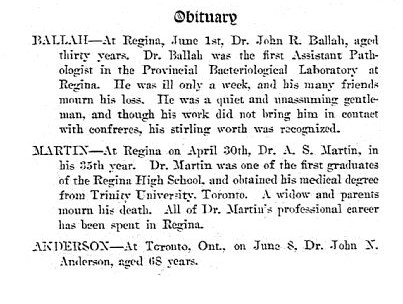
There's also an Obituary section

http://www.canadiana.ca/view/oocihm.8_05218_3/36?r=0&s=1


And here's the Officers and Committee Members of the Saskatchewan Medical Association

http://www.canadiana.ca/view/oocihm.8_05218_1/3?r=0&s=1


And here's a letter to the editor:

http://www.canadiana.ca/view/oocihm.8_05218_11/33?r=0&s=1


As you can see from the examples above, these Journals included news and articles from across Canada, and the world. It stands to reason not to leave out medical journals from other areas of Canada as well while you're searching. Canadiana has the following available on their site: