Monday, 18 May 2020

British Columbia Ancestors: Historical BC Government Gazette Online

Government Gazettes are a great resource. During the early years of Canada, these publications gave information on many aspects of the lives of our ancestors. They had notices of divorces, bankruptcies, and business dealings, just to name a few. I've written before on the Canada Gazette, the publication of the federal government. But provincial governments publish their own versions.I've found 3 online sources for free digitizations.


University of Victoria
Their collection, Official Gazettes of the Province of British Columbia, contains 715 issues. The issues run from 1863 to 1871, before it became a Canadian Province.

https://vault.library.uvic.ca/collections/d9265b4b-b757-4508-bc7d-85bd3ae91ddc?locale=en
The set up is extremely easy to use. They are by default listed by date created ascending, but you can modify the list to

  • date created descending
  • title ascending
  • title descending
  • relevance
  • date modified ascending
  • date modified descending
Just pick a year and issue and click on the image to have it open to browse page by page. My suggestion if using this method is to right click on the issue title and open the issue in a new window. It will make it much easier on yourself than constantly using the back arrow to go back to the main page.

If your searching for something specific, use the search bar located just above the issues list to search by keyword. This will then give you a list of issues with your keyword. It does not however, highlight the keyword within the issue itself.

Once you're looking at a particular issue, you can zoom in and out by using your mouse. You can also full screen the issue. To save, you can download or print the whole issue. 


University of British Columbia
Their collection of digitized directories has duplicates of the ones that UVic has, but also later editions up to 1882. The ones on this site have an entire year in book form. Just click on the volume and it will take you into the image viewer. As with the UVic's collecton, I would suggest opening in a new tab for ease of browsing volumes. You can search within each volume sing the search bar, or you can browse page by page. If you use the search function, the result will first highlight a page within the volume for your keyword. It will then highlight the word itself.


As with UVic's collection you can manipulate the image. You can also download individual pages to your computer. 


Internet Archive
Lastly, Internet Archive has a huge amount of years on their site in the collection Official Gazettes of the Province of British Columbia. They have various years from the start of the colony up to 1974. A good chunk of them are not tagged with a date. You can search within specific volumes with keywords. You can zoom in and out. To save a specific page, right click on the image, and then on Save image as. There is no way to print directly from the site.


So, what can be found in these issues? Here's a list of Road Tax Defaulters from 1870:


And here's a notice from 1868 looking for information on who shot John Crocket, alias Crosby. They are offering a $100 reward. That's quite a large sum back then.


And in August of 1864, there is a very lengthy account of the Bentick Arm Expedition. It runs for several pages


Here's some estate notices from 1879


And here's a Register of Medical Practitioners from 1873


Here's some notices of intention to purchase land from 1882


Here's some about Coal Prospecting Licences in 1911


Saturday, 9 May 2020

Alberta Ancestors: Digital Directories on Canadiana


I can't stress enough how important it is to have Canadiana bookmarked on your internet browser. This fantastic free resource has a massive amount of digitized material relating to Canada. While looking for inspiration for my blog post this week, I used the following search term in the main search box:

"Alberta" AND "directory"


When you think "directory", the first thought is City/County directories. These are a great resource, but I wanted to find more "out of the box" results. As usual, Canadiana did not disappoint with unusual material.

Directory of poultry breeders of Alberta, 1918
If your ancestor was in the poultry industry, then this one's for you. Like a regular directory, it has listings with addresses of anyone involved in the industry. It also has advertisements like these ones:


Here's the recent winners of trophies from the Alberta Provincial Poultry Association


Calgary, Alberta, Canada, her industries and resources
This is great resource if your ancestor owned a business in Calgary. Along with the usual advertisements, there are also short sketches of the businesses and owners. Here's one about the local laundry owner, John Dean


Some are longer entries, giving some great details. Look at this lengthy one for George Murdoch


Opportunities in Alberta, 1916
This is one of a series of publications. Their purpose was to entice people to come and settle in the province. They gave overviews of the province as a whole in terms of land and employment opportunities. They also gave details about districts and towns. If you were wanting information on what your ancestor's community was like, these are a good resource. Here's the snippet on what the community of McLeod, Alberta


Henderson's northwest brand book (1889)
If your ancestor was a rancher, you might want to look at this. Each ranch listed describes their brand and where on the animal it is located. Some even have a visual to help


Even better, at the back of the book is a reverse index, showing the brands. You could then go to the page reference and find the ranch it belongs to.


Digest Western law reporter, vols. 1 to 24, Territories law reports vols. 1 to 7 : and the official reports for the provinces of Alberta, British Columbia, Manitoba and Saskatchewan, concurrent with the W.L.R., together with a collection of other cases of special interest to Western Canada / compiled by Thomas T. Rolph and Walter E. Lear
This is an interesting one! If your ancestor was involved in a legal case before 1915, you'll want to look at this. The front of the book lists court cases alphabetically. Look for your case name, and then use the column numbers listed to find the case details


These are just a few examples. While you're at it, also check these links that popped up in the results


Sunday, 3 May 2020

Saskatchewan Ancestors: Medical Journals on Canadiana

Every now and again I like to randomly search the website Canadiana, just to see what pops up. For those who don't know, Canadiana, and it's sister site Heritage, are free sites. They have an incredible amount of documents digitized. They run the gamut of official government records and correspondence relating to immigration, agriculture, wars, and settlement of the west, to name a few. They also have non government books, magazines, and periodical. You never know what you might find.

One of the drawbacks to both sites is that unless you are very specific with your key words, you can get lost in the results. They have recently revamped both sites, and it's a fantastic look. It appears they have attempted to stream line things a bit as well. But part of the fun of just using broad keywords in your search is that you may in fact stumble across a record set you didn't even know existed. Such was the case when I used the keyword Saskatchewan on Canadiana. As to be expected, I got over 30,000 hits. But one that caught my eye was the Saskatchewan Medical Journal. Canadiana has 16 issues digitized. There are 4 issues from 1909, and 12 for 1910. If your Saskatchewan ancestor was a doctor during these years, you'll want to check the issues out.

http://www.canadiana.ca/view/oocihm.8_05218_1/2?r=0&s=1

The Journal of course has articles that would probably interest only medical professions. Much the same as the The New England Historical and Genealogical Register wouldn't be of much interest to anyone outside of our community. But hidden among the pages are still some gems. The Personals and News sections give little snippets about the medical community, much the same as an About Town section of a local newspaper.

http://www.canadiana.ca/view/oocihm.8_05218_8/31?r=0&s=1

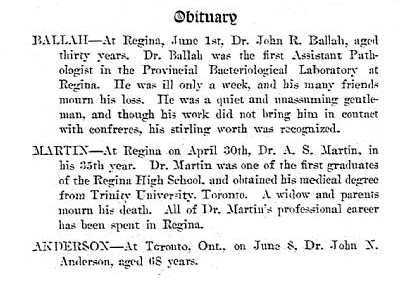
There's also an Obituary section

http://www.canadiana.ca/view/oocihm.8_05218_3/36?r=0&s=1


And here's the Officers and Committee Members of the Saskatchewan Medical Association

http://www.canadiana.ca/view/oocihm.8_05218_1/3?r=0&s=1


And here's a letter to the editor:

http://www.canadiana.ca/view/oocihm.8_05218_11/33?r=0&s=1


As you can see from the examples above, these Journals included news and articles from across Canada, and the world. It stands to reason not to leave out medical journals from other areas of Canada as well while you're searching. Canadiana has the following available on their site:


Sunday, 26 April 2020

Newfoundland Ancestors: Online Newspapers at Memorial University of Newfoundland

I'm always on the lookout for online newspaper sites. Especially free ones. Recently while doing some housekeeping on my internet bookmarks, I found one from Memorial University of Newfoundland of their online collection of newspapers.

http://collections.mun.ca/cdm/landingpage/collection/cns_news

This collection is part of their Digital Archives Initiative. The site claims that this only comprises of a small part of their off line collection. Here's hoping they will add to it. Right now, they have the following titiles:

Banner of Temperance Jan. 18, 1851 - Dec. 6, 1851 (12 issues)


  • The Carbonear Herald and Outport Telephone - Carbonear Herald and Outport Telephone, May 22, 1879 - Feb. 17, 1882. (120 issues), Carbonear Herald and Railroad Journal, Mar. 17 - Aug. 26, 1882. (5 issues)
  • The Conception-Bay Man Sep. 3, 1856 - Feb. 16, 1859 (100 issues)
  • The Confederate Volumes 1..14 for Apr. 7 - July 16, 1948. (14 issues)
  • The Daily Globe Daily (except Sunday), Dec. 16, 1924 - Apr. 26, 1926. Three times a week, Apr. 29 - June 5, 1926. (298 issues)
  • The Daily Tribune - Daily Tribune Nov. 4, 1892 - Dec. 2, 1893; (272 issues), Tribune Dec. 6-30, 1893. (5 issues)
  • The Enterprise Oct. 21, 1896 - Nov. 3, 1897 (103 issues)
  • Fishermen's Advocate Published Coakerville, St. John's and Port Union N.L 1910-1980 (5 issues)
  • The Independent Volumes 1..14 Mar. 22 - July 15, 1948 (14 issues)
  • The Mercury And General Advertiser Feb. 3, 1846 - Oct. 15, 1846 (28 issues)
  • Morning Advertiser and Shipping Gazette Sep. 21, 1844 - Apr. 26, 1845 (109 issues)
  • Morning Despatch. Published St. John's N.L. Jul. 13, 1892 - Aug. 22, 1892 (32 issues)
  • The Morning Herald Nov. 28, 1879 - Feb. 21, 1880 (54 issues)
  • The Newfoundland Commercial Journal Jun. 22, 1881 - Dec. 8, 1855 (69 issues)
  • Newfoundland Mercantile Journal Earliest issue located: Sept. 11, 1816 (no. 108). - Last issue located: June 7, 1827 (376 issues)
  • The Newfoundland Vindicator Jan. 2, 1841 - May 14, 1842 (69 issues)
  • The Newfoundland Weekly - Newfoundland Weekly, Began publication: Jul. 19, 1924. - Last issue located: Jan. 9, 1932, The Newfoundland Times, Began publication: Sep. 6, 1941. - Last issue located: Dec. 20, 1941, The Newfoundland Weekly, Began publication: Dec. 7, 1940. - Last issue located: Aug. 23, 1941.
  • The Newfoundlander. Oct. 6, 1934 - Dec. 20, 1934 (10 issues)
  • Our Country Aug. 25, 1883 - May 11, 1885 (152 Issues)
  • The Plaindealer Published St. John's N.L. Jun. 1, 1907 - Aug. 16, 1921 (29 Issues)
  • The Record Jan. 18, 1862 - Dec. 29, 1863 (94 Issues)
  • The Register Sep. 17, 1880 - Dec. 16, 1880 (70 Issues)
  • The Reporter Jan. 31, 1856 - Dec. 25, 1856 (47 Issues)
  • Sentinel and Conception Bay Advertiser - Sentinel and Conception Bay Advertiser Oct 27, 1836 – Jul 20, 1837 and Dec 13, 1838 - Nov 19, 1844. (148 issues), The Carbonear Sentinel And Conception Bay Advertiser July 27, 1837 - Nov. 29, 1838. (26 issues), The Sentinel, Mar. 13, 1945 - Oct. 30, 1845. (12 Issues)
  • The Star And Conception Bay Weekly Reporter Feb. 4, 1874 - May 6, 1875 (39 Issues)
  • The Star And Newfoundland Advocate Nov. 14, 1840 - Jan. 14, 1847 (295 Issues)
  • St. John’s Free Press and Semiweekly Advertiser - The St. John's Free Press And Daily Advertiser Apr. 9, 1877 - May 29, 1877 (37 Issues), The St. John's Free Press And Semi-Weekly Advertiser Jun. 11, 1877 - Jul. 22, 1878 (46 Issues)
  • Terra Nova Advocate - St. John's Advertiser, May 5, 1875 - Apr. 29, 1876. (97 Issues), Terra Nova Advocate and Political Observer, May 4, 1876 - May 5, 1880. (377 Issues), Terra Nova Advocate, May 8, 1880 - Dec. 12, 1890. (786 Issues)
  • The Vindicator And Brigus Reporter Earliest issue located: May 4, 1898 (v. 1, no. 2). Ceased publication: Oct. 28, 1903 (14 Issues)
  • The Weekly Express Began publication: Jan. 6, 1858. - Latest issue located: Dec. 27, 1859 (102 Issues)
  • The Weekly Herald And Conception-Bay General Advertiser Jan. 1, 1845 - Jun. 6, 1854. (483 issues)
  • The Weekly News Began publication: Mar. 29, 1894 - Dec. 6, 1894 Ceased publication: June 1906. (36 Issues)


You can use the site by a few different ways

Browse the Collection
This will bring up digital images of every issue in the collection. There are over 5,000 issues.
http://collections.mun.ca/cdm/search/collection/cns_news


You can either click on the image of the issue or the issue title. This will take you into the image viewer. I'll explain the image viewer at the bottom of the post.


Search Boxes
Now, there are 2 search boxes on the site. If you use the large one at the top, it will search all the newspapers in the main list I provided above. If you use the smaller one, then not only will it search the newspaper titles featured, but also

  • The Colonist
  • The Daily News
  • The Daily Star
  • The Evening Advocate
  • The Evening Herald
  • The Harbor Grace Standard
  • The Morning Courier
  • The Patriot And Terra-Nova Herald 
  • The St. John's Daily News
  • The Telegram
  • The Twillingate Sun
  • The Western Star

Seems like a no brainer to use the smaller search box. I typed in Greening, which is a Newfoundland surname I'm familiar with. The search resulted in 1887 issues with that surname mentioned. On the results screen, you can filter the results by Relevance, Title, Subject, or Description. The default setting is by Title.


Now, the system isn't foolproof. Several issues I clicked on did not actually have Greening anywhere in the issue. But for those that did, the image viewer helpfully told me how many places and where.


By Newspaper
This function lets you click on a particular newspaper. Clicking on a newspaper title will take you to one of two screens. If you click on the main list of newspapers, then it will take you to the familiar results screen. Just pick an issue and it will take you to the image viewer. As you can see from the screen shot above, you can then narrow by date by using the menu on the far left sidebar. You can do a search within the image viewer of the issue, which I'll talk about in a minute.

If however, you click on one of the titles in the second group of papers, you will be take to a different screen.
http://collections.mun.ca/cdm/landingpage/collection/daily_star

Here, you can browse by particular year and/or month. You can also use that large search box at the top to search keywords within the publication. In this case you don't want to use the small one, because it will search all newspaper titles.


Image Viewer
Ok, so I decided to make a section about the image viewer itself, because it's fantastic. As with most online viewers, you can zoom in and out. You can print the page, and you can also download it to your computer in 3 different sizes. But it also has some great tricks.

First of all, it has its own search box to search within an issue. Click on the Text Searxh tab and put your search word. Like I said, it isn't fool proof. It will miss mentions, mainly due to the fonts used. But it does highlight when it does find a result. It will also tell you what page and where. Here's an instance for searching for the word schooner in the Newfoundland Mercantile Journal, 1816-09-11, no. 108


Also in some issues, they have indexed article headings. If you click on that article, it opens in a new window by itself. You can then download or print the single article


Newfoundland Mercantile Journal
To finish off this post, one newspaper title I want to highlight in the collection is the Newfoundland Mercantile Journal. This newspaper can give you some more unusual tidbits on your ancestors than you would normally find. According to the collection description, it focused less on what we regularly find in newspapers such as local gossip and BMDs. It's focus was more business orientated, so there was shipping news, industry advertisements, legal notices, and articles from foreign press sources. Here's a few examples of what I found among its pages.


Sunday, 19 April 2020

British Columbia Ancestors: Naturalization Records on Family Search


Naturalization records can be a valuable brick wall buster. These records often tell country of origin and immigration details that may not be found in other records. The naturalization process applied to immigrants that did not come from the UK. Our UK ancestors were automatically considered Canadian citizens. Some of the details found in naturalization records can be:
  • Residence
  • Place of origin
  • Date of arrival in Canada
  • Residence
  • Years residing in Canada
  • Occupation
  • Residence
  • Date of birth
  • Place of birth
  • Date of immigration
  • Name of ship
                    If your ancestor applied for Naturalization in British Columbia between 1859 and 1926, then you'll want to check out Family Search's browse only collection British Columbia Naturalization Records, 1859-1926. This collection of over 23,000 images focuses on naturalization records from Victoria and Cranbrook. The records contain any or all of the following forms:
                    • Application
                    • Oath of Allegiance
                    • Oath of Residence
                    • Naturalization Certificate
                    https://www.familysearch.org/search/collection/2001101


                    To narrow your browsing, first you'll want to pick either Victoria or Cranbrook. 


                    Cranbrook
                    The records in this collection consists of 9 boxes covering from 1905 to 1923. This section also includes a handy index. You'll want to first go to the index to find your ancestor. These are not listed alphabetically. They are arranged by box and file number. The boxes are arranged by immigration year. Also take note of the Folio number to the right of the applicant's name. This will come in handy when you're looking for the file.


                    Once you find your ancestor, just go to the box and file number to get the file. I decided to take a look at Fetsuya Yamaguchi, who applied for Naturalization in 1907. His records are in Box 1 File 9, and he is Folio 39/1907. I then went to the subset Naturalization records Box 1 to Box 6, 1905-1919 and bounced forward through the images. At the bottom of each image is a tag showing the Folio number. I found the start of Fetsuya's documents in image 120


                    Subsequent documents let me know that there was a transcription error on the index. Looking at the handwritten word February alerted me to the fact that his name was actually Tetsuya Yamaguchi. He came to Canada from Yokamaha Japan about 3 years earlier. He was a merchant in Japan, and a labourer in Cranbrook. The documents relating to him included his application, his oaths of allegiance, and his Naturalization Certificate.


                    Victoria
                    Unfortunately there is no index for this section. Covering 1859 to 1917, and then also 1926. It is divided into 6 subsections
                    • Naturalization records Box 1, file 1, no 1 to Box 10, file 9, no 843, 1859-1896
                    • Naturalization records Box 10, file 9, no 844 to Box 18, file 9, no 1585, 1896-1899
                    • Naturalization records Box 18, file 9, no 1586 to Box 26, file 6, no 2288, 1899-1902
                    • Naturalization records Box 26, file 6, no 2289 to Box 32, file none, no 2938, 1902-1906
                    • Naturalization records Box 33, file 1, no 2939 to Box 38, file 10, no 3523, 1906-1909
                    • Naturalization records Box 39, file 1, no 3524 to Box 44, file 11, 4119, 1909-1917, 1926
                    Since BC did not join Confederation until 1871, the records pre 1871 look different. Before joining Confederation, the Naturalization process was handled by the Colonial Governors. As such, you are going to see more handwritten entries, as opposed to the forms in later years. The earliest years are oaths of allegiance only. Here's one from 1859 for William Henry MacNeil 

                    In the years after joining Confederation, you will see the paperwork getting more standardized. First it was still all handwritten, as with Peter Bordot in 1871


                    Later as the years go on, the forms become very standardized.


                    As with anything with Family Search, you have the option to zoom in and out on the digital images. As well, you can print or download to your computer. If you want to find out a little more about the collection, you can read Family Search's wiki page on the collection.

                    Saturday, 11 April 2020

                    Alberta Ancestors: The Wainwright Public Library Newspaper Archives

                    Many public libraries across the country are in the process of digitizing newspapers. Not all of them offer access to non library card holders though. One exception is the Wrainwright Public Library. Wainwright, Alberta is located about 200 km southeast of Edmonton.
                    Google Image

                    The Wainright Public Library partnered with Wainwright Main Street Project, Battle River Historical Society (Wainwright Museum) and Buffalo National Park Interpretive Centre to digitize 110 years of the Wainright Star Chronicle. It is free to use for everyone, and they have done a good job of having nice clear images. On the main portal entry page, it lets you know the system requirements to be able to use the database. If you click on First -Time User Click Here, it gives you help on making sure your computer is set up properly
                    http://libraries.arcasearchdev.com/ca/wc/?paper=___
                    When you enter the portal, a new window will open. Another screen will also pop up that gives you excellent instructions on how to use the site. If it doesn't make sure you allow pop ups, then exit and re-enter the site and it should work. If you're still having problems, click here. This will bring them up for you.

                    So, enter your search term in the search bar. Out of curiosity, I used "spanish flu". Genealogists and Family Historians can't help but see the comparisons to our current circumstances 100 years later. I got 15 results. I also tried "spanish influenza", and got a further 25 hits.


                    Select the issue you want on the right, and click on it.This will put the particular page in full screen as a PDF. Now, the downside is that highlighted text won't show. You'll have to skim the page to find where your search term is. But, let's face it. Who doesn't end up looking at the whole page anyway? Besides, it's not like research time is short these days. Because of being in PDF, you can download the page, or print it. You can also zoom in and out. I would suggest if you don't want a full page to take screen shots. 

                    To go back to your results, just click on the Show Form button just below the search bar. This will take you back to your results page.


                    Because this is a newspaper that covers a less populated area, you're going to get more personal stories than you would in a large urban newspaper. For instance, in the screenshot above is the annual report of the Edgerton and District Church of England. Edward Haddocks just completed his first year as the minister, and he gave a report on how it went for him.


                    Here's some tidbits from a column they ran in 1938 that highlighted local residents' comings and goings from past issues. The ones listed here are from 1928.


                    Here's a third, that appeared on the same page as an influenza article in 1918. This one tells about how the local curling club is getting ready for a new season.


                    The Wainwright Public Library is allowing people to sponsor a publication year for $50. The sponsor would receive a receipt for tax purposes. If you are interested, they have contact information on their page here. It also lists what years have already been taken, and their sponsors.

                    Sunday, 5 April 2020

                    Brick Wall Ancestor Got You Down? Try Some Transcribing and Indexing

                    A lot of people have more time for genealogy these days. Us genealogists are handling the new measures better than most, because we have no problem staying in and losing hours in pursuit of our ancestors. My job is considered essential, so I still get up and go to work every day. However, I'm still getting in more research time than normal due to physical distancing.

                    The downside to everything is that the Archives and Libraries are closed. But thanks to the digital age we live in, there is a TON of online resources for us to further our research. But what to do when that Brick Wall Ancestor starts making you tear your hair out? Why not take a frustration break and do some transcribing, indexing and/or tagging of photos. Several projects have started up over the last few weeks. These projects are gifts that keep on giving.


                    1. It helps the genealogy community as a whole. Someone years from now is going to be finding that record or photo and do a happy dance. 
                    2. By stepping away from your own research and focusing elsewhere, you'll have a clearer head when you go back to it. 
                    3. You get to hone your skills at deciphering handwriting.
                    4. You might stumble onto a record or photo that is applicable to your own research

                    So, this week, I'm going to provide links to projects. Now, I usually try and focus on Canadian research in my blog. But in the interest of genealogy as a whole, I'm going to include projects outside of Canada as well. 


                    Family Search
                    These guys have always got some projects going on. Just go to their Indexing page to get started. They have projects from all over the world in many different languages. A couple relating to Canadian research are:


                    Ancestry
                    The World Indexing Project by Ancestry is another global initiative. You will have to download the keying tool in order to participate. Each record set shows the language and difficulty level. No Canadian projects right now, but they have:
                    • United Kingdom-4
                    • Germany- 2
                    • Australia- 2
                    • Ukraine- 1
                    • Italy - 1


                    https://co-lab.bac-lac.gc.ca/eng
                    Library and Archives Canada
                    Co-Lab is the LAC's central hub for their projects. They have divided their "challenges" into different categories: transcription, translation, tagging, and description. There are 13 challenges on the go right now, including:

                    Here are some other projects I've found out about

                    Canada


                    United States
                    • The Newberry Library in Chicago has letters and diaries needing transcribing that deal with 19th and early 20th century life in the Midwest
                    • The New York Public Library has a few projects on the go. A really fascinating one is the NYPL Community Oral History Project. Volunteers are needed to help with the transcribing of oral histories about life in New York City.
                    • The Smithsonian always has projects on the go.Check out their Digital Volunteers page regularly to see what they have. Right now, they have 18 projects in progress. 
                    • The U.S. National Archives is another site with multiple projects on the go. I counted at least 20 projects on their Citizen Achivist page. They have everything from the beginner level to expert level
                    • The Library of Congress has 16 "campaigns" going on right now. Each campaign is made up of smaller projects.

                    And Elsewhere...
                    • University College London has huge project going on transcribing the writings of philosopher Jeremy Bentham
                    • Free UK Genealogy is a huge crowd sourcing project for UK BMDs and Census records
                    • Gould Genealogy made a post in February of 2019 of transcription projects in Australia. It's a year old but will give yo a good starting point in finding records to transcribe there.
                    • The UK National Archives have several projects that don't require on site access
                    • French site Geneanet has lots of indexing projects
                    • The NIOD in the Netherlands are looking for people to help transcribe WWII diaries

                    Look Locally
                    If you want a project that coincides with your own research interests, try contacting the local Institution or Society of your area of research. They are always looking for volunteers. I checked on Genealogical Society web pages across Canada, and almost all had a notice looking for transcribing/indexing volunteers. In the current COVID world, some of these projects could be on hiatus. However, if the material can be done from your home, then I'm sure they would be glad to have you on board. Some require you to be a member. Now is as good a time as any to try out a membership and see what they're about.


                    If you know of any transcription/indexing projects let us know in the comments.