Tuesday, 11 February 2020

Celebrating 100 Years of the RCMP Part 2- Records at Library and Archives Canada

Fort Walsh, Saskatchewan, 1878; NWMP Headquarters until 1882.http://collectionscanada.gc.ca/pam_archives/index.php?fuseaction=genitem.displayEcopies&lang=eng&rec_nbr=3711122&rec_nbr_list=3723709,3379430,3379427,3379428,3379429,3711122,4921978,3855779,3714948,3711794&title=Fort+Walsh%2C+Saskatchewan%2C+1878%3B+NWMP+Headquarters+until+1882.+&ecopy=e008128929-v6


Our national police force under the name Royal Canadian Police Force turned 100 this month. Last post, I gave a bit of history on the RCMP and gave an introduction to their website. This post, I'm going to look at what Library and Archives Canada holds on your RCMP ancestor.

The LAC holds an impressive amount of material related to the RCMP. Most of it is not online. I did a quick archives search using "RCMP", and got over 11,000 hits that are not online. This is the overall breakdown of the types of materials not digitized:
  • Architectural and technical drawings (94)
  • Art (606)
  • Maps and cartographic material (72)
  • Moving images (63)
  • Multiple media (3)
  • Objects (including medals and pins) (33)
  • Photographs (1,729)
  • Sound recordings (49)
  • Stamps and stamp products (135)
  • Textual material (10,412)
  • Unknown (24)

Most RCMP records at the LAC are classed under RG18, so when I did a search using "RG18", I received over 43,000 hits. This is the breakdown:
  • Architectural and technical drawings (18)
  • Art (11)
  • Maps and cartographic material (22)
  • Moving images (43)
  • Multiple media (5)
  • Objects (including medals and pins) (2)
  • Photographs (27)
  • Sound recordings (35)
  • Stamps and stamp products (0)
  • Textual material (43,227)
  • Unknown (0)

Using "NWMP" (Northwest Mounted Police) as a search term gave me 745 textual records not online. Using "RNWP", the name of the unit after Royal Honors were given to the unit, gives another 289 textual records. I used "Dominion Police Force" and got another 37 textual records. As you can see, the numbers are very different, and so are the breakdowns. Which just goes to show you, don't do a "one and done" method when using searching databases.

So what is online? Here's a few gems I found among the results:

Lastly, LAC has 1 database containing service files of Northwest Mounted Police. The collection, North West Mounted Police (NWMP) - Personnel Records, 1873-1904, also contains some Dominion Police files.
http://www.bac-lac.gc.ca/eng/discover/nwmp-personnel-records/Pages/north-west-mounted-police.aspx

In the service files, you will be able to find documents such as:
  • Application for Engagement
  • Medical Examination
  • NWMP Description Summary
  • Discharge Board Report
  • Discharge Certificate 
  • Re-engagement
To search for your ancestor, click on Search: Database. You can search by Surname, Given Name, and/or Regimental Number. I did a search using "Steele". Along with the legendary Sir Sam Steele, there were 8 other officer by the name of Steele. I clicked on the rather wonderfully named Godfrey MacNeil Steele. His service file is 34 pages long. Unlike the WWI service files you can get from the LAC, these can't be downloaded in bulk. You will have to download each page separately to your computer. But look at the amount of information on just the first page of his file:

On just the first page, you find out
  • He served from 1873 to 1876, before deserting
  • He died in May 1928.
  • He is buried in Westbank Cemetery in Westbank, British Columbia
  • His regimental number was 18A.
The second page has extracts from a correspondence log. It appears there was problems with his pay, and he made inquiries.

Some things to keep in mind when searching the database:
  • A lot of times, only first initials were used. You might have better luck searching without given names
  • It is unfortunately not a complete collection. Not all service records have survived.
  • This collection, as the title suggests, only has files up to 1904. LAC holds all the files up to 1920. If your ancestor's service falls between 1904 and 1920, you will have to contact Library and Archives Canada. These are not digitized, but you can still do a search to see if there is a file.


Next post, in Part 3, we will look at the records Family Search has.

Monday, 3 February 2020

Celebrating 100 Years of the RCMP Part 1- A Brief History and the RCMP Website

http://www.rcmp-grc.gc.ca/en


February 1st marked the 100th anniversary of our National Police force, the RCMP, in it's present form. The institution itself is almost 150 years old. In 1920, the Royal Northwest Mounted Police absorbed the Dominion Police and become the Royal Canadian Mounted Police. In celebration of this milestone in our history, I'm going to look at the records of our national police force. But first some background.


The Dominion Police
The Dominion Police force was established in 1868, in response to the assassination of Thomas D'Arcy Magee. The original mandate was to protect the Parliament buildings in Ottawa. This authority was then extended to the Naval Shipyards in Halifax and Esquimalt, and providing bodyguards to politicians.

Because of the Fenian Raids, the scope of the Dominion Police was extended even further, to enforce federal laws across a young Canada. They became our first Secret Service. They were the ones to start a fingerprint and criminal records database. By the early 1900's they had earned and garnered respect for their role, bringing arrests in many high profile cases. Once the Northwest Mounted Police was established, the Dominion Police's focus was focused solely on Eastern Canada. Their area covered Nova Scotia, New Brunswick, Prince Edward Island, Quebec and Ontario (with the exception of the northwest of the province).

However, the 1916 fire that destroyed Center Block of the Parliament Buildings was the beginning of the end for the Dominion Police. To this day, the cause of the fire has not been determined. Back in 1916, there was a strong suspicion that it was deliberate sabotage by the Germans. The Dominion police force were not only the protectors of the Parliament buildings but Canada's Secret Police. If it was indeed sabotage, as was generally thought, then they had failed spectacularly.

On February 1, 1920 they were absorbed into the Northwest Mounted Police. 152 Dominion police officers chose to become part of the Royal Canadian Mounted Police and became the "A" Division. In 2013, "A" Division was renamed to the National Division. This division's mandate is special investigations and protection.


Northwest Mounted Police (NWMP)
Created in 1873, the NWMP were originally sent to Manitoba. In 1874 they expanded to Saskatchewan and Alberta to combat American whisky traders conducting business with the Indigenous peoples. Their reach extended further west thanks to the Yukon Gold Rush. By 1912 they had extended north to the Arctic and also covered northern Manitoba and Northwestern Ontario. Their duties were to:


  • establish law and order
  • collect customs dues
  • enforce prohibition
  • supervise the treaties between First Nations and the federal government
  • assist in the settlement process
  • ensure the welfare of immigrants
  • fight prairie fires, disease and destitution


In 1904, King Edward VII gave Royal honors to the unit, and they then became the Royal Northwest Mounted Police (RNWMP). Thanks to such high profile events as the hunt for the Mad Trapper, and to individuals such as Sir Sam Steele, the RNWMP became an iconic symbol of the Canadian West.


The Royal Canadian Mounted Police
The national police force of today came into effect on February 1 1920. The Dominion Police were disbanded and absorbed into the Royal Northwest Mounted Police. The newly named RCMP now had jurisdiction of the whole of Canada from coast to coast. Over the years, provincial police forces were established, but then absorbed into the RCMP. Today the RCMP has main jurisdiction in most our provinces and all 3 territories. The only exceptions are Ontario, Quebec, and Newfoundland/Labrador, which still have their own provincial police forces. In these provinces, the RCMP maintain jurisdiction over federal matters. They have also been intertwined with Canada's military. There have been RCMP units serving overseas as part of Canada's military for many years.


Researching Your Ancestor
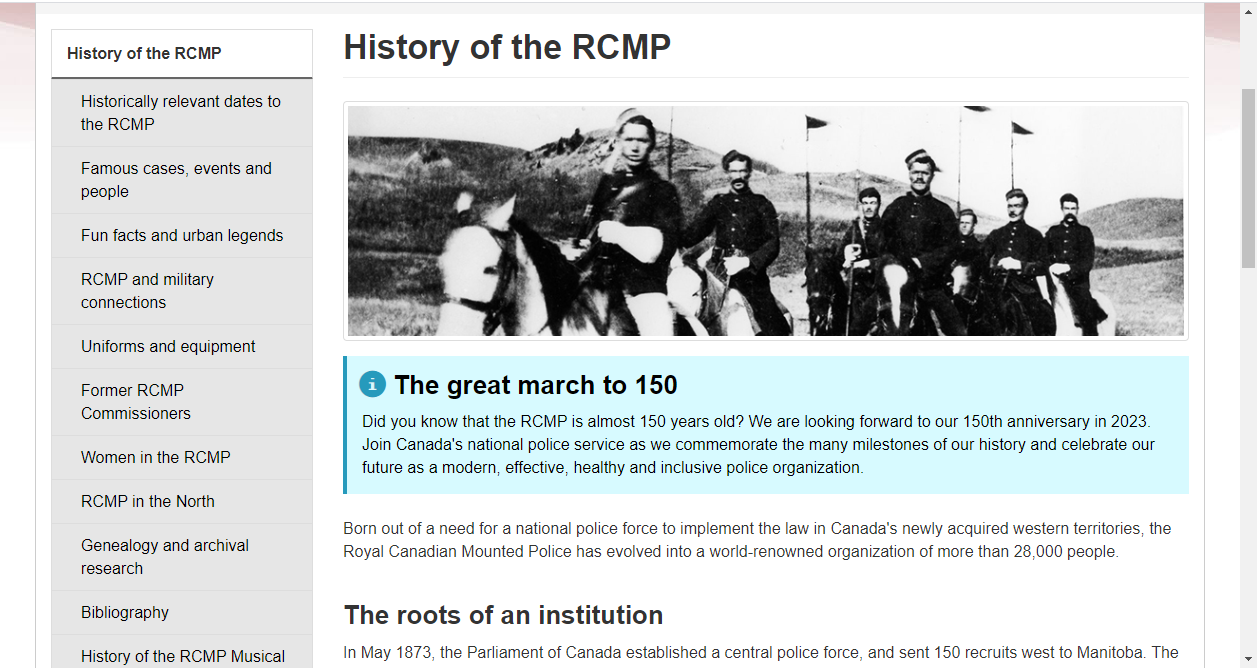
So, where to find records? Over the next few blog posts I'm going to look at a few different record sets. This post I'll look at the RCMP website.This website is a very good starting point in your research of RCMP ancestors. I found a great deal of information by using the A-Z Site Index. For this blog post though, I'm going to focus on two sections.

http://www.rcmp-grc.gc.ca/en/history-rcmp

History of the RCMP
This page gives a great overview of the RCMP's history. Even if you don't have an ancestor who served, the history buff in every genealogist will find it interesting. In particular check out the Historically relevant dates to the RCMP. This can really help you fit your ancestor into RCMP history.


http://www.rcmp-grc.gc.ca/hon/index-eng.htm

Honors and Recognition Programs
If your ancestor died in the course of their duties, then you'll want to check this section out. Each link gives you information on the several different ways fallen RCMP members are remembered. Of particular interest is the RCMP Honor Roll. This searchable index lists 243 officers from 1873 to 2017. The index has the following headings:

  • Name
  • Reg #
  • Start of Service
  • End of Service
  • Description of cause of death
Some of the descriptions are ones that you would normally find in respect to what an RCMP's duties are. Some have made the list while serving overseas during Canada's war efforts. Some however, are more unusual. For instance:
  • Entry 17, Reg#2086, Cst. William Tyrrell Reading, Start of Service 1888-04-10 End of Service 1890-12-14, Died from injuries received at Calgary, when Supt. J.H. McIllre’s horse, which he was exercising, fell on him.
  • Entry 33, Reg#3566, Sgt. Ralph Morton L. Donaldson, Start of Service 1900-04-04 End of Service 1908-08-14, Drowned when his Police boat was attacked by a herd of walruses, off Marble Island, Hudson Bay, N.W.T.


According to their genealogy section, RCMP service files post 1920 are still held by the RCMP. The files are protected under the Privacy Act. You may be able to get a redacted file if your ancestor has been deceased less than 20 years through an Access to Information Request. If they have been deceased more than 20 years, it appears you might be able to get an non redacted file, Information on how to obtain a post 1920 service file is available here.

Pre 1920 service files are in the custody of Library and Archives Canada. Next post, I'm going to look at what you can find at the LAC.

Tuesday, 28 January 2020

Metis Ancestors: Resources from the Glenbow Museum

If you have Metis ancestors, then you know finding resources for them can be difficult. One of the sites you should be book marking is the online collection at the Glenbow Museum in Calgary. This online collection contains genealogies with source citations.

Metis in Canada are the descendants of marriages between Indigineous and non Indigenous people. For the most part, the marriages were between Indigenous women and the European men employed in the fur trade. The Glenbow's collection deals with Metis in what is now Manitoba, Saskatchewan, and Alberta. Some parts of the Northwest Territories, Ontario and British Columbia are also covered.

https://www.glenbow.org/collections/archives/genealogy/
 In their online collection are several resources. They do warn that the researcher will need to trace the family line back pre 1900 for their collection to be helpful for research. They have included on the site a PDF of a pedigree chart to help in research.

Not everything is digitized. However, these are still important because they give the important file numbers you need. This way you can provide the exact file numbers to staff when you visit in person. Even if you hire a researcher to do the visit for you, giving them this number will save a lot of valuable research time.


Charles Denney fonds and Métis genealogy files
This collection comprises of genealogical files for Prairie Metis as well as those families connected to the Red River Settlement. The collection was compiled between 1967 and 1985. Among the collection is charts, photographs, and correspondence. It also contains indexes and microfilms of census and parish records. There are genealogies of approximately 1200 family lines in the collection. The majority of it has not been digitized, but there are a few. It is divided into 9 subsections:
  • Series 1 Scanned Document Family history files : alphabetical list. — 1967-1985
  • Series 1-A Family history files : microfilm copies. - Microfilmed 1990 (originally created 1967-1985)
  • Series 2 Denney's indexes to family history files. — 1967-1985
  • Series 3 Scanned Document Collected reference materials. — 1956-1990 (originally created 1709-1985)
  • Series 4 Denney family personal papers. — 1906-2001
  • Series 5 Scanned Document Photographs. — [ca. 1855]-2000
  • Series 6 Elsie Denney's family genealogy. — [ca. 1900-1996]
  • Series 7 Miscellaneous writing. — 1924-2000, predominant 1972-2000
  • Series 8 Subject files. — [ca. 1910]-2002
  • Series 9 Priscilla Gilmour's papers. — 1927-1945, predominant 1942-1945

Now, if your file of interest is digitized, you will see this:


Just click on the "View now" to see the digitized documents in the file. They are digitized as a PDF, so can be downloaded to your computer. Onsite, the collection has restricted access for conservation reasons. They have microfilms available.


Pat McCloy Genealogical Collection
This collection, compiled from the 1970s to 1996, has a wealth of information. Along with index cards, there is also primary source material. It has wills, certificates, correspondence, newspaper clippings, obituaries, and photographs. There are 8 subsections:

  • Series 1 Genealogical research files. - [ca. 1970s-1996]
  • Series 2 Alphabetical files. - n.d.
  • Series 3 Miscellaneous genealogical files. - n.d.
  • Series 4 Thomas Rennie "Pat" McCloy personal papers. - [1900-1970s]
  • Series 5 McKay genealogical index cards. - Compiled [ca. 1970s-1996]
  • Series 6 Genealogical index cards. - Compiled [ca. 1970s-1996]
  • Series 7 Research notes index cards. - Compiled [ca. 1970s-1996]
  • Series 8 Scanned Document Photographs. - [ca. 1870s]-1941

Only Series 8, Scanned Document Photographs. - [ca. 1870s]-1941, has digitized images. The 9 images contained people and places in the Prairies and British Columbia. Onsite, there are no restrictions on access.


Warren Sinclair's Metis Genealogy collection
This collection contains 450 Metis biographies and 910 descendancy charts. The collection also includes indexes for both the biographies and charts. As a side note, this collection is also available at the HBC Archives in Winnipeg. The collection appears to be fully digitized, and is divided into two subsections:

  • Series 1 Scanned Document Tables of contents, biographies, and indices. - 1997-1999
  • Series 2 Scanned Document Descendancy tables. - 1997-1999

Both the biographies and charts have extensive source citations. A real bonus for us, since we can go straight to the horse's mouth so to speak, to verify. If you've never used a descendancy chart before, they are titled with the earliest known ancestor couple, and work down the successive generations that were born pre 1900. Onsite, there are no restrictions on access.


Geoff Burtonshaw's Metis Genealogy Research collection
This is a collection of photocopied material from Library and Archives Canada, churches, and libraries. It also includes correspondence, researcher lists, and the personal memoirs of Geoff Burtonshaw. Not all of the collection is digitized. It is divided into 6 subsections:

  • Series 1 Scanned Document Geoff Burtonshaw's writings. -- [ca. 1990s]
  • Series 2 Scanned Document Metis genealogy reference files. -- [ca. 1981-2009]
  • Series 3 Alphabetical files of Metis researchers. -- [ca. 1981-2009]
  • Series 4 Terry Punch correspondence. -- 1989-2003
  • Series 5 Personal papers. -- 1881-1980s
  • Series 6 Photographs (unprocessed). -- [ca. 1940s-2000s
Those familiar with Maritime research will recognize Terry Punch's name. Very little of the collection has been digitized. Onsite, there are no restrictions to access.


The Glenbow Library Newspaper Clippings files
This last online collection does not have digitized images. It's function is more of a finding aid to prepare for an onsite visit. You can either search or browse by:
  • Keywords or Phrases
  • People
  • Place
  • Subject
They have included some instructions to maximize your searches on the collection's main page.
http://ww2.glenbow.org/search/libraryNewspaperSearch.aspx


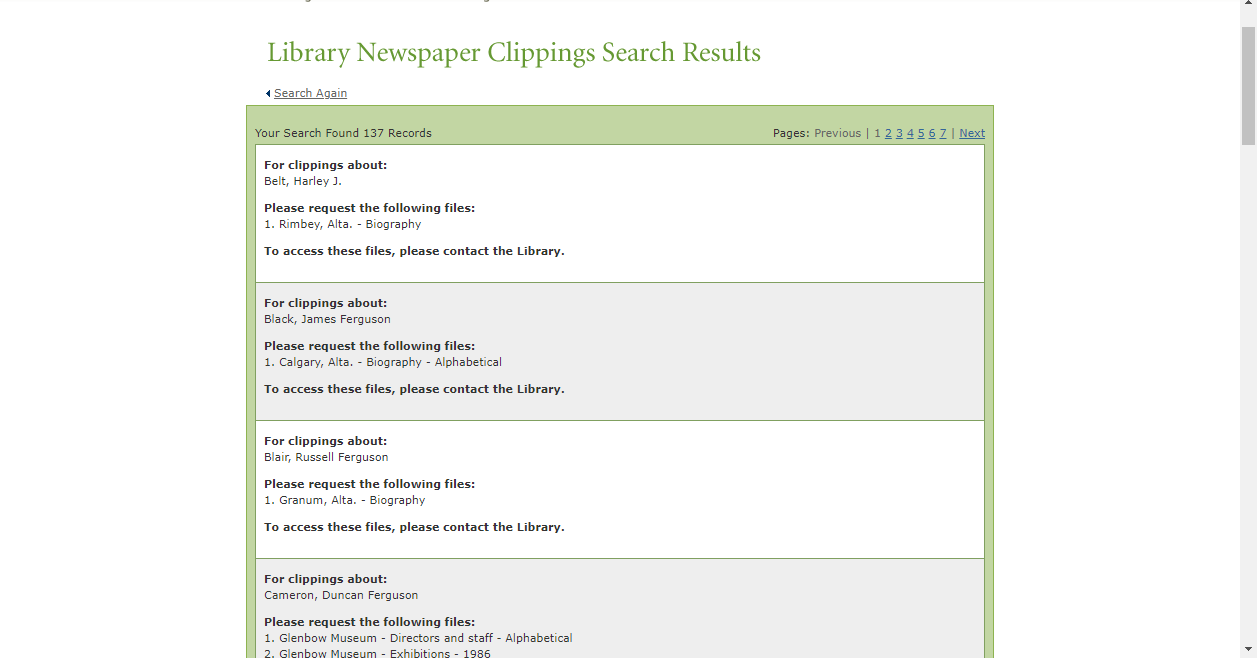
The results page will tell you what collections to ask to look at when you visit. For instance, when I typed in "Ferguson" as a surname, I received results that looked like this:
http://ww2.glenbow.org/search/libraryNewspaperResults.aspx

The Archives notes on the main page that this section is a work in progress. They will continue to add search terms as the collection gets examined over time. In other words, keep checking back to see what new items turn up.


A Final Note
The Library and Archives reading room at the Glenbow Museum is now closed. They have been moving their collection over to the Glenbow Western Research Centre. The Centre is located on the second floor of the Taylor Family Digital Library on the University of Calgary’s main campus. They have requested that any research inquiries for material access be directed to archives@ucalgary.ca.


Sunday, 19 January 2020

Quebec Ancestors: Church Indexes on Family Search

Flag of Quebec.png


Those with Quebec ancestors are lucky in the fact there are a tremendous amount of church records digitized online. This is especially true for Catholic ancestors. But if you're having trouble finding a record, you might want to look at Family Search's browse only collection Quebec Index to Civil Copy of Church Records, 1642-1902.

One of the unique things about the province is that churches supplied the entries for government civil registration. This continued until well past when other Provincial governments had their own forms. This collection contains the indexes to the civil copies of the baptisms, marriages and burials in the province from 1642 to 1902. there are over 1.3 million images in the collection. They are in French, but the Family Search wiki provides some guides:


To navigate the collection, you'll first narrow down by denomination:
  • Catholic
  • Catholic and Non Catholic
  • Non Catholic
You then further your search by:
  • County and City or Town
  • Record Type - Baptism, Marriage, or Burial
  • Name Range, Year Range, Archival Number
https://www.familysearch.org/search/image/index?owc=waypoints
In all three sections, you can find some or all of the following information:
  • Date of baptism, marriage, or burial
  • Place of baptism, marriage, or burial
  • Residence
  • Baby's name
  • Bride/ Groom names
  • Deceased's name
  • Parents' names
  • Names of witnesses
  • Cause of death
  • Date of birth or death
  • Occupation


Catholic
This section only has one section by location: Ile-de-Montréal, Lapraire, Chambly, Vaudreuil-Soulanges counties. It has the following record types:
  • Baptisms Index
  • Baptisms Index (Alphabetical)
  • Baptisms Index (Chronological)
  • Burials Index (Alphabetical)
  • Marriages Index (Alphabetical)
  • Marriages Index (Females)
  • Marriages Index (Males)
Each section is further divided into the name range, year range and reference number. Most of the index cards appear to be hand written, but there are a few typed ones as well. Here's one for a marriage:

They were married at Ste. Brigide on 6 June 1874. This card unfortunately does not have parents' names, but some do.  The Fo. 104 refers to the entry number from the church's registers. 

Keep in mind that the first subsection, Baptisms Index, only gives first names of the child. If your ancestor was born illegitimate, you'll definitely want to look at this one. I found several in there.


Catholic and Non Catholic
This section covers only the Judicial District of Saint-Francois. It is further divided into 3 sections:

  • Births Index (Alphabetical)
  • Deaths Index (Alphabetical)
  • Marriages Index (Alphabetical)
The cards in this section look more like standard forms, where the writer can just fill in the required information. The digitizing for this section isn't the best, but it's still fairly readable. Here's a birth record:


Non Catholic
This section covers three locations:
    Ile-de-Montréal, Lapraire, Chambly, Vaudreuil-Soulanges counties
    • Baptisms Index (Alphabetical)
    • Burials Index (Alphabetical)
    • Marriages Index (Females)
    • Marriages Index (Males)
    Judicial District of Beauharnois
    • Baptisms Index (Alphabetical)
    • Burials Index (Alphabetical)
    • Marriages Index (Alphabetical)

    Judicial District of Bedford
    • Baptisms Index (Divided alphabetically and by year)
    These are either index cards, or alphabetical lists. Here's a list of deaths with A surnames from 1881/1882/ part of 1883 in Bedford.


    Next Step
    The obvious next step is to find the original record. There will be information not included in these indexes. You can take the information from the indexes and then go to BAnQ's website to find the original.


    Sunday, 12 January 2020

    Manitoba Ancestors: Browsing Early Manitoba through Census records

    One of the problems with ancestors in Canada's West is finding early records. Thanks to the Hudson's Bay Company, those with Manitoba ancestors can find them pre 1870. Family Search has a browse only collection online called Manitoba Census Indexes, 1831-1870. This collection has index cards of the Red River Settlement covering from 1831 to 1869. It also includes cards for the 1870 Manitoba provincial census taken by the Department of Agriculture. Arranged alphabetically, the collection is divided into 2 sections. There are over 30,000 images in total

    1831 to 1870
    This collection contains cards indexed from nominal censuses in 1832, 1833, 1838, 1840, 1843. 1846/1847, 1849, 1856 and 1870. The censuses cover the Lower Settlement, Grant Land, and Indian Villages. 1856 and 1870 are not complete. On these cards you'll find any or all of the following information:

    • Head of household
    • Age
    • Residence
    • Religion
    • Country of Birth
    • Property
    • Livestock
    • Land Cultivated
    The set is further divided in to 5 sections:
    • A to Emlyn, Narcisse
    • Emlyn, Solomon to Lavallee, Francois
    • Lavallee, Francois Xavier to Pilon, Antoine
    • Pilon, Antoine to Z
    The first few frames of the the first section gives some statistical information. It can help to give you a sense of the Settlement as a whole. Here's a card listing Place of Birth for 1832/1833:

    https://www.familysearch.org/ark:/61903/3:1:3QSQ-G9SG-GT3J?i=13&wc=MQRB-1TG%3A341584201%2C341584202&cc=2023280

    By 1849, the Place of Birth for residents looked like this:

    https://www.familysearch.org/ark:/61903/3:1:3QSQ-G9SG-GTY4?i=18&wc=MQRB-1TG%3A341584201%2C341584202&cc=2023280

    Depending on how long your ancestor lived in the settlement, you'll be able to follow then by looking at a series of cards. Here's a series of cards for a Neil McDonald:


    If you're looking for a female ancestor, you might get an important bonus for them. Some of the cards for 1870 can also include maiden name and father's name. Here's one for Mrs. Nancy McDonald

    As you can see with Nancy, she is noted as a "half breed". One could probably assume that her father was European and her mother was Indigenous. Please keep in mind that you'll see terms that are no longer socially acceptable today.


    1870
    This section contains only cards for the 1870 census from the Department of Agriculture. It is further divided into 6 sections:
    • A to Delorier, Elise
    • Delorier, Genevieve (Lacourse) to Henderson, Anna A.
    • Henderson, Catherine (McBeath) to McIntosh, Isabella M.
    • McIntosh, Joanna A. to Prudhom, Mrs. William
    • Prudhom, William to Stevens, Harriet
    • Stevens, Henri to Z
    Some of the information you can find:
    • Head of household
    • Age 
    • Residence
    • Birthplace
    • Race
    • Marital Status
    • Spouse' Name
    • Spouse's Age
    • Children's Names
    • Children's Ages
    • Religion
    As well, the cards also list household number and census page. Here's one for Robert Hoorie:

    Now, each person gets their own card. So using this card, you can find cards for each of the other family members. Wives were cross referenced. Robert's wife Christine Henderson shows like this under her maiden name

    And here she is under Hoorie, Christine

    If you didn't know Christine's name, this is how she is cross referenced as Mrs. Robert Hoorie


    The cards for both sections were created by the Archives of Manitoba. If you want to see the originals, they are onsite. Microfilms of them are available for inter library loan. Some have been digitized on the Archives of Manitoba website, but not all of them that I could see. 

    Thursday, 26 December 2019

    52 Ancestors: Week 49 - Fall Fairs


    Week 49's prompt for the 52 Ancestors challenge is "Craft". A big part of Canadian culture, especially in rural areas, is the fall fairs or exhibitions. Along with livestock and agricultural displays, there were often craft competitions. People of all ages submitted their crafts for judging. There were competitions for woodworking, art, sewing, and knitting to name a few. So where to find resources?


    Canadiana
    When I used the search term "agricultural fair", I received thousands of hits. Here's a sampling of what I found


    Peel's Prairie Provinces
    As usual, this site comes through for resources on Canada's West. Here's a sampling of what I found:


    Newspapers
    These are the best way to find out how award winning your ancestor craft skills were. Rural newspapers, especially, posted the winners of competitions. You may even be lucky enough to find  a photo. Here are some places to find newspapers:
    • Local libraries
    • University libraries
    • Provincial and City Archives
    • The Ancestor Hunt

    Miscellaneous
    Here are some "thinking outside the box" sources:


    Sunday, 15 December 2019

    52 Ancestors: Week 48 - Deportation Records at the LAC

    The prompt for Week 48 of 52 ancestors if "thief". Not all of our ancestors were upstanding citizens. Genealogists and Family Historians tend to be thrilled finding these ancestors, because they make for interesting stories for others. Let's face it, our relatives who haven't been bit by the genealogy bug tend to get all glassy eyed when we talk about our passion. If we have an interesting ancestor though, they have more interest in what we're saying. This post I decided to look at records relating to the deportation records. Do you have an ancestor who came to Canada, but mysteriously vanished from records? Or maybe they somehow ended back in their country of birth and you can't figure out why. You might want to look at the deportation records through Library and Archives Canada then.

    Library and Archives Canada has a great overview on what you can find on their web page Thematic Guide - Deportation from Canada, 1893-1977. What I'm going to focus on is the files belonging to the record group Records of the Immigration Branch (RG76). This group of records is by no means complete, as not all records have survived. They have three groupings of records:

    • Files that relate to an individual deportee
    • Files that include lists of names or correspondence about particular deportees
    • Files that do not contain names of deportees

    Before you get started, you'll want to open a new window on your computer and have Heritage open and ready to go. The microfilms have been digitized, but you can't view them on LAC's website. You can only view them on Heritage. What you're going to do is note the microfilm details and then put that microfilm number into Heritage's search box. 


    Files on Individual Deportees
    Click on the heading. This will reveal a list of names that do not appear to be in any particular order. Once you find a name that interests you, take note of the file information. I scrolled through and found this rather interesting entry


    As you can see, this is for an entire family. So, we want to look at microfilm C-10430, file 774753. Next we'll go to Heritage and enter C-10430 in the search box.
    http://heritage.canadiana.ca/?usrlang=en


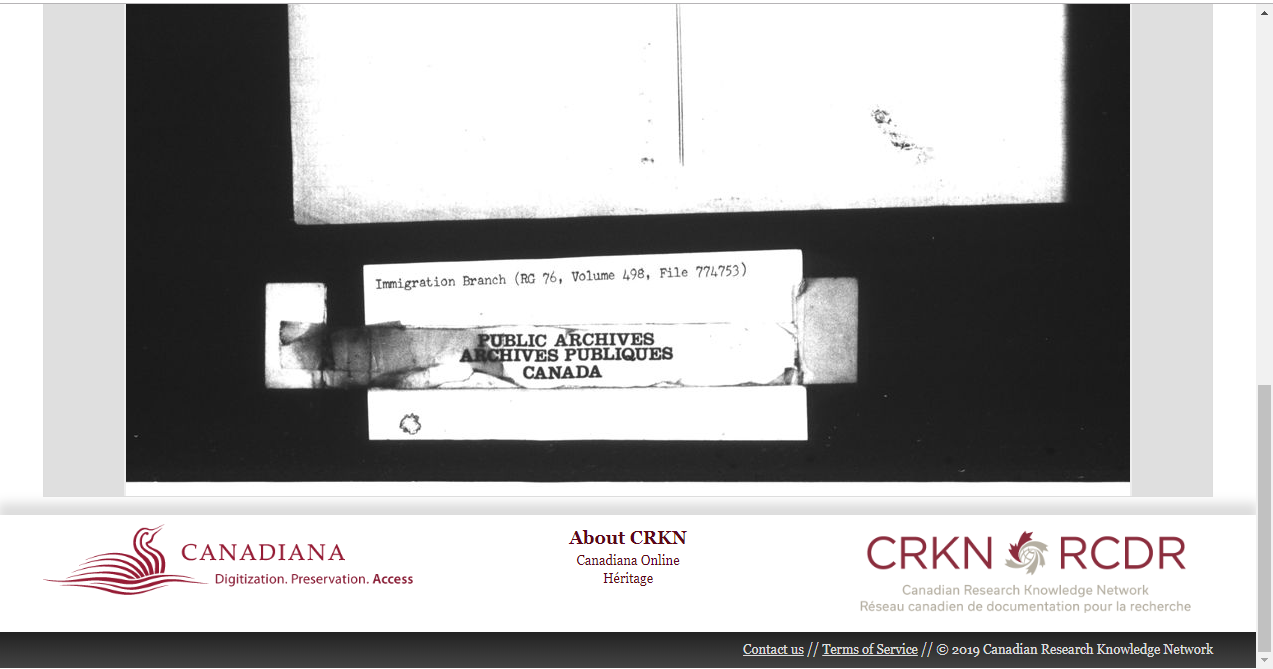
    In the results, the top result is the microfilm we want. Now we're going to click on that and find the file we need. Because there is not search capability, we're going to jump back and forth through the images until we find the file. This can be done by jumping head on images by using the image tab on the left


    And then looking at the bottom of the digitized document for the file number. 


    So I found the first page of the file. It is quite a few pages. Apparently it started with a letter from a local citizen complaining about the recent immigrants from England. 


    Long story short, the Department of Immigration investigated, and decided to deport the family in 1908. John, his wife Eliza and five children were sent by train to Montreal, then to Maine. Once there they were boarded on a ship to Liverpool. They were deemed undesirable because "...Mortimer is a drunkard, abusive to his wife and family and the neighbours speak against him...". The file also includes
    • Names and ages of each family member
    • John's occupation and some work history
    • Ship name and dates of immigration
    • How they arrived in Chatham
    • Ship name and date of departure back to England
    • Residence of John Mortimer's mother in England
    • Their trip to Canada was paid for by the Central (Unemployed) Body in England
    • A letter from Eliza Mortimer's father inquiring as to why the family was deported, and the response from the Department of Immigration
    A sad end to this file is a letter written by John's wife Eliza in 1923. Apparently John deserted the family and boarded ship under an assumed name back to Canada. She is writing in hopes the Immigration Department can find him. One of their children has died, and another has been hospitalized. The letter gives her address in London. The Department wrote back asking for information, but that's where the file ends.


    Lists and Correspondence of Individual Deportees
    You open the entries the same as for the group above. In this group I found this entry


    When I switched over to Heritage, I looked at microfilm C-10634, and looked for file 805792. This huge file involves the following Scottish men"

    • Ross Fraser
    • Horatio Dunlop
    • Donald Tough
    • David Moffat
    • William McBride
    • David Anderson
    • Robert Hill
    • James Quinn
    • Peter Tierney
    • Charles Miller
    • Donald/W McLean
    • John Ferguson
    • James Hughes
    • James Hutchison
    As the below states, these men were brought over from Glasgow as strike breakers, and then let go once the strike was over


    This was the rail company's response


    As with the previous section, you can find a ton of little details about the men. Within the first 25 or so pages I found:
    • Immigration details
    • Work history and pay
    • Family and friends names back in Scotland, some with addresses
    • Current address
    There was also deportation details on some additional men in the same file:
    • Alfred Black
    • John Skinner
    • Malcolm McLean
    • Joseph Healey
    • William Robertson
    • John Phillips
    • Patrick Rawdon


    Files Not Containing Individual Names of Deportees
    This section deals with documents generated within the Government and their agencies themselves. The only names mentioned are those employed within the Government, rail companies, and steam ship companies. It also includes some governmental policies and procedures. When I looked through the entries, I found this


    Now when I looked at this file, part 7 has letters from various agencies asking for the Alien registration of 1917/18. Its the section two after that that is interesting


    In this section is correspondence with various immigration agencies, providing samples of the Enemy Alien Registration Exeat form. These were used when the person wished to leave Canada. However, in this section are also completed forms. Here's one that even includes a picture


    Now, for any of these sections, you can save the documents to your computer by right clicking on the image, and choosing save image. This will be better than just a screen shot, because as you can see above, it also includes the source information at the bottom.