Saturday, 3 February 2018

Newfoundland Ancestors: Newfoundland's Grand Banks


https://en.wikipedia.org/wiki/Flag_of_Newfoundland_and_Labrador


Newfoundland and Labrador can be one of the more challenging provinces to research. Joining Canada in 1949, it is our newest province (Nunavut was created in 1999, but is a Territory). Because of this, you are not going to look at the traditional Census and other government records that we rely on for the rest of Canada.


http://ngb.chebucto.org/


Thanks to the Newfoundland's Grand Banks website, researching from a distance is a whole lot easier. Run by volunteers, this site has an incredible amount of transcribed information. In an email exchange with Don Tate, I found out that there are over 100,000 files of information, and that the site gets around 1800 visits per day. Even on their home page you can get lost with all the links to the individual databases. They are also available along the tab bar, which has everything separated to into categories. For the purpose of the blog, I'm going to concentrate on the tab bar.


B,M,D,W
Hovering over this tab gives you four options:

  • Cemetery Transcriptions
Divided first by district, and then by community. You can then look at individual cemeteries. Beside each cemetery it tells you how complete the transcriptions are, and whether there are accompanying photos of headstones.
If you're not sure of where your ancestor might be buried, at the bottom of the district list is a link to the Stonepics Database index. Arranged alphabetically by surname, each name gives you a town code of where that person's name has appeared on a headstone, war memorial or monuments. There is a code index as well, to help you determine the town name. They've also provided the link to the StonePics Database website. Here you can purchase CDs arranged by community that have the photos and transcriptions.

  • Parish Records
These transcriptions are grouped by district, then by church. The year range is different for each church, but I saw records from the 1700's to the 1970's. There is also an Other Countries section that lists miscellaneous records of those with Newfoundland ties in Nova Scotia, Quebec, England, and Ireland.

  • Vital Statistics
This section contain transcriptions that predate 1891, when civil registration commenced in Newfoundland. Grouped first by region and then by church. There are 3 other sections titled USA, Canada, and Foreign. These are civil registration transcriptions from outside of Newfoundland for people with a Newfoundland connection.

  • Wills Indexes
As the title suggests, here you can find indexes and transcriptions of wills and estate files found both in Newfoundland and outside of it. Also among the collection are two section that contain miscellaneous court records and deeds. It's a good idea to check these out as well. Remember that a lot of families didn't register a will or estate file in the usual manner, and instead used land registries to record a will. It was often cheaper and faster to do it this way, as well as making sure land passed down to those named in the will. As well, I noticed in the indexes Power of Attorney, Marriage Certificate, and Licence entries. Don't forget to check out the additional information section, to learn how to obtain copies of wills.


Official Lists
Here you can find various Government records, as well as Business Directories

  • Newfoundland Census Records
Here are Census transcriptions that range from John Berry's 1675 Census, to the 1945 Newfoundland Census. This is a great resource, since Newfoundland doesn't become part of the Canadian Census Collection until after 1949.

  • US Census Records
This little gem gives you information on Newfoundlanders living in Essex County, MA in 1870, and various parts of the US in 1880. They also have Newfoundlanders enumerated as crews on vessels in the 1930 Census.

  • Census of Canada Records
This is where you can find Canadian with a Newfoundland connection from 1871 to 1911. As well, they have Labrador transcriptions for 1911.

  • British Census Records
Covering the 1841-1911 census years, this collection highlights people in England with a Newfoundland connection.

  • Crown Lands
A really interesting section. Make sure you look at the subsection Registry Volumes. It gives a bit of history of the Crown Lands Grants. It also mentions that the Great St. John's Fire of 1892 destroyed many of the books. The 20 volumes lost in the fire have been partially reconstructed from land owner copies and sources from other collections. 

  • Court Records
This section has court records from Ferryland, Harbour Grace, Placentia & St. Mary's,and Trinity Bay. It also has an indenture agreement from 1817. The majority of the Court records I looked at dealt with civil law, but I did notice a criminal law entry here and there as well.

  • Early Fishing Rooms/ Planters
here you can find specialized censuses and reports of the Fishing Rooms, and lists of Planters. These go back to the 1700's and early 1800's. I did notice some entries that cover the later 1800's as well.

  • Business Directories
The amount of transcribing work done here is amazing. Covering the years 1864-1941, for Newfoundland, there is also the 1867 British Mercantile List. Some of the years not only have the names transcribed, but also the information pages that appear at the front of directories. I can only imagine how many hours of work went into this.

  • Voter's Lists
Separated by region, this section is a collection of voter's list covering a variety of years before Newfoundland became part of Canada. Some areas have only one year represented, while clicking on others gives you a few different years.


Other Lists
There are several options to choose from here as well.

  • Maps
Maps are a good resource that people don't always use. Here you'll find maps of Bonavists Bay, Carbonear, St. John's, Lance Cove, and and Port de Grace.

  • Newspaper Transcriptions
This is another one that boggles the mind on how many hours went into this. There are Government Publications, and local and provincial newspapers. You'll also find extracts from newspapers from across Canada. They also have some from the US and the UK. There's even a section of obituaries from internet sites. Looking through this section made me wish I had a Newfoundland connection in my own tree.

  • Passenger and Immigrant Lists
A collection of not only ship's passenger lists, but trains as well. At the bottom is a miscellanoues section of Immigrants located in other source material such as church records, newspapers, and wills. The entries list rather specific source citations, so you can go find the original source.

  • Telephone Directories
There are transcriptions of telephone directories for Habour Main, St. John's, and St. George's. 

  • Road Reports
Sounds mundane, but what an interesting source of information! I was expecting to see a list of roads and bridges in certain areas. While some of them are, I also found lists of men doing road work. I even found an 1846 list of names that was "...for the Relief of Sufferers by the Gale". 

  • Community Names
A handy chart that gives you community names. You also get their Latitude and Longitude. The best part though is that it also gives you what district they were in for the 1921, 1935, and 1940 Censuses.

  • Community Name Changes
Here you can find names of communities that had their name changed. It will also tell you where some of the communities were relocated to after the Resettlement in the 1950's 1960's and 1970's. 

  • Church Society Reports
These are reports of donors to churches throughout Newfoundland. The donations were to the British North American Society for Educating the Poor. It was one of the first school systems in Newfoundland.

  • Information from Other Countries
here you'll find a hodge podge of information relating to records outside Newfoundland. Those listed had Newfoundland connection. There's everything from Australian Convicts to the American Civil War, to English Apprenticeship Records.


Districts
each District of Newfoundland is named. Clicking on the district will give you links to what's available on the website for that area. it also has links to outside sites to help further your research. Down at the bottom you can access a map showing all the districts

http://ngb.chebucto.org/Districts/index.shtml

 
Historical
Yet another section that had a lot of work put into it.
  • Colonial Office Records
Transcriptions of records from mainly the 1700's, you'll find an eclectic mix. There's letters and lists, but also petitions. I also found a verdict of the trial of George Rider in 1774, and a medical report by Dr. Henry Stabb, a surgeon.

  • House of Assembly Records
Another eclectic mix of records. I saw entries dealing with Land records, pauper applications, coroner's reports, and school inspections. There's also entires from Prince Edward Island, Nova Scotia, and the Province of Canada.

  • Historical Information
Divided by District, here you can find excerpts from publications and collections dealing with that particular district. The entries run the gamut in historical and genealogical context. You can even find an entry on how the fish was cured before it was sent back to England.

  • Newfoundland Disasters
Listed according to type of Disaster, clicking on the individual entries gives you an account of the tragedy. The information is very well sourced and can include interviews, newspaper accounts, church records and vital statistic information. There's even a list of newfoundlanders lost in the Halifax Explosion.

  • Newfoundland Military Records
This section has military information on Newfoundlanders in WW I and WW II. There's also a bibliography, in case you want to check out their sources.

  • Treasury of Newfoundland Stories
An entertaining section. These are stories transcribed from the book The Treasury of Newfoundland Stories. It include both fiction and non-fiction.


Photos
Separated by district, you can find photos of not only buildings and people but geography as well. They also have a section of unidentified photos. If you recognize anyone in the photos, you can go to the bottom of the page and click on the "Contact Us" link to let them know.


Other
  • Available Research Sources
A collection of churches, archives, museums and libraries. You can also get contact information for Crown Lands and the Vital Statistics Office.

  • Available Genealogy Resources
Links to genealogy sites, churches, government sites, and books. You can also find Census information, finding aids, and lists of Methodist ministers.

  • NGB Research Interest Forum
Grouped by surname, here you can find contact information for other researchers interested in a particular surname.

  • Personal Web pages
A great collection of not only personal pages, but also general genealogy pages targeting specific groups. Among those listed are ones relating to the Acadians, military, and the Newfoundland Forestry Group.

  • Family Bibles
There's 21 bibles listed here, with extracts of entries from each. 

http://ngb.chebucto.org/Families/1bible-transcriptions-idx.shtml


  • Vital Family Records
This collection has records from 8 families., These were submitted as missing records to the government for early Vital Statistic information. They are found in The Rooms in the Delayed Births section. 
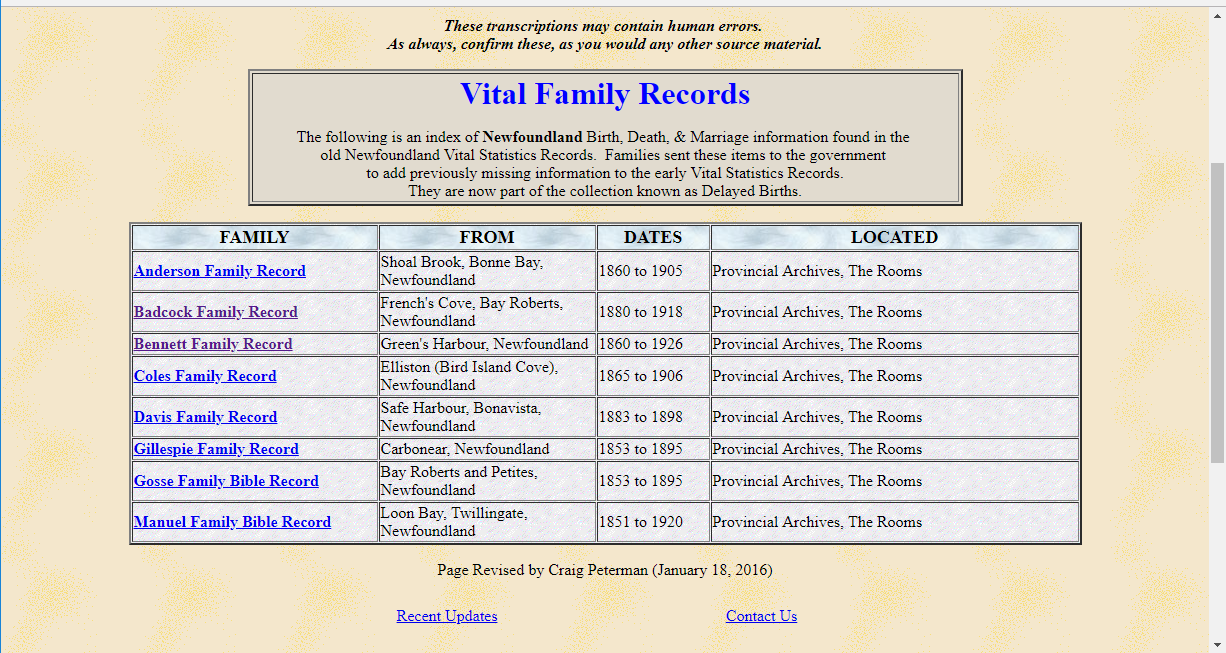
http://ngb.chebucto.org/Families/1vital-family-records-idx.shtml


Contacts
  • Newfoundland Genealogy Mailing Lists
There are several mailing lists that you can join that focus on Newfoundland research. Keep in mind though that some of these are Rootsweb, and therefore won't be functioning properly.

  • Message Board
The volunteers who run this site will not do research for you. I cannot stress this enough. So please do not contact them with research requests. However, if you do have questions,you can post a message here to see if another visitor can answer. It is an active board, as I saw discussion topics from 2017 and one from 2018 in there.

  • Contact NGB
By right clicking on Don Tate's name, you can copy his email address into your email to send him a message. He also stresses here that they do not offer research services.


About
Here you can find out how to submit information to be posted on the site. They also have a list of contributors. You can also find information about the website, and new additions. In fact, just this week they've added new information on wills, cemeteries, and photos. 


A final note:

The work put into this website is absolutely phenomenal. I am still in awe of the amount of information available. A huge thanks goes to all the people who have put their time into it. The information here is copyrighted, but they have given permission for reproductions of it for personal use. I received permission from Don Tate to include screen shots from the site for this blog post. 

Now, even though I don't have Newfoundland roots, I have a friend who does. I think I'm going to start doing a little digging on their behalf....


Saturday, 27 January 2018

St. Distaff's Day and Our Textile Ancestors


https://commons.wikimedia.org/wiki/File:Drop_spindle_with_wool_of_alpaca_Peru.jpg


This week's blog post will appeal to those of you who are trivia and history buffs, but there is a genealogy connection. On January 6 I attended the St. Distaff's Day celebration at the Fort St.John North Peace Museum. The North Peace Spinners and Weavers Guild were there to show visitors the ancient art of spinning wool. I tried it out myself and let me tell you, it is quite labour intensive! You take the wool and wind it onto the drop spindle. Bit by bit, you stretch (draft) the unspun wool out and twist it as thin as possible. Then you wind it around your drop spindle and continue the process. When your piece of batting is finished you twist the end onto another piece of batting and continue the process of thinning it and twisting it. It took a bit of coordination to keep the unspun wool from getting tangled up into the newly spun wool. Needless to say my spun wool was full of lumps and bumps, and no one will be using it to knit or crochet. But it was actually a lot of fun to try. The ladies there were all very enthusiastic and patient teaching everyone. I was assured that for a first attempt I actually didn't do too badly.

Now for the history part. Spinning wool has been documented back to Egyptian times. It was one of the most important roles of women. Not only were clothes made from the wool and other fibers spun, but sails, aprons, hats and blankets as well. To spin enough for clothing would take weeks. Enough for a single sail could take months. This was a job that women of all classes did. It doesn't matter if your female ancestor came from a poor or wealthy family. She would have been spinning wool regardless.

The spinning wheel greatly reduced the time involved. Though no one is positive of the actual origin of the spinning wheel, some believe it was invented in India. It came to Europe in the middle ages when explorers brought it back with them from the Middle East. Even with a spinning wheel, it was still not a quick process. There were a few spinning wheels on display at the demonstration. One of them comes from Quebec, and I was told it dates back to the early 1800's.


https://commons.wikimedia.org/wiki/File:A_young_girl_is_sitting_at_a_spinning_wheel._Engraving_by_Fr_Wellcome_V0039573.jpg


St. Distaff's Day (January 7) was the day when women would resume this work after the twelve days of Christmas. It signaled a return to the normal everyday duties. There is actually no St. Distaff. The word distaff refers to the stick or spindle that holds the unspun wool. It gives the ability for the hand spinner to have what is essentially a third hand. Men would not resume work until the following Monday (called Plough Monday). Since men were still idle on St. Distaff's Day, it has been documented that they would play pranks on the women trying to resume the work of spinning. A favourite one was apparently to try and set fire to the piles of flax waiting to be spun!

Now for the trivia and genealogy connection. Today we have terms and phrases that seem to have no context in our modern world. Have you sometimes wondered where they come from? Because of the importance of spinning in our ancestor's lives pre industrial age, some of these words made it into popular language and are still used today:


  • Spinster: Because of the labour and time involved, the majority of spinning usually fell to girls and unmarried women. This is why we also see the term "spinster" on marriage documents. Even today the phrase is used, though it has developed into a more derogatory term to refer to an older woman who has never been married.

  • Distaff Side: Sometimes in the more scholarly genealogy writing, you will see a reference to the "distaff side" of a person's family lines. This is referring to what we now call the maternal line. 
Over the years, many occupations arose out of spinning and weaving. If your ancestor was listed in any of the occupations, they were involved in textiles in some way. This list also includes occupations from the industrial era in textiles. It was extracted from the site Hall Genealogy Site Old Occupation Names. This is in no way a complete list, it's just a sampling.

  • Alnager/Aulnager: The official who examined woolen goods and gave them a stamp of approval

  • Antigropelos Maker: A maker of waterproof leggings

  • Archil Maker: One who made purple dye from lichen, to be used in textiles

  • Back Tenter: Someone who worked behind the weaving looms, clearing out the debris by ducking under the big industrial looms. Because of their smaller size, this was a job mostly done by children.

  • Back Washer: The person who cleaned wool in the process for worsted wool (a higher quality wool yarn).

  • Bat Maker: Made the wadding used in quilts and mattresses

  • Bayweaver: Made baize. This is the fabric that today you would see on pool tables.

  • Beamer: The person who set up the yarn for looms

  • Cambric Maker: Made a fine linen fabric called Cambric

  • Carder: Combed the wool or cotton

  • Card Maker: Made the combs for carding wool

  • Card Nailer: Maintained the teeth on the carding machine

  • Cemmer: A person who hand combed yarn before weaving

  • Danter: Female overseer in a silk winding room

  • Delaine Weaver: Made a light wool cloth called Delaine

  • Deviller: Ran the machine that tore rags- a "devil"

  • Doffer: Replaced empty bobbins on the loom

  • Doubler: Twisted the yarn in mills

  • Fear- Naught Maker: made a thick woollen cloth that provided a protective layer 

  • Fettler: Cleaned the mill machinery

  • First Hand: Silk weaver who owned their own loom

  • Flax Dresser: The person who prepares the flax for the spinner

  • Flowering Muslin: Did embroidery

  • Gaunter: Glove Maker

  • Grey Cloth Dealer: Sold greycloth, which was the finished products of the looms before bleaching and dyeing

  • Hackler: Combed the flax before linen making

  • Hairweaver: Wove with horsehair


There are Guilds right across Canada that are keeping the tradition of spinning alive. Along with my local group, a quick google search gave me some others:

  • Camilla Valley Farm has an extensive list of Guilds from Canada, the U.S., the UK, Australia and New Zealand

Wednesday, 3 January 2018

New Brunswick Ancestors: Update to the PANB County Guides

https://en.wikipedia.org/wiki/Flag_of_New_Brunswick


A while back I wrote a blog post about the County Guides at the Provincial Archives of New Brunswick (PANB). They are a wonderful resource, but at the time of writing they were last updated in 2006. I'm happy to say that over the holidays, the PANB gave us a Christmas gift and updated them. In this post I'm going to highlight some of the changes. You can see my original post on them for reference here.


  • Guide to Family Histories

This is new section that has me tickled pink. Clicking on the link provided will take you to the index's search screen. Type in a name and the results will tell you if there's a written family history about your person at the Archives. According to the Introduction, this can be anything from a couple of lines of information to a whole book. Included in the index is any or all of the following:
  • Surname
  • First Name
  • Archive Reference Number
  • Remarks
  • County Location of the ancestor 
Using the reference number you can find out whether it's on microfilm or not. If it is, you can use inter library loan to obtain it. In the introduction they also suggest looking at the index Guide to Biographies at the Provincial Archives. This can be accessed here.


  • Census Returns
No big changes here. But there is a mention that transcripts are available for purchase from the Associates of the Provincial Archives. I do not remember seeing that last time.


  • Vital Statistics
They've combined the old version sections Returns of Birth, Marriages and Deaths, and Burial Records into one section here. It's been updated what's available online on their main BMD databases. They've also added a link to the government website for accessing records that are still under privacy restrictions. The main databases tend to be listed in all the County Guides, but there are some that are County specific. It's a good idea to check and see what unique collections are available for your ancestor. For instance, the databases Early County Marriage Records (RS155), and Marriage Bonds (RS155A) are not listed in the Madawaska County Guide. However, they do have a collection called Repertoire des mariages de diocese d'Edmunston, N.-B. et du compte d'Aroostock (MC301).

There's also what I believe is a new addition to the Guides, Index to Death Registrations of Soldiers, 1941-1947. This index has death information for WWII soldiers who were New Brunswick born, but died elsewhere. They warn that is not a complete collection. Also making it into the collection are some American and non New Brunswick born. The certificates themselves are not available to view online, but by looking at the microfilm F20079 you can see the certificates. They are filled in like a normal death registration, so you will get to see such information as birth date, cause of death, and parents' names and birthplaces.

The information on the cemeteries databases have been updated. They've also added that there is some cemetery transcriptions at the Archives that is not included in their database.


  • Land Records
Along with information on the Land Petitions and Land Grants collections, there is a new collection added to some of the Guides called Registry Office Records (RS##). Not all Counties have this collection in their Guide (Northumberland County is one that doesn't). The year range for each County is different, but it says among this collection are:
  • Deeds
  • Leases
  • Liens
  • Mortgages
Also included are some wills. This is a place where beginning genealogists might not think to look for a will. Sometimes people would use a will to transfer ownership of land to the heirs and/or spouse. If your ancestors did not have a lot of money, there's a good chance that instead of looking at probate records, you should be looking at land records to find a will. 

The RS# associated with this collection is different for each County, so if you're contacting the Archives for microfilm numbers make sure you have the right collection number.


  • Immigration Records
Not much has changed here, but they have added a note that Passengers to New Brunswick: The Customs House Records; 1833, 1834, 1837, 1838 by Daniel F. Johnson (MC80/1263) is available to view at the Archives.


  • Court Records
This section has microfilm numbers for both the Probate Court Books, and separate microfilms for the Probate Court files. Read over the instructions to save yourself some grief. For instance, the Madawaska County Courthouse had a fire in 1909, and destroyed most of the records from 1873-1909. Also note that if you are looking for a probate file post 1930, they can only be viewed at the PANB. Meanwhile in Victoria County, you can get microfilms of files up to 1972.

The Court of Equity Records is still not available online either as an index or complete digital image.


  • Education Records
This section also has no new collections that I could pinpoint from the old version, but still worth checking out, especially if your ancestor was involved in the education system.


  • Directories
They have noted that an online index to the Hutchinson and Lovell directories is available on their website. You can access it here for the Hutchinson directories and here for the Lovell directory. Both indexes list Name, Street, Community, County, and Occupation.


  • City Council Records
Because the record sets differ for each County, I cannot immediately tell if there are new ones added. As before, not all microfilm numbers are listed. Some collections you will have to request the numbers.


  • Newspapers
As with the section above, the newspapers listed are different for each County. I cannot immediately tell if there are any new newspapers added, or if any years have been added to existing ones. Also like the City Council records, you may have to contact the Archives to get the microfilm numbers you need. You can also look at their online index Daniel F. Johnson's New Brunswick Newspaper Vital Statistics. It was originally compiled by Daniel F. Johnson and put online by the Archives in his memory. You have the option of a name or a full text search. Just remember that if you search by name, make sure you are putting in all the name variations you can think of. My grandmother was a MALLAIS, so I've had to look at MALLET, MALLETT, and even MALLEY to find ancestors. If you're looking for a MC or MAC name, try also M' in your search (i.e. M'Donald).


  • New Brunswick Museum Vertical Files
No changes to this section.


  • Church Records
I like how they've improved the look of this sections. It's much cleaner looking and easier to find a specific church. They've also updated what's available. I looked at the Burnt Church records in Northumberland County. I mentioned in my original post that this was the my grandfather's people were a part of. There's a new microfilm for St. Ann's that covers the years 1891-1938. Happy dance!


  • Other Institutions to Contact or Visit
Another updated section. Along with mailing addresses, they've also included phone numbers and websites if available.


  • Website References
A new section that gives you web addresses for the PANB, LAC, the Associates of the Provincial Archives of New Brunswick, and Service New Brunswick.


Now, if you'll excuse me, I've got a list of microfilm numbers to make.....


Thursday, 28 December 2017

Yukon Ancestors: yukongenealogy.com

https://en.wikipedia.org/wiki/Flag_of_Yukon


If you're lucky enough to have an ancestor that spent time in the Territories, it's a double edged sword. You know they're probably going to have the kind of life story that we as genealogists crave. But you also know that genealogy in Canada's North doesn't come as easy as in the South. If you have a Yukon ancestor though, then you're in luck. Yukon Genealogy is a government funded website to give research on that adventurous ancestor a jump start.

http://www.yukongenealogy.com/index


You can get right to searching three ways on the home page: Yukon Genealogy Archives, Specialty (Deaths, professions, etc.), or Dawson City Museum Pan for Gold.

Just for fun, I entered "McDonald" with no filters. I got hundreds of results, broken down first by the three main databases, then by specific source. The range of source material is incredible. It would take me years to go through them all, so I scrolled way back to the top and filtered to just Yukon Archives Genealogy results.

http://www.yukongenealogy.com/search?search=McDonald&archives_people=1

As you can see in the picture, the database has

  • Name
  • Home Town
  • Call Number
  • Occupation
  • Yukon Location
  • Nationality
  • Notes
Now, the Call Number is the location of the record at the Yukon Archives. If you see where I've circled above, there is a link there that says Source. Click that and a pop up window gives a brief explanation of the records they've created the database from. At the bottom of that is a link that says View the Sources. Clicking on that link will not only give you an itemized list of all the sources used (and there are a lot), but also the matching call numbers. Now you know exactly what record you should be looking at to see the original. You also have the option of printing all the results near the top of the results section. That can come in handy if you ever make it to the Archives. You'll notice in my results that the list starts out with 2 ladies who married McDonald men, and a man by the name of Chisholm applying for a liquor licence for McDonald and Aurora Hotels. The results will not only give you a McDonald surname, but anywhere McDonald is found. 

I checked the Yukon Archives' main website, and they do offer reproduction services. You can check out the information on their service here.

Next I decided to use the Specialty (Deaths, Professions, etc.) filter. You also have the option of filtering this one even further to a specific record set
  • Francophone Yukoners
  • Sourdough Air Display, 1971-2006
  • Yukon Barristers Roll
  • Pioneer Cemetery,1900-1965
  • Yukon River Basin, Deaths and Burials, 1887-2007
  • Grey Mountain Cemetery,1960-1976
  • Yukon News Obituary Index, 1966-2005
  • Missing in the Klondike, 1898-1958
  • Yukon Businesses
  • Census 1891 & 1901: First Nations Communities
  • Whitehorse Star Weddings, Births & Deaths, 1964-1965
Even if you don't filter even farther, the results are broken down by record set. It will even tell you if nothing was found in a particular collection.


Each record set has different headings, and by clicking Source beside the Title, you can find out more about each one. The majority of them were taken from archival material at the Yukon Archives. I found it a little amusing that under Yukon Businesses, almost all the McDonalds listed ran bars, saloons, hotels, and roadhouses. Apparently customer service runs in the McDonald genes.

The last main filter, Dawson City Museum Pan for Gold, is a great database if your ancestor had anything to do with the Gold Rush. Just look at the individual record sets:


One set I found interesting was the Dawson City Mortuary Records,1898-1938. The notes contain a great deal of information. This was the entry for a Daniel H. McDonald:

MACDONALD H. Daniel, 48 years (McDonald); crushed by caterpillar tractor, Bear Creek; March 4, 1933, Dr. Nunn; St. Paul's Church, Hillside Cemetery; IOOF; teamster

Not bad. In one entry we know when, where and how he died. We have the doctor's name who was in attendance.We know where he's buried. We know an approximate birth year (1933-48=1885). He was a member of the I.O.O.F and a teamster. Just that one entry gives us a few avenues of research. Here's another one for a Finlay McDonald:

MCDONALD Finlay, 59 years; ptomaine poisoning, St. Mary's Hospital; May 30, 1919, Culbertson & LaChapelle; funeral at St. Andrew's Church; Yukon Gold Company; paint man.

Here we know when, where, and how he died. We can put his birth around 1860. We know where his funeral was and which funeral home handled it. We know he was a paint man for the Yukon Gold Company. We can look at church records, funeral home records, hospital records, and employment records to find out more about him. In case you were wondering, ptomaine poisoning is food poisoning from bacterial contamination of food.

Going along the tab bar at the top are these headings:


Links
Here you can access sets of links by clicking on highlighted text. First is websites and contact emails for government organizations, historical sites and societies, churches, universities, and genealogy webpages. Quite a few of the links don't work any more, but a quick google search should be able to take you to the updated link.

The next highlighted text will take you to Yukon specific sites. There's City and Territorial Government contact info, churches, and fraternal organizations. You can also get info for Historical organizations and info to contact the various First Nations. There's also info on newspapers.

Lastly is the contact information and website link to the Yukon Archives. There's a link to a handy 90 page PDF on researching there. It's free to download and will give you everything you need to prepare for a visit to the Archives.


Tips for Family Research
This page is a general tip page on beginning family history research. But if you scroll down to the bottom, they have provided forms to print off to help you keep organized:

  • Family History Worksheet
  • Family Homes
  • Family Tree
  • Family Records by Generation
  • Family Records Vital Statistics
  • Military Records
  • Oral histories
  • Schools and Graduations
  • Employment History
  • Immigration Records
  • Research Log
Everyone keeps records differently, but you're sure to find at least one form that works for you.


Acknowledgements
Maintained by the Yukon Archives, the site had funding from both the Yukon Government and the Canadian Government.. Links to the Archive and the government departments that provided funding is here.


Wednesday, 20 December 2017

British Columbia Ancestors: viHistory

https://en.wikipedia.org/wiki/Flag_of_British_Columbia

If your ancestor resided on Vancouver Island, then you should check out viHistory, a website that teamed the University of Victoria and Vancouver Island University. There are over 100,000 records on the site, and it was last updated in 2015. The majority of the site is transcription, and not original digital documents. However, it is well sourced, so you can follow back to the original document to verify.


http://www.vihistory.ca/index.php


Search
This page will take you right to the search fields of the following specific record sets:
  • Census
  • Directories
  • Tax Assessment Rolls
You can also search by other unique ways:
  • Global Name Search- allows you to search for a name in all three of the above record sets at once
  • Site Search- allows you to search through the other information on the site using key words. It intentionally filters out anything from the census, directory and tax rolls. I tried using words such as "McDonald", "factory", "carpenter", "miner", and "insurance", and got no results. When I typed in "maps" it took me to their map page.
  • Annotation Search- This will let you search for user submitted notes. I typed in "McDonald" and got two hits. One was a family researcher adding in additional information about the family of Albert McDonald in the 1891 census. The second was a note that Kate McDonald was transcribed as a house hold servant in the 1891 census, but on the "manuscript census" she was enumerated as a housemaid.
  • Other Search Options: Here you can search for occupations and religions in the census. Or you can search for occupations or employer names in the city directories. You can also search for a specific Indian Band name in the 1881 census of Vancouver Island here. Lastly, if you wanted to find out about the census districts and sub districts of Vancouver Island's 1881 and 1891 censuses, this is where you can look them up.

Census
This tab will let you look at various census transcriptions for Vancouver Island from 1871-1911. You can search all the census records available at once by name, occupation, or religion. Or you can search specific census sets:
  • 1871 Victoria Municipal Census: Only heads of household are named, but everyone is counted. An interesting side note to this one is that people were also counted by race (White, Chinese, Native or Coloured)
  • 1881 Vancouver Island Census
  • 1891 Vancouver Island Census
  • 1891 Victoria Municipal Check Census: This is a rather interesting one. The civic leaders of Victoria were positive that this area was under counted in the federal census of April 1891. So they did another census of the area in September 1891, and came out with about 7,000 more people. The federal government did not accept the new numbers, but if you have a Victoria ancestor in 1891, it's a unique record set that people don't usually have.
  • 1901 City of Victoria and Vancouver Island Census
  • 1911 City of Victoria Census
  • 1911 Alberni and Port Alberni Census
Now, I tried several times to use "McDonald" in the general census search function, and it kept giving me error messages. Those of us with McDonald heritage know that you can find a McDonald in just about any Canadian record set. We're everywhere. So I went census by census, and found McDonalds in each one. Do take note though that you will have to use "fuzzy search" and name variations. I had to type in "MacDonald" to get hits in some years.The transcriptions are pretty good, including information that you don't usually see in indexes and transcriptions. As well, you can get general information on each census if you click on an individual census year. 

Directories
Here you can do a general search of all directories by name, occupation, or employer. You can also search by specific directory sets:
  • 1882 Directories for Nanaimo and Victoria
  • 1892 Directories for Nanaimo and Victoria
  • 1902 Victoria Directory
  • British Columbia City Directories 1860-1940
Set up the same way as the census section, you will get transcriptions of the first three groups. They show name, residence, occupation, employer, and employer address. Not all entries have all information, only what is taken from that particular directory

The last set of British Columbia City Directories is supposed to take you to digital images of them through the Vancouver Public Library. However, I got the dreaded "404" error when I clicked on it.


Properties
This is an interesting one. You can search the tax assessments of Nanaimo (1881,1891) or Victoria (1901). Here you'll get the location and dimensions of a particular owner's property. The nice thing is that if your ancestor owned more than one property, then all of them will come up on a name search. In Nanaimo in 1881, there were 8 properties owned by a McDonald. Seven of the eight were owned by a WJ McDonald. He must have either passed away or fell on hard times though, because in 1891 he didn't own any. 

You can also search the Victoria Building Construction Documents, 1877-1921. This database documents building construction in Victoria. It takes information from building permits and historic newspapers. You can search by street name, applicant name, and/or permit year. I typed in McDonald and among the results, I found a J.T. McDonald that was rather industrious in 1912. In May he built a 1 story frame garage on McGregor Street for a cost of $250. In August he built 2 frame dwellings at Oak Bay and Verrinder Streets. They were both 1 1/2 stories, and a total of 14 rooms. They were built at a cost of $5,600. Then, in September, he built a brick building designed for stores and apartments. It also had a total of 14 rooms and cost $11,000.


Documents
This tab leads you an eclectic mix of record sets.

  • Biographies and Profiles c.1890
Biographical sketches of business men, factories and firms of both Victoria and Nanaimo. It's labelled as a work in progress so keep checking back if you don't find someone at first. There are source citations from the books they are taken from, so you will know what book to track down to see the original write up.
  • Population Figures
Here you can get a break down of population numbers for all of British Columbia in 1901. They are broken down by electoral district, federal district, ethnic origin, and nationality. The ethnic origin can also be further broken down. British origin is further broken down by English, Irish, Manx, Scottish, and Welsh.

Next they've broken down Chinese, Japanese, and Indians by district.

A fun one is sexes and conjugal condition. 52 males were listed as divorced, but only 37 females. 

The next one shows polling information from the 1900 elections, broken down by electoral division.

Lastly, there are breakdowns on religion. There is a huge range of religions listed here. As to be expected, the largest numbers are from Church of England, Presbyterian, and Roman Catholic. But I did notice that 3 people identified as fire worshipers, and 1 person stated that they were a Reincarnationalist.
  • Divisions and Boundaries of Victoria
Here you can follow the growth of Victoria through By Laws and Acts from 1873 to 1892.
  • Changes to Street names in Early 20th Century
This one will come in handy. There are two tables. The first is the current name of  a street, and then its previous name, location, and neighbourhood name. They also have included extra notes if the name has changed more than once. For instance, part of Dowler used to be called Second, and part of that section is now the Blanshard Elemntary School grounds.  The second table shows the old street name first, then the new name.


Maps
This tab will take you to links to explore maps of Victoria, Nanaimo, and Vancouver Island that cover the years 1884-1953. However, there is a warning at the top of the page that they are having technical difficulties with the map display system. I tried varous ones and couldn't get any that I clicked on to work. Hopefully they get it fixed soon, because it looks like a fun one to play with.


Links
Here you can find links to various Archives' websites and Digital Newspapers. There's also a link to the BC GenWeb and some historical sites. I tried all of them and the only broken link was to the British Columbia City Directories I mentioned earlier.


About
This will take you to an information page giving you a brief background on the website, and the contributors. 


Help
The last tab gives you detailed instructions on using the various databases. This is also where you can submit any annotations on information given. If you find any inconsistencies or errors, you can also notify those who maintain the site here.


Thursday, 14 December 2017

Manitoba Ancestors: Hudson's Bay Company Archives

If you have an ancestor who worked in the Hudson's Bay Company or the Northwest Company, then you need to check out the Hudson's Bay Company Archives. This is a fantastic resource that can take you back to the early years of the company. Even if you don't have an ancestor, the resources will thrill a history buff. As part of the Archives of Manitoba, it is funded in part by the Hudson's Bay Company History Foundation. The Archive holdings 1670-1920 have been declared as part of the UNESCO Memory of the World Register, such is the importance of the Archive material about the early European history of the continent and the fur trade.

https://www.gov.mb.ca/chc/archives/hbca/index.html


What my post focuses on is the online databases specific to the HBC Archives.


Biographical Sheets
This collection contains sheets that look like cue cards. They are listed alphabetically by surname. The details of of each employee's occupation(s) and time with the company is listed, with reference numbers to the Archive document where the information was found. You may also find birth and death dates, family members, where they immigrated from, and where they went when they retired. Not all employees have a sheet, and not all sheets have the same information. There's a link to explain the terms and coding here. I have a friend who we suspect his immigrating ancestor, John Ferguson, was an HBC employee. There is only one John Ferguson in the biographical sheets, and this is what is looks like:

https://www.gov.mb.ca/chc/archives/hbca/biographical/f/ferguson_john.pdf

As you can see, he worked for the HBC from 1829-1836. In 1836 he retired to the Red River Settlement, and between 1836 and 1843 he had two children. This corresponds to information we had gleaned from census records about our particular John Ferguson. By 1851 John had moved down to Port Credit, Ontario. Two of his children had listed their birthplace as Hudson's Bay. It will take further investigation to confirm that this is the John Ferguson we are looking for, but at first glance this looks promising.


Post Maps
Clicking on the link will take you to a general map that shows 494 of the 501 posts in Canada and parts of the United States. You can further narrow things down to province, territory, or the United States. Or, if you know the name of the post, you can search by the post name. Did you know that there was a post in Hawaii? I didn't, until I looked at this map. Continuing with our John Ferguson, you'll notice on our biographical sheet that he didn't have a specific post he was assigned to. However, it said that he worked in the Swan River district, which is in modern day Manitoba. When I entered "Swan River" in the search box, I got 3 possibilities, two in central Manitoba and one in Southern Saskatchewan. Now while you cannot access details of a particular post, it does give you its location on the map. This can give you an idea of where your ancestor would have been located, and where to search locally for records.


Name Indexes
This one is further divided into three categories: Hudson's Bay Company Records, Northwest Company Records, and Red River Settlement Records.


  • Hudson Bay Company Records
This is a set of three indexes regarding HBC employees. The first is Servant's Contracts (1780-c1926). This index contains over 9,000 names, and can tell you the year their contract started, age, posting, occupation, and the location number of the file. There is a heading called Origin that could be misleading. It is actually where the person signed up, and not necessarily their home country. The heading Miscellaneous has monetary notes for the most part. Even though the index has some information, the Archives does say that looking at the file itself can give you a lot more. Within the files you can also see reference letters, applications, photos, and academic certificates. There is a John Ferguson listed in the index:

https://www.gov.mb.ca/chc/archives/hbca/name_indexes/hbc_servants_contracts.html


Now if you look at the location code, it is a different code than the ones listed on his biographical sheet. This might be a different John Ferguson than the one in the biographical sheets, but much of the information matches.

The next index is Northern Department Servant's Engagement Registers (1823-1895). Set up the same way as the index above, you'll find the same sort of information. Looking at the file itself will give you additional information of wages, reaons for leaving the employ of the HBC, and terms of service. I found a John Ferguson that had location codes that match the biographical sheets.

The third index is Register Books of Wills and Administrations of Proprietors (1717-1903). This index has the names and dates of shareholders' wills. If you've looked at an ancestor's will before, then you know that they can give you information on family and friends, assets, and biographical information. Not to mention that in some cases, the deceased was rather free with their opinions on their extended family. It can be entertaining reading. There were no Fergusons in this index, but I did find 2 McDonald entries. It gave me the year range of the book, and the location code.

Original records can be viewed onsite. Some have been microfilmed, and can be ordered through inter library loan.


  • Northwest Company Records
There are 2 indexes here. The first is the Northwest Company Account Books (1795-1827). The index does not give you a lot of information. There's name, sometimes a date, and a location code. Looking at the original records though can give you the location they worked out of, and monetary information such as pay and cash advances.

The second index is Northwest Company Servants' Contracts (1787-1822). This one is set up similar to the previous index. You will need to look at the original record to glean information such as terms of service, equipment supplied, and winter posts.

One thing you should note though is that the majority of the names I looked at in both indexes French names. Those of us who have French ancestry in Canada know that you should always look for variations in spelling. This is especially true if the person writing the record was not French.

Like the HBC records, you can view these either on site, or if microfilmed, through inter library loan.


  • Red River Settlement Records
There is only one index for the Red River Settlement, but it's a good one. Extracts from registers of baptisms, marriages and burials in Rupert's Land sent to the Govenor and Committee (1821-1851) has over 6,000 pre civil registration records for the people who were part of the Red River Settlement. The index itself will give you the event date, type of event, parties involved and relatives, place of residence, place of burial, and/or ages. The original record can be found using the corresponding location codes. In the original record you can also get information such as occupations, location of the event, witnesses, and the names of the clergy.

As a bonus, these records have been digitized and can be viewed on line. Strangely enough, I found no Ferguson entries in the index. But here's a page from 1821:

http://pam.minisisinc.com/scripts/mwimain.dll/144/LISTINGS_IMAGES/LISTINGS_DET_IMAGES/SISN%20137307?sessionsearch


The link to the complete set of registers is here. Scroll down the page to get the individual page images.


Other Information

If you'd like more general information on the Hudson's Bay Company and its employees, the Archives has some good reading on its Common Research Topics Page. Here you can learn more about artifacts, land sales done by the HBC, and even about the iconic HBC point blankets.

Lastly, by clicking here you can access the HBC Library Catalogue. It can only be accessed in the Research Room at the Archives of Manitoba, but I think it's worth making the trip for. It contains books, periodicals and articles relating to not only the HBC, but Indigenous Peoples as well. It also has items covering history of the US, the Arctic, and Western Canada. 


Tuesday, 12 December 2017

Apologies

My apologies on having no posts for the last two weeks. Sometimes as much as one would like to devote time to genealogy, life outside of it gets in the way. A lot of tying up loose ends at my house in Ontario had to be done in a very short time frame. It made for a very intense couple of weeks that left little time for sleeping, let alone time for anything fun like genealogy!

Next week I start a new "job that pays for genealogy". Along with a new location, I'll be starting a new career path in insurance. It's going to be a crazy few months learning a new job and a new career.

There will definitely be a blog post this week, and even with the new changes on the job front, the weekly posts should continue on schedule. Until my next post though, be sure to check out my tab on blogs to follow to get your genealogy and history fix.